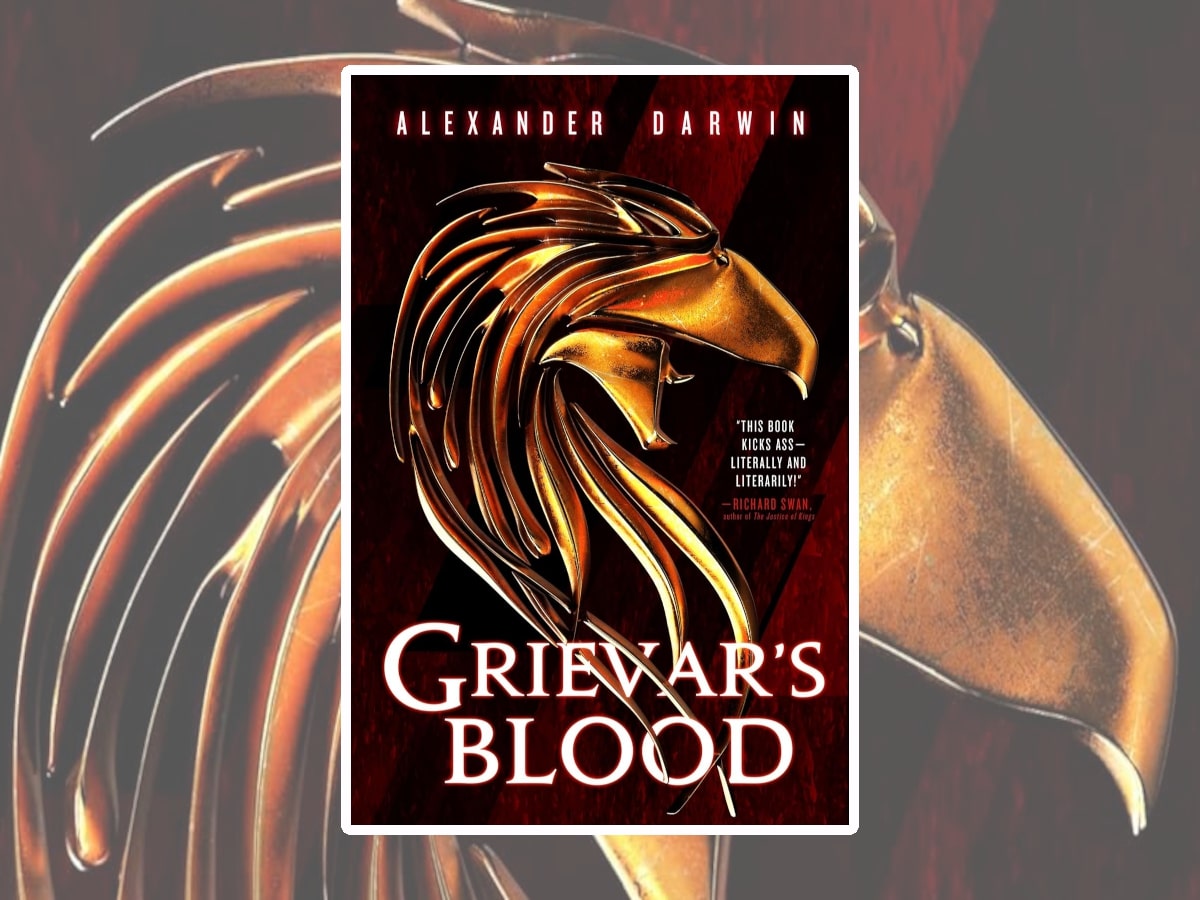
Back in June, I reviewed The Combat Codes, a martial arts training school coming-of-age story set in a cyberpunk-style universe. I said at the end of that review that I was very much looking forward to seeing where book two, Grievar’s Blood, took the story. I have now read Grievar’s Blood, but did it live up to my hopes and expectations?
What Is Grievar’s Blood?
As mentioned above, this book is a sequel, and whilst I’ll try to make this review as unspoilery as possible, there may be some spoilers for book one. I’d check out my review of book one first if you think you might be interested.
When we last left Cego and his friends, one of them, Sol, had run off to find her father’s body. The rest were returning to the Lyceum (essentially Hogwarts for people who are good at fighting) for their second year of combat training.
We know that Cego is something special, that he is marked for greatness. We also know that, thanks to being raised inside synthetic vats, Cego and his brothers have a special link to one another—even though they are not together. His younger brother, Sam, is missing, whilst Silas is another Grievar gladiator fighting for a rival province. Silas is the best there is.
The new term rapidly slides into chaos as Cego finds himself accused of a crime he did not commit. Alone and facing trial, Cego must hope to persuade the court of his innocence, without the comforting presence of two of his closest allies. His mentor, Murray Pearson, is deep in the underworld looking for Sam, whilst Sol is still trying to infiltrate the estate of the daimyo holding her father’s corpse.
The narrative in Grievar’s Blood is much more fragmented than in the first book. We follow Cego for probably less than a third of the book, and the rest of the time we are shown alternative narrative strands. How all these weave together is for the reader to find out!
Why Read Grievar’s Blood?
I had spent the latter half of reading Grievar’s Blood envisaging that my review would talk about the difficulties of moving from a genesis novel into a more overarching narrative for book two. It amused me therefore that in his acknowledgments, author Alexander Darwin describes how we “often hear of ‘middle book syndrome,’ where the second book in the trilogy serves to do nothing more than move the character and world pieces around to prepare for a satisfying finale.”
This is almost exactly how I see Grievar’s Blood, so Darwin’s assertion about how much he enjoyed avoiding doing this felt hollow. If you want an example of how the bridging novel is done well, check out Shauna Lawless’ Gael Song books. Book two in that series successfully evolves the plot and character simultaneously.
The problem, for me, with Grievar’s Blood is that Cego almost immediately loses agency in his own novel.
The next paragraph contains spoilers for book two. I’ve decided to include it because none of the events in this part of the novel were remotely surprising, so whilst they are technically there are spoilers, it’s nothing you won’t guess when reading the book
Cego’s trial is presided over by an infallible robot; it can’t make a mistake. The process robs Cego of any chance of exerting his own character. He’s at the mercy of the system. The robot then returns the wrong verdict, making it seem not at all infallible and the whole process pointless—just a deus ex machina to push Cego to where he needs to go next.
Sentencing (conveniently) is mortal combat. This is fine, but the odds are so massively stacked against Cego that there is no way he can win. Only we know that he will. He can do this by surrendering to the mysterious blacklight inside of him. Again, Cego is being controlled; he has no agency, and to be frank, by this point, it’s hard to care what happens to him because we know he won’t die. He will, however, be in exactly the right place for when book three starts.
/spoilers.
All that is disappointing, yet the novel still has legs. The other parts of Grievar’s Blood make for an exciting read. Sol’s travails to find her dead father both evolve her character and advance the plot into interesting areas. Similarly, Murray Pearson’s quest for Sam and his battles against past demons take an interesting turn. There’s another strand where we see Silas performing in the arena. What goes on around him between bouts opens our eyes to the corruption of the system and helps set up the rebellion that will come in book three.
Characterization of Cego takes a dive in Grievar’s Blood. The poor chap becomes a cipher for what is needed. This is less true of the other characters. Their stories help them grow as characters. Their journeys are more interesting and elevate the novel so that it remains a worthwhile read. The fomenting rebellion plot that reveals itself during book two is also intriguing. We’ve moved beyond the schoolyard, with some interesting politics, powerplays, and, dare I say it, commentary on the rapacious nature of late-stage capitalism.
Whilst I found Grievar’s Blood uneven, I’m still interested in seeing how things will play out in the final book, Blacklight Born. One thing the book has no problem with is action scenes. The fights in the book are exciting and visceral. The decision to make all the combats hand to hand gives them an immediacy that is often missing when weapons are used. It also makes the act of “cheating” and using technology all the more shocking. There is a side theme here of the perils of using performance-enhancing upgrades, which are perhaps informed by the author’s experience on the competitive martial arts circuit.
Whilst not an unalloyed success, the series as a whole still has much to recommend it. If you can overlook Cego’s lack of agency in this second outing there is still much to enjoy. If you love novels with close combat and no quarter given you’re in for an absolute treat.
If you would like to pick up a copy of Grievar’s Blood you can do so here in the US and here in the UK. (Affiliate Links)
If you enjoyed this review, check out my other book reviews.
Don’t just take my word for it. Get a second opinion from all these lovely book bloggers on the Grievar’s Blood blog tour.

I received a copy of this book in order to write this review.