

Today’s stack is a bit of a grab-bag! I have a few more spooky comics and one silly one, and then a non-fiction book about cryptocurrency that may actually include one of the scariest of today’s books. Let’s start with some of the lighter fare.
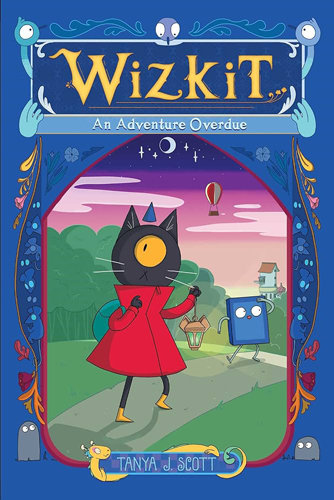
Wizkit: An Adventure Overdue by Tanya J. Scott
Wizkit is a one-eyed cat apprenticed to a wizard, and she’s more interested in learning spells to do her chores or conjure baked goods than exploring the world outside. While tidying up, Wizkit discovers a sobbing book that says it’s overdue, so the wizard sends Wizkit on a journey to the library to return the book, to her dismay. The book is overly enthusiastic about the idea, and Wizkit just wants to get it over with so she doesn’t have to listen to the book anymore.
But, of course, the trip to the library isn’t simple, and the two have all sorts of wacky encounters, from a dragon sitting in a dry riverbed to a pair of talking rocks to a three-headed bird that is arguing with itself. At each stop, the two manage to find a solution, and Wizkit gradually warms up to the book (who does have some good ideas), and by the time they reach the library she finds she’s got some new ideas she wants to try out herself. It’s a cute book, aimed at middle grade readers.

The Lollipop Kids Volume 1: Things That Go Bump in the Night written by Adam Glass and Aidan Glass, illustrated by Diego Yapur
Nick is a fourteen-year-old kid who lives in New York City with his sister and his dad, and today he’s been trying to track down his sister Mia, who didn’t come home last night. They used to be close, but lately things have been a bit more strained—but she’s gonna get in trouble if dad finds out. As he wanders through Central Park, he follows what he thinks could be clues to her location … and then finds himself being chased by the Big Bad Wolf. Yes, that one.
He’s rescued by a group of kids wielding magical weapons, and is soon introduced to the Lollipop Kids, a secret society that guards the city from ancient monsters, brought to the New World when immigrants first arrived. It turns out that Central Park is a sort of magical cage, and the Lollipop Kids are responsible for making sure it stays shut. There’s a catch, though: as soon as you turn 18, you forget everything about the Lollipop Kids and the monsters, so adults are oblivious to what’s happening right in their (metaphorical) backyards.
Created by the father-and-son team of Adam and Aidan Glass, The Lollipop Kids is a clever play on old (mostly European) folklore. Nick is dyslexic (like Aidan), and his dyslexia is illustrated in the comic as the way he sees the world differently, which comes into play when following some clues a few times in the story. This book is mostly an origin story for Nick and includes a big battle that concludes by the end of the volume, but there’s definitely an opening for more of Nick’s adventures with the Lollipop Kids in the future.

Beyond the Breach Volume 1: Losing California written by Ed Brisson, illustrated by Damian Couceiro
This comic book originated during the pandemic when Brisson and Couceiro both had some time between projects. As Brisson explains in the introduction, it combines his family’s postponed plans for a cross-country road trip with Couceiro’s desire to draw lots of “monsters and unspeakable terrors.” What they end up with is a post-apocalyptic trip that Brisson describes as their “thinly veiled pandemic anxiety tale.”
Vanessa needs to get away. Her mom has just passed away after a drawn-out illness, and she’s also had a bad breakup, so she hits the road and heads for the redwoods. But then there’s a bizarre tear in reality, and when Vanessa comes to, her car is wrecked, her cell phone doesn’t work, and the forest is filled with giant flying bugs. She manages to rescue a little boy, Dougie, as well as this weird fuzzy gremlin named Kai, and the three of them make a run for it.
We eventually learn that The Breach has smashed a couple of different worlds together—that part reminds me a little bit of (the more kid-friendly) The Last Kids on Earth series, where worlds have collided and now Earth is filled with weird monsters. Vanessa and her new friends encounter one weird thing after another, plus some people who are understandably freaked out and suspicious of anyone new. Vanessa’s first task is to get Dougie home to Twin Falls—if anyone will even be there to welcome him—and then after that she hopes to find her sister, because they didn’t leave each other on good terms before The Breach.
If you like monsters and weird creatures (and a good bit of gore), Beyond the Breach is a wild ride. Will there be more Beyond the Breach? I haven’t been able to find any news about the series continuing past the five issues collected in this volume, but although there is a wrapping-up point for the current storyline, The Breach itself has not been resolved and Vanessa is still on the road by the end, so it’s definitely left open-ended for future travels.

The Phantom Scientist by Robin Cousin, translated by Edward Gauvin
A mysterious institute in the forest, with twenty-four researchers invited over a period of time with full funding, each with their own distinct specializations: robotics, botany, chatbots, and more. Stéphane Douasy is the last to arrive and is still getting the lay of the land, and soon realizes that things here are a bit weird. Some of the scientists seem suspicious of each other, if not downright hostile. And then there’s his missing downstairs neighbor, the Phantom Scientist. There’s supposed to be somebody there, but the other residents of Building F have never seen him around. Meanwhile, the institute’s director is consulting strange charts, recording video journals about chaos theory and “the Paniandy Problem,” while hiding all of that from any of the scientists who come to meet with him.
As the readers, we get peeks behind the curtain—a mysterious man out in the forest, taking measurements and muttering to himself. A video journal of the previous director being dragged away while fires burn in the background. But even though we can see these things, we don’t know how it all adds up, which creates an unsettling feeling. You can feel the events building up toward something but you don’t know what. The illustration style is sparse, deceptively simple, and the characters have a rounded, almost cute look to them, which somehow makes the feelings of dread even more disconcerting. Ultimately, I found this a really fascinating story with just enough ties to real-world science to hook you into its world as the mystery is slowly uncovered.

Number Go Up: Inside Crypto’s Wild Rise and Staggering Fall by Zeke Faux
Zeke Faux is a reporter for Bloomberg News, and has written a good bit about cryptocurrency over the past few years. He was ultimately trying to pull at the threads of Tether, a “stablecoin” that is supposedly tied to the US dollar: every Tether coin is supposed to be backed by an actual dollar in holdings, and the price of the coin is fixed at $1 rather than rising and falling based on supply and demand, as many other cryptocurrencies do. Tether is often used as an intermediate—it’s accepted by the various crypto exchanges, and is an easy way to move your money from one exchange to another.
But Faux suspected that Tether was built on a house of cards; the founder, Giancarlo Devasini, has a colorful background and was incredibly hard to pin down for an interview. Much of the book describes Faux’s journeys tracing Devasini’s past and looking for evidence of fraud or subterfuge, and he comes up empty again and again. For me, that was one of the weak points of the book—as much as this investigation into Tether was built up as his primary goal, I expected there to be some sort of payout by the end.
Instead, the more conclusive story is about Sam Bankman-Fried, the so-called “Golden Boy of Crypto,” who is currently on trial. The “staggering fall” in the book’s subtitle points mostly at the crash of FTX, the crypto exchange run by Bankman-Fried, and we do get a good look at some of what happened there. Faux interviewed SBF a few times, including at his home in the Bahamas after the crash but shortly before his arrest.
Along the way, though, we also dip into several parts of the bizarre world of crypto: NFTs, for instance, and the hype around images of weird apes. We get a brief explanation of how cryptocurrency got started, and some of its biggest hits, though Faux always has a healthy dose of skepticism about the whole affair. One line early in the book feels like a good summary: “This was, amazingly, even sketchier than it sounds.” Reading about how things work, it’s amazing how much money was sunk into crypto and its affiliated systems, with flimsy promises about guarantees. The ease at which you could lose vast amounts of money is shocking.
But perhaps the most horrific section wasn’t about the shaky foundations of cryptocurrency, but one of its uses. Faux is the target of a “pig-butchering” scam, where the scammer says they have some secret investment techniques and promises you huge returns for your money. They fatten you up with some small investments first, and when you finally make the big deposit, they vanish with your money. Because cryptocurrency is hard to match up to real-world IDs once it has been transferred into one of the big crypto exchanges, it has become very popular among scammers.
But it’s not the pig-butchering scam itself that’s scary—variations of that scam have been around for a long time. Faux plays along with the scammer for a while, hoping to find out more about the person behind the scam. What he discovers is a huge industry in Cambodia, where people have been lured with promises of jobs and are then enslaved and forced to run the scams. One compound, named Chinatown, may house as many as 6,000 people, who are often tortured or even killed, and that’s just one of these types of locations. Faux makes a visit to Cambodia himself, meeting up with some reporters who have been trying to expose this problem as well as a Vietnamese YouTuber who has been rescuing or ransoming people from these compounds. That chapter is disturbing, and a huge contrast to the promises that cryptocurrency will democratize banking and finance, but it has enabled this “scam slave complex” and others like it.
While cryptocurrency prices did have a huge crash last year—I’ve seen estimates that over $2 trillion in value was lost in 2022—it may still be premature to call it a “staggering fall.” Tether survived the 2022 crash, “like some kind of financial cockroach.” As Faux frustratingly points out, there just seem to be enough Bitcoin faithful that they’ll just keep at it. Even though he still doesn’t think it’s actually useful, he no longer believes you can bet against it.
Ultimately, I think Number Go Up is a fascinating but depressing look at the world of cryptocurrency. It’s not unbiased, and I’m sure crypo advocates have all sorts of critiques about how Faux oversimplifies things or gets some aspects wrong, but I do think there’s enough about it that I’ve independently learned elsewhere that I generally find myself in agreement. The story meanders a bit and I felt like the threads didn’t always connect smoothly, but each section made a good story in itself, and there were a lot of eye-opening moments. If you’ve been following the past week’s news about SBF and you’re feeling lost, this book serves as a pretty good foundation for what’s going on.
My Current Read
I think I’ve gotten through most of my Halloween-y comics for now, so I’m back to reading The Archive Undying by Emma Mieko Candon, which I’d set aside for a little bit. It’s good, but not a quick read, with a lot of things that take some time to unpack, so I’m making my way through it slowly.
Disclosure: I received review copies of these books. Affiliate links to Bookshop.org help support my writing and independent booksellers!


