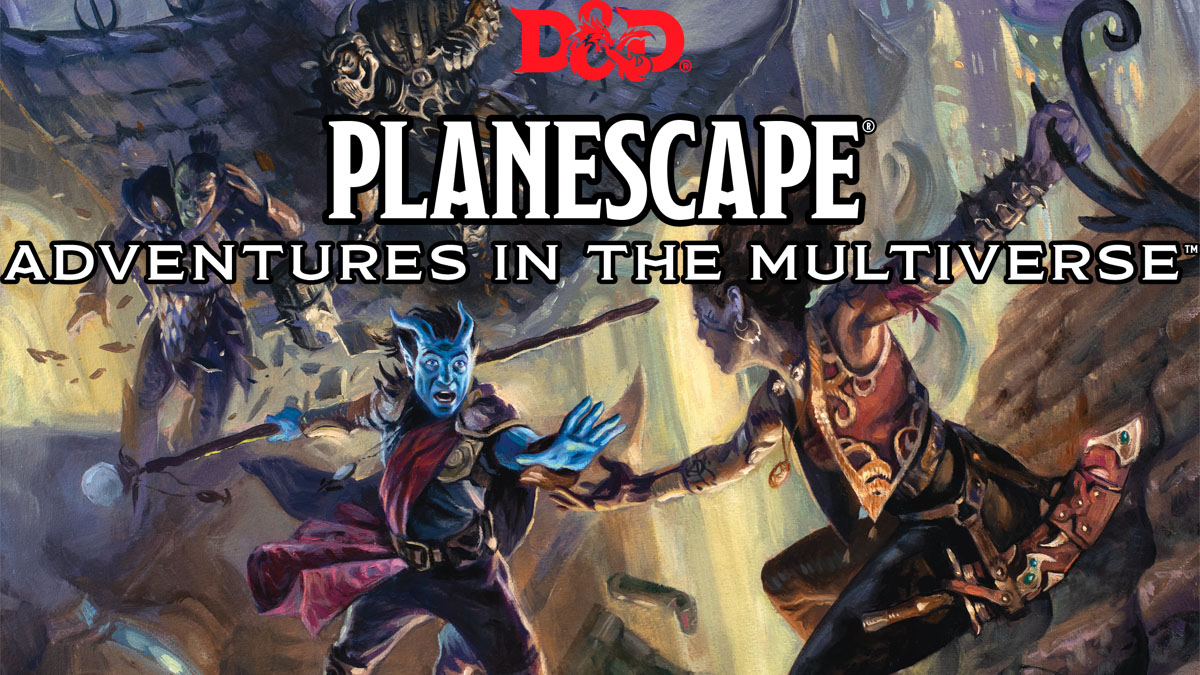
Ah, Planescape. Infinite adventures, realms beyond imagination, and lots and lots of treasure to be found. In the 5th edition release of the iconic interplanar setting, there are three separate resources, each of which assists your DM with the Herculean task of bringing a multiverse to life. Note that in this article there is a section for all readers and a section for Dungeon Masters. The Dungeon Master section is not meant to be read by anyone who will play an adventurer in a Planescape campaign, as this section includes spoilers and explanations to help DMs get ready to run their own game. If you’re looking to buy the boxed set, it’s available on Amazon.
For Players
The resource made to be used by players is called Sigil and the Outlands. There are new character customization options along with many details on Sigil (pronounced sih-gill, not si-jill), the Outlands, and the many political groups currently running the interplanar show.
Character Creation
Feats
The first major feature is the feat Scion of the Outer Planes: Gain a cantrip and resistance to a type of damage, based on the plane you are connected to. Both of the new backgrounds award the new feat, but your DM could approve the feat’s use with any background that fits the theme of your character better, so long as it’s a Planescape adventure. Players who have this feat can also choose between six other feats, each of which requires the Scion of the Outer Planes feat, at level 4. Some feats allow massively game-changing abilities, like the ability to open a planar portal without a key!
Backgrounds
There are two new backgrounds included in Sigil and the Outlands. The first is Gate Warden, a background that offers character customization options based on the effects planar portals have on mortals in their vicinity. The second background is the Planar Philosopher, which allows you to be allied with one of Sigil’s 12 (current) factions, which comes with various benefits when looking for information or lodging with that faction.

Magic Items
There are only 3 new magic items, but none of them are inconsequential. The most impactful one is the Mimir, a skull-shaped magical item that can be made of (or look like) any kind of material, from precious gems to gears. The Mimir can be a guide, a quest-giver, or a friendly reference tool, allowing characters and players access to information only found in the Dungeon Master’s Guide, or in later chapters of Sigil and the Outlands. Mimirs have the ability to completely reshape the trajectory of an adventure, and leave a lot of room for DMs to play with what information the players have access to throughout a campaign.
Doors, Doors, Doors
The rest of Sigil and the Outlands is focused on the many places in (and connected to) Sigil and the Outlands. Players can read this material without spoiling the campaign, but unless their character is specifically familiar with the relevant details, players should only read what their DM approves, so they can discover all the strange and wonderful things that can pop up in their campaign.
This Section Is for DMs
There are two other books in the boxed set, titled Turn of Fortune’s Wheel and Morte’s Planar Parade. Both of these resources are for the exclusive use of the DM, until the DM shares that content with the players. There are great mysteries to unpack, and the joy of discovery is very much an intended feature of the Planescape adventure. If you are a player, skip the spoiler box below, as it’s intended for DMs only.
Morte’s Planar Parade

This surprisingly diminutive 64-page monster reference packs more punch than expected. Because it’s in a boxed set, which also houses a player’s reference, an adventure, and a DM’s screen, the Monster Manual can’t be quite as large as some would like. That said, the pages are well-used and packed full of information which makes it easier to bring the Turn of Fortune’s Wheel adventure to life.
Key Features
Petitioners
There is a very small block of rules for making a post-mortal character, also known as a Petitioner. These once-mortal beings are unable to return to their home plane without the use of exceptional magic, such as the True Ressurection spell, but generally do not wish to leave. They are at home with their deity or their deity’s plane, agents, etc. Critically, this section does not explain rules historically provided for Petitioners, including rules about levels, immunities, HP, food, sleep, and other qualities. While MPP does not state it, previous iterations of Petitioners were never player characters. It is unclear whether players are meant to be able to become Petitioners in this updated version of the setting.
Challenge Ratings
The Challenge Ratings in MPP range from 0 to 26, covering a wide array of planar creatures from Hound Archons to Time Dragons. The many creatures included allow DMs to expand all campaigns—not just those in the outer planes—to fill out different niches. Sunflies have a CR of 0 but make adorable pets. If they swarm, however, they can be dangerous to low-level characters because the swarms’ Sting attack takes on magnified powers that disrupt combat and non-combat encounters.
Time Dragons
For DMs looking to really spice up their worlds, the Time Dragon is an excellent way to change up the typical metallic/chromatic dragon stereotype. Time dragons are neither good nor evil, and they can be a highly coveted ally or ferocious foe. To use Time Dragons as allies, note that Time Dragons can take their allies to any place and time. But beware, spending too much time in the presence of an adult or ancient Time Dragon can have long-lasting effects as time moves more slowly around them, and a year spent in their lair will be matched by 10 years’ progress in the rest of the world. People searching for a cure, afraid of aging, or any number of other plights a character might find themselves in may seek a Time Dragon to slow things down. On the other hand, if your characters are disturbing the intended order of things—or, at least, the order the dragon thinks is correct—they may find themselves confronted by a Time Dragon who has decided to interrupt them before they can alter the future. In this case, players will do well to quickly change tack, because an Ancient Time Dragon is one of the 10 most dangerous creatures in modern Dungeons & Dragons.
As a side note, the others of the 10 most dangerous creatures in modern Dungeons & Dragons include six Greatwyrms, the Aspect of Tiamat, and the Aspect of Bahamut (all from Fizban’s Treasury of Dragons), alongside the Archduke Zariel of Avernus from Baldur’s Gate: Descent into Avernus. Dragons continue to rule the roost, as it were.
Turn of Fortune’s Wheel
The first thing you need to know about the adventure Turn of Fortune’s Wheel is that it takes place entirely in Sigil and the Outlands. You will not need resources for other planes, such as Ravnica, the Forgotten Realms, or Wildemount. If you buy the boxed set, you have all the resources needed to run the adventure, assuming at least one player has access to character creation materials and/or D&D Beyond.
The Glitch
You may have seen such spoiler-filled headlines as How to Build Glitch Characters for Planescape. If you have, it may be no secret to you, or even your players, that the Glitch is a major story component for players adventuring in Planescape. The basic idea is as follows: each of your characters wakes up in a morgue in Sigil, with little-to-no memory of their lives so far. The universe has identified these characters as people it doesn’t know what to do with. Since the universe doesn’t know where they, their souls, or their bodies belong, it’s just stuck them all together in Sigil.
Death Is a Speedbump
Players won’t really notice anything too far amiss, however, until someone dies. After an appropriate period of time, that character will meet up with the group again, but they will have an all-new character sheet. Yes, same characters, same memories, new character sheet. Anything and everything can be different, other than the identity—class, race, size, spells, talents, you name it. Players will have a total of 3 Glitched character sheets, all representing different versions of the same person. This is the essential component of the Glitch and a large part of how players tell their story will be what stays the same, what changes, and how people always recognize the character, even when they are in a new body.
Nexus Features
Each character will choose one or more Nexus features, details about their character that the Universe keeps consistent between glitches. This can be birthmarks, tattoos, mannerisms, accents, a distinctive limp, or any number of other details. The characters should decide on their Nexus feature when making their first character sheet. You can have players create all three character sheets at once, or have them create a new character using the same name, identity, and Nexus features when they die.
There’s No Best Way
There’s no great way to surprise your players because losing a character and/or creating a new one can be emotionally taxing and time-consuming. For my own games, preparing the character sheets in advance worked best. I don’t love the level of surprise that comes with the DM saying “Oops, you died, fill in this new character sheet, and be quick about it.” Instead, I told my players that the multiverse is weird and that different things might alter their character in different ways. I have them create three character sheets with the same key traits, and then they get to choose which one of those three to play. I keep the others on hand until someone dies, and then we move on. For the first death, when the surviving characters came upon their newly-remixed glitched friend, that player was handed their second sheet and told “You don’t know what happened.” Then I just let the story go from there.
The Actual Adventure of Turn of Fortune’s Wheel
Here’s the skinny on the actual adventure, and the reasons I think Turn of Fortune’s Wheel is one of the best adventures for groups who like to start at a low level and reach higher levels. There is a lot to talk about, but I don’t want to spoil all the fun, so let’s focus on broad strokes.
Travel
Sigil and the Outlands are difficult to navigate because of the many cosmic influences on the realms. Early in their adventure, the players are able to befriend the owner and operator of a unique vehicle which allows them to travel rimward (away from Sigil) or spireward (toward Sigil) and everything in between. This vehicle is the only way players can reliably navigate the Outlands, so it’s a real boon. The operator is also a great ally for characters unfamiliar with the multiverse because the Gith is a scholar who can explain many universal truths to confused adventurers.
Level Skips
Players start with level 3 glitched characters, which is a decent place for many campaigns. Each class has some distinctive tools at this level, and none of them are completely overwhelming to new players either. Late in the game, players will skip from 10th level to level 17. At this point, players should be well-familiar with their characters’ various abilities and classes. With Glitch characters, this is really important, because a single player may need to learn three separate classes, feats, and abilities that they’ve never used before. Going from level 3 to level 10 the traditional way is a very good way to make sure nobody skips to the 17th level without understanding the underlying realities of their characters. As a surprise option, when they jump from 10 to 17 (remembering who they are and finding one of their previous incarnations in the process) they can create a whole new Glitch variant character sheet that reflects who the character was before the Glitch happened. At this point, level 17, the players choose one version of their character, and all Glitch variants are retired.
Heroic Adventure
If you were wondering why the skip from 10-17 is necessary, the last leg of the adventure should answer nicely. This section has the adventurers taking up re-discovered magic items, and their newly expanded powers, while they head into the demiplane responsible for the Glitch in the first place. The adventurers will face powerful enemies and shenanigans on their way to restore order to the multiverse. Hopefully, they won’t rely too heavily on the Glitch’s life-saving powers, however, because they’ve been restored and normal death rules apply to these high-level characters.
Afterplay
After finishing the adventure, the player characters are level 18, which is too high for most hardback adventures. That said, with the resources at your disposal as a DM, you can easily have these players tackle some personal quests, vendettas, or other agendas. If your players are satisfied with their revenge on the BBEG, they can become planar travelers, using Sigil as a hub to explore the multiverse. Characters who are nominally retired as such can easily be brought back in future campaigns to offer wisdom, assistance, or invitations to adventure. DMs can also reserve copies of the Glitch characters to use as easter eggs in other games since planar travelers can go pretty much anywhere—and any time—using the magic of Sigil and the denizens of the Outer Planes.
TL;DR
Planescape: Adventures in the Multiverse is a boxed-set campaign, complete with an adventure, a setting, and a monster reference. Also included is the DM’s screen which offers tools to help DMs navigate their players through the Outlands. Whether you’re looking for a new way to play, or just looking to expand your toolbox, it’s hard to go wrong with Planescape. All in all, I’d have to say it’s one of the best introductions or re-introductions to Dungeons & Dragons that’s been released in quite some time. With a complex cosmology, unique mechanics, and an adventure spanning from level 3 to level 18, there’s a lot to love.