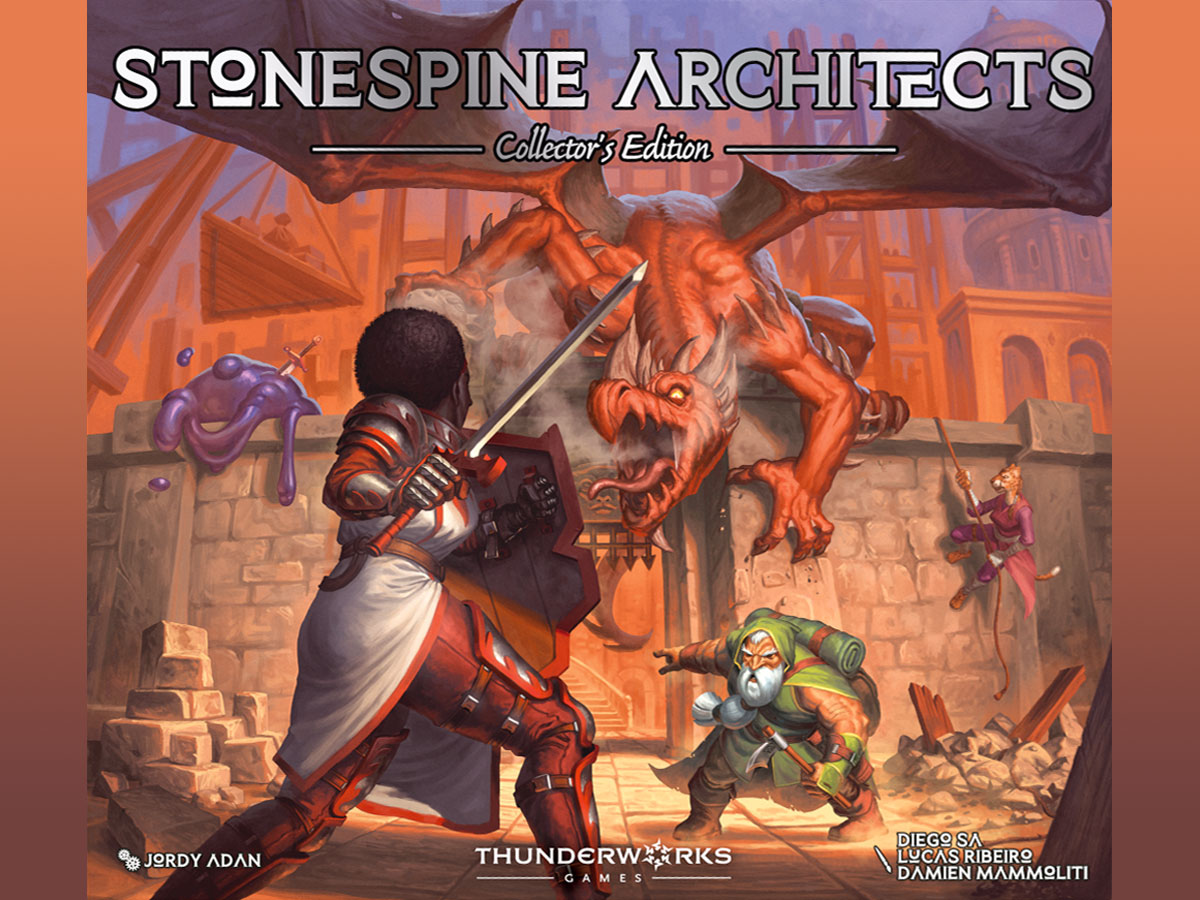
It’s time to put your dungeon-building skills to the test—how will they stand up to actual heroes?
What Is Stonespine Architects: Invasion?
Stonespine Architects: Invasion is an expansion for Stonespine Architects, a dungeon-building game for 1 to 5 players, ages 10 and up, and takes about 60 to 90 minutes* to play. It’s currently seeking funding on Kickstarter, with a pledge level of $41 for the retail edition of the expansion. Note that this is an expansion and requires the base game, which is also available through this Kickstarter in case you missed it the first time around. There’s also an option to get a larger collector’s edition box (with or without the base game included).
Stonespine Architects: Invasion was designed by Jordy Adan and published by Thunderworks Games, with illustrations by Damien Mammoliti, Lucas Ribeiro, and Diego Sá.
*My experience says it’s likely to run longer than an hour and half, especially with a full player count—more on that later.
New to Kickstarter? Check out our crowdfunding primer.
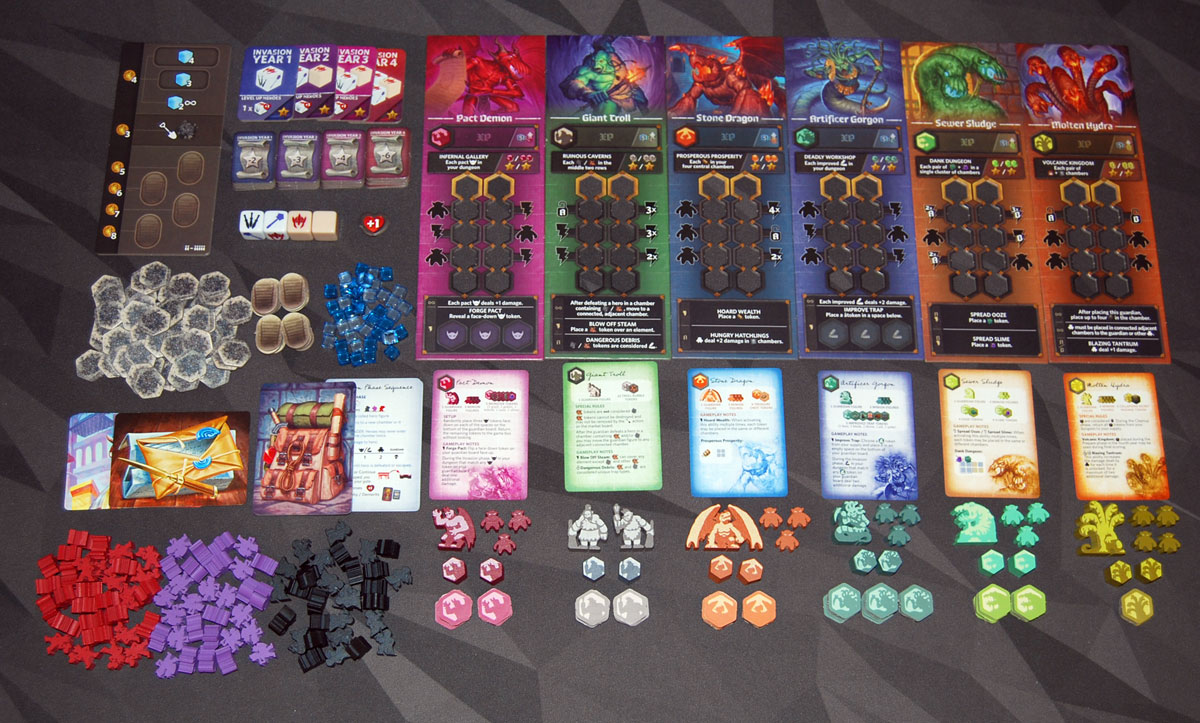
Stonespine Architects: Invasion Components
Note: My review is based on a prototype copy, so it is subject to change and may not reflect final component quality.
Here’s what comes in the box:
- Market board
- 4 Trophy tokens
- 20 Demerit tokens
- 4 Invasion dice
- 4 Health tokens
- 51 Rubble tokens
- 18 Secret Passage tokens
- 50 XP cubes
- 4 Goal cards
- 6 Challenge cards
- 12 Hero cards
- 5 Invasion reference cards
- 90 Hero figures (30 each in black, purple, and red)
- 6 Guardian boards
- 6 Guardian reference cards
- 7 Guardian meeples
- 12 Level markers (2 per guardian)
- 16 Minion meeples
- 63 Guardian tokens
- Scorepad
Kickstarter backers will also receive a mini-expansion included in the expansion that adds 6 more hero cards to the mix.
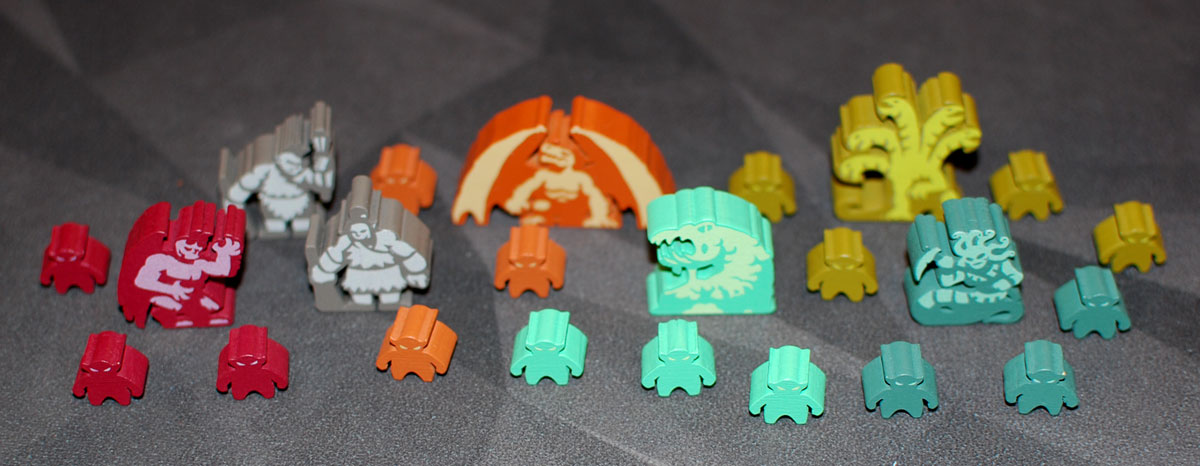
The big addition to the game is the guardians. Each of the 6 guardians has a number of different components: a big meeple (or two) for the guardian itself, some little minion meeples (they’re all the same but color-coded to match the guardians), and a variety of hex-shaped tokens that vary from guardian to guardian.

The guardian boards have two tracks of hex-shaped holes that you’ll use to level up, and each board is double-sided, with a different set of abilities for a variant version of the guardian.
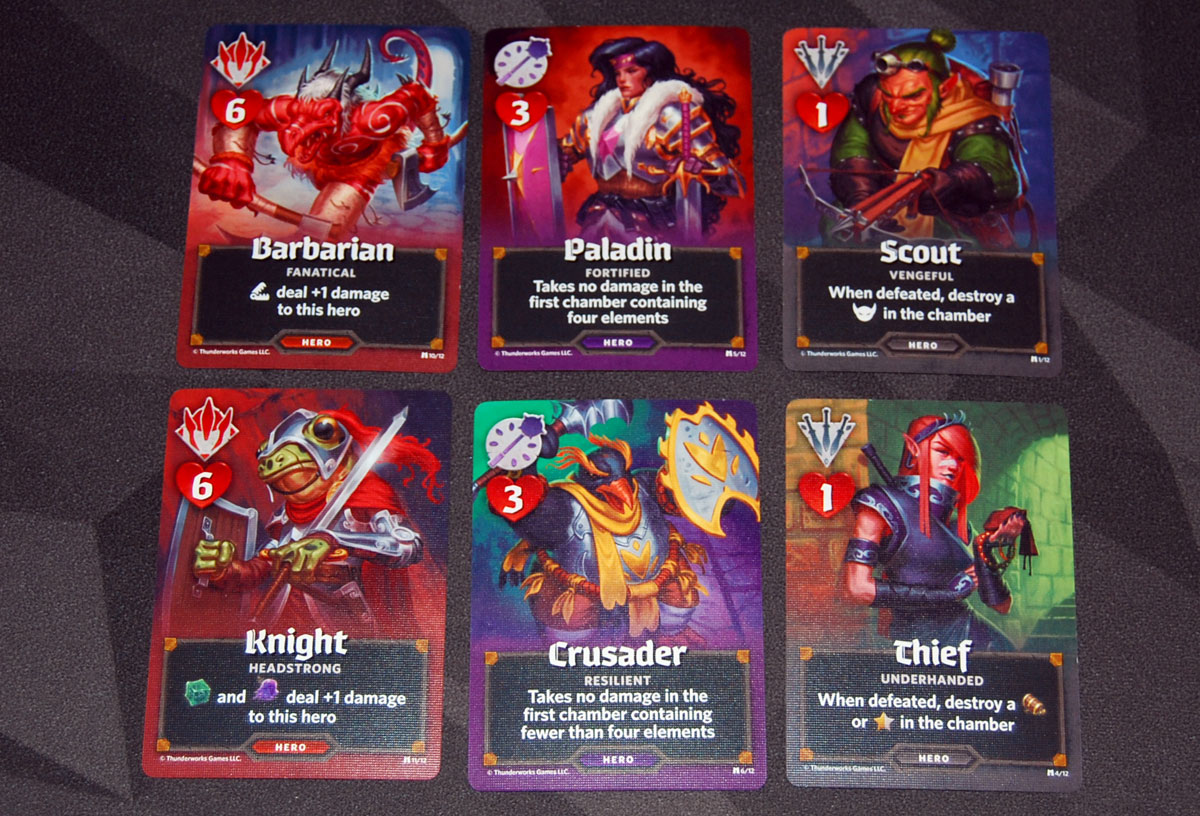
The hapless heroes who will (presumably) die in your dungeon come in three flavors: strength (red), magic (purple), and dexterity (black). There are multiple cards for each one, so each game can have a different mix of heroes to defeat.
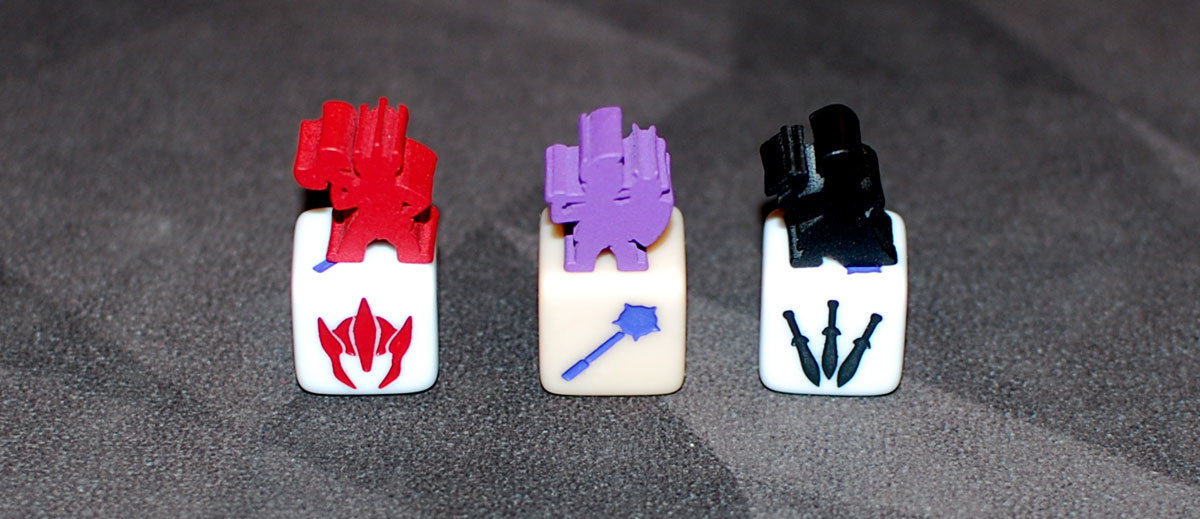
The invasion dice are custom six-sided dice. Two of them have heroes on all six faces, and two of them only have heroes on three faces.
How to Play Stonespine Architects: Invasion
You can download a copy of the rulebook here. I won’t explain the base gameplay here, and will focus on what’s new in Invasion. For the base game, refer to my original review.
The Goal
The objective of the game is to score the most points by building a dungeon that meets your blueprints, challenges, and goal, as well as defeating the heroes that enter the dungeon.
Setup
There are some new goals and challenges mixed into the decks, and a few old challenges that should be removed from the base game. Set up the game as usual, and then add the following.
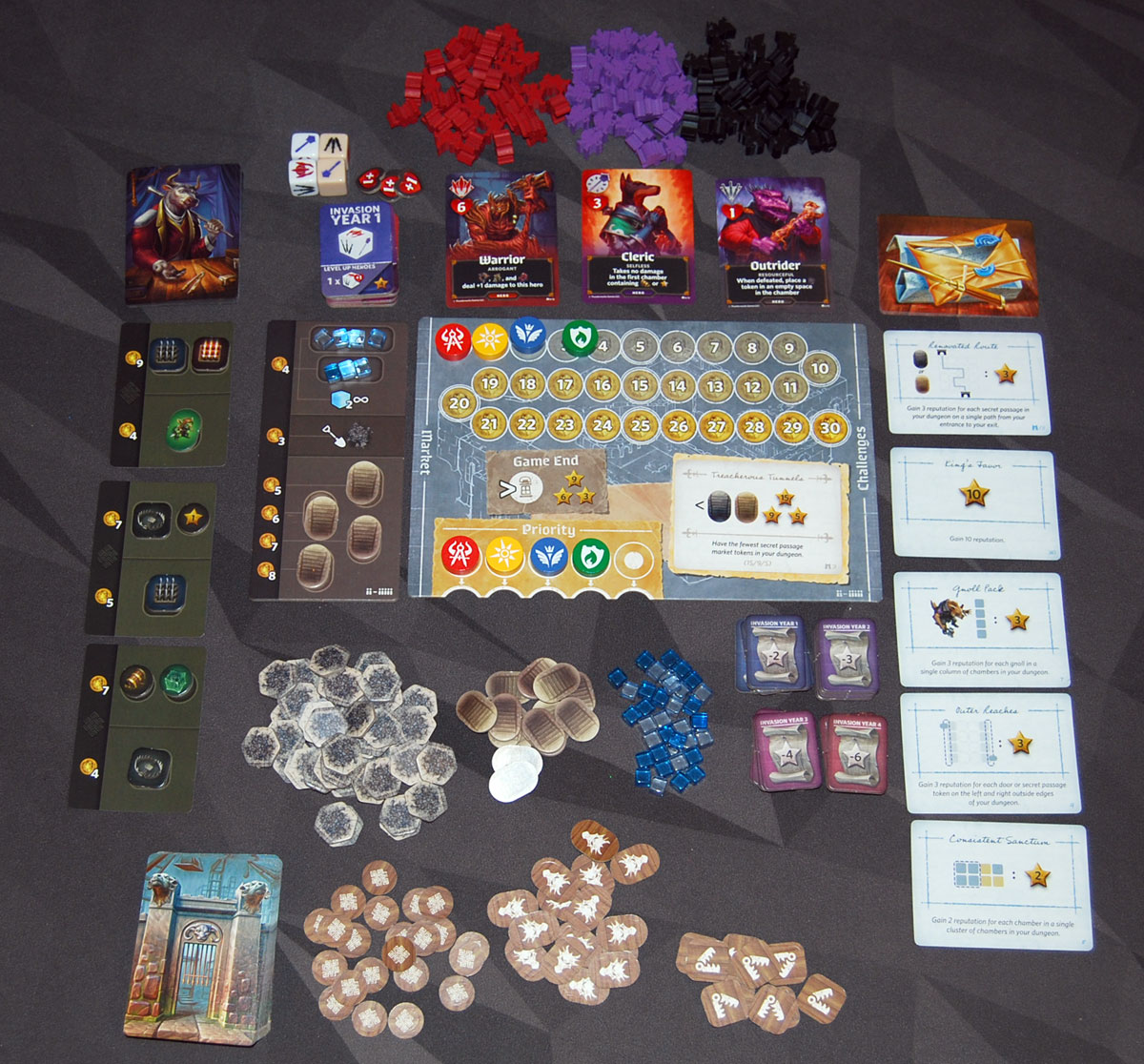
Place the market board nearby, with a supply of XP cubes, secret passages, and rubble tokens. Fill the market board with XP and secret passages as indicated.
Shuffle each of the hero types and draw one of each type, placing them next to supplies of hero meeples. Place invasion dice and health markers nearby. Sort the trophy tokens and demerit tokens by year and place them in stacks.
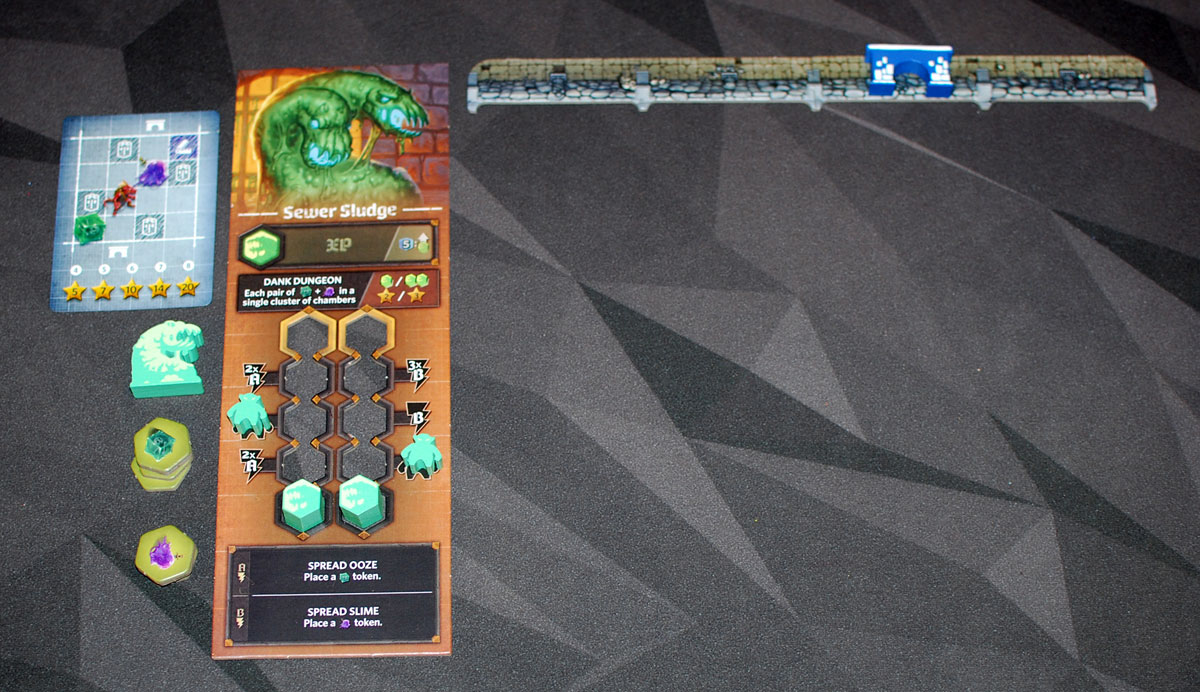
In reverse turn order, each player chooses a guardian and takes all the components associated with that guardian. Each guardian has two versions, and the reference card indicates which of the components will be needed. Place minions next to the level tracks where indicated, and place the level markers at the bottom of each track. Some guardians will have additional setup indicated on their reference cards.
Everyone places their doorway marker lying down at their entrance, indicating that the dungeon is closed.
Gameplay
The game takes four “years,” and each year has these phases: Construction, Improvement, Preparation, Invasion, and Cleanup. Preparation and Invasion are the new phases in the expansion.
The Construction phase is the same: players will pick and pass cards, adding them to their dungeons until everyone has added a row of 4 cards.
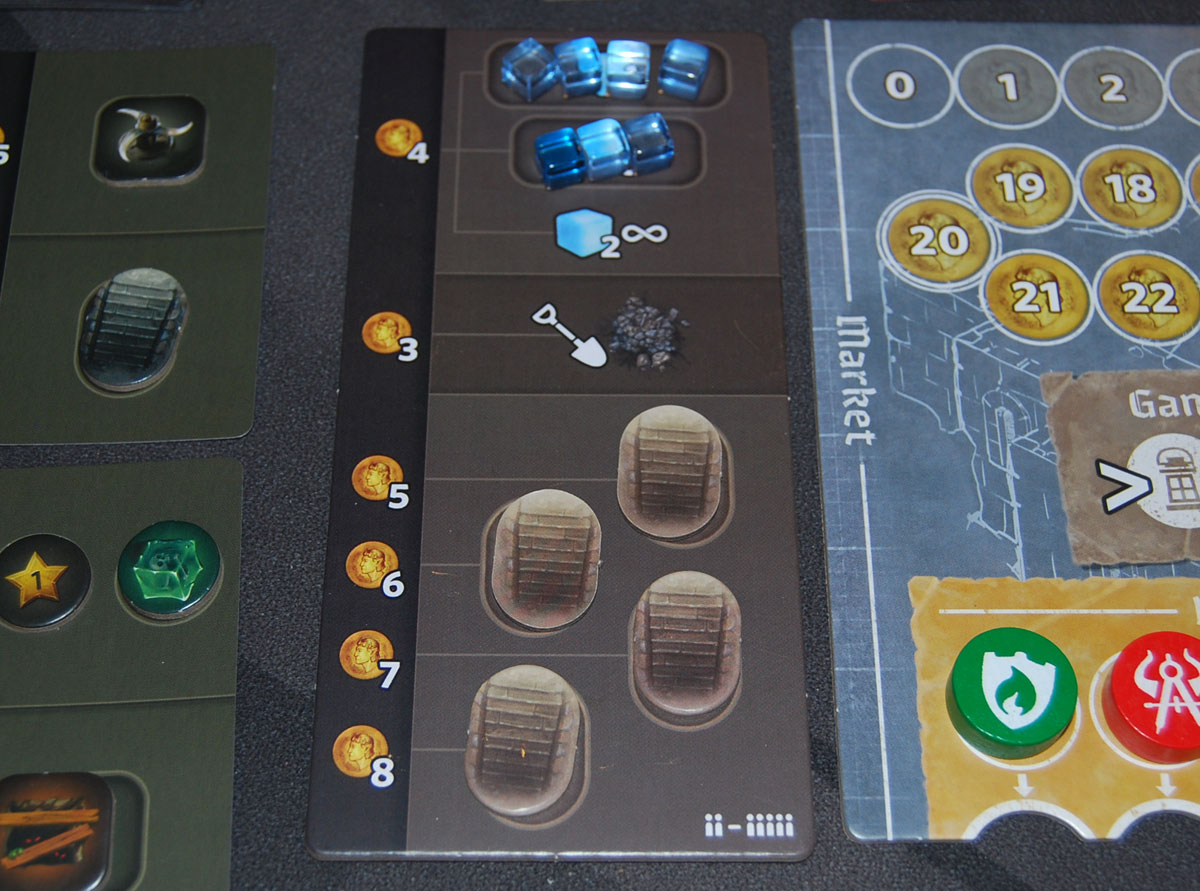
Improvement is when you spend money to buy things from the market. In addition to the original market cards (where you can get monsters, traps, etc.), there’s now a new market board with three more options:
- XP – the earlier you buy, the more XP you get for $4.
- Remove Rubble – some of the heroes will add rubble to your dungeon, covering up other features, and you can spend $3 per rubble removed.
- Secret Passage – sometimes the original market will include secret passages, but this market board always has four available each year, in increasing prices from $5 to $8.
Every time you gain 5 XP, you must level up your guardian, spending the XP and moving one of your level markers up. If you reach a minion, you add it to your supply. If you reach a lightning bolt, you immediately activate the lightning bolt power shown at the bottom of your guardian board. If you reach an open lock icon (with a letter in it), you have unlocked the corresponding ability at the bottom of the board.
During the Preparation phase, everyone simultaneously places their guardian meeple and any minions from their supply into their dungeon. These meeples do not count toward the limit of 4 features per room. Once ready, stand your doorway up to indicate that your dungeon is open.
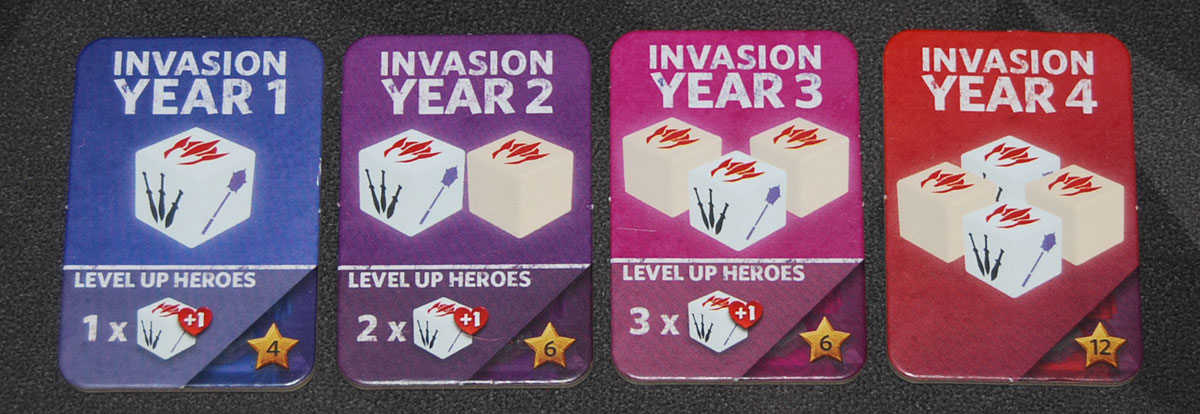
When all dungeons are open, it’s time for the Invasion phase. The player with highest priority rolls the dice shown on the trophy token for the current year, and everyone gains hero meeples based on the roll.
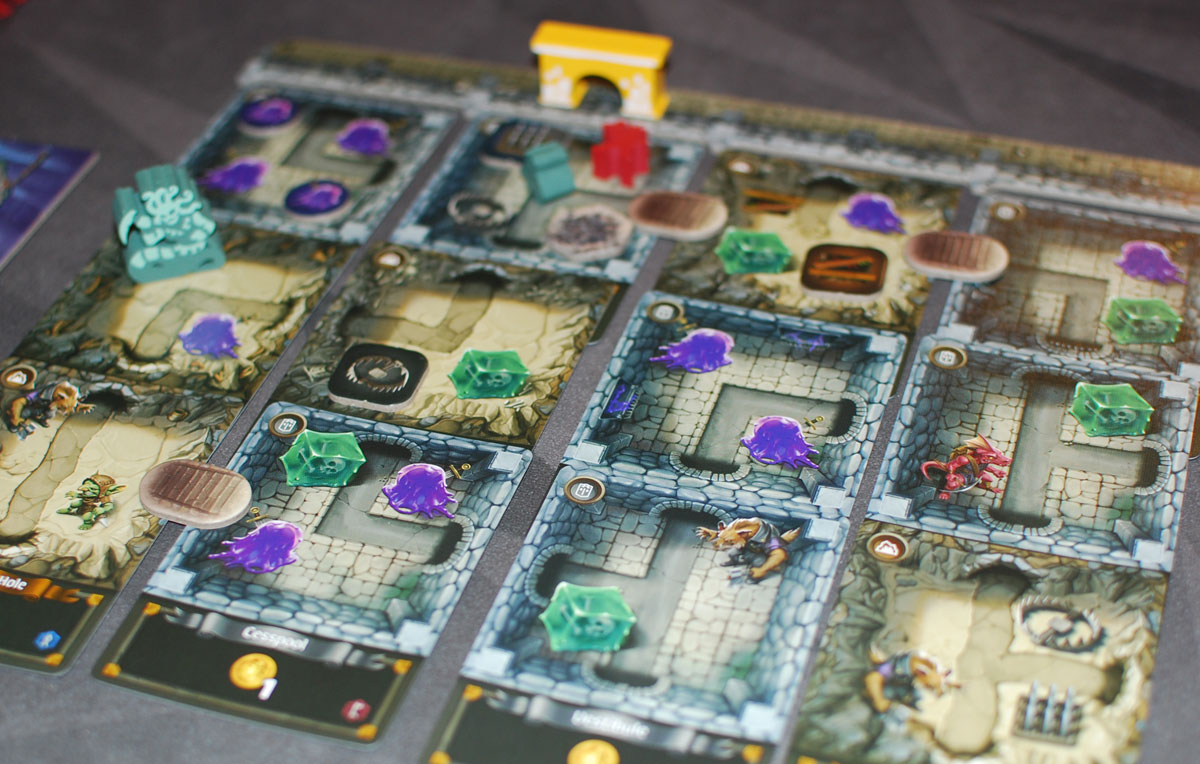
If there are multiple heroes, players may choose the order that they enter the dungeon, through your entrance location. When a hero enters, they first check if there is a defeated hero in the chamber. If so, then they ignore everything in that room and continue to a connected room. If they enter a space with a guardian, then they are defeated and you leave them in the room. Otherwise, they take 1 damage from each monster and trap, and 2 damage from each minion in the room. If the hero has health left, they continue.
When a hero continues, you may choose which room they go to next if there are multiple options, but they cannot enter the same chamber twice. If there are no more rooms to enter and they haven’t been defeated, then they escape, and you place them next to your doorway and close your dungeon. Any remaining heroes that haven’t entered your dungeon are returned to the supply.

Once everyone is done with the heroes from the wave, players decide if they want to welcome another wave of heroes. If your dungeon is still open, you can leave it open, or lay your doorway down to close it. If there’s anyone with an open dungeon, the process repeats: roll the dice again, get more heroes, and trace their paths through the dungeons.
If all the dungeons have been closed, then the heroes level up: roll dice shown on the trophy token, and add health to the corresponding heroes.

The player who defeated the most heroes without any escaped heroes gains the trophy token for that year—if everyone had escaped heroes, nobody gets the trophy. (Ties are broken by priority order.) Each player with an escaped hero takes a demerit token for that year. Everyone counts up all the heroes in their dungeon (including the escaped ones) and gains that much XP. (Remember: you must level up as you gain XP, except in Year 4 you may choose to keep it toward final scoring instead.)
Finally, you do the Cleanup phase: in addition to the regular cleanup, return all heroes to the supply, remove your guardian and minions from the dungeon and place them back in your supply, and refill the market board.
Game End
The game ends after the fourth year. You still score all the same things from the base game (goal, blueprint, challenges, and path), and then add the following:
- Trophy tokens
- Demerit tokens
- Leftover XP (1 point each)
- Guardian bonuses: if one or both of your level markers reached the very top of the track, you will score bonus points as indicated at the top of the track.
The highest score wins, with ties broken by priority order!
Solo Mode
The solo mode is played like the base game’s solo mode against the automated player Jael. You use the back side of the new market board, which has spaces that indicate what Jael will try to purchase if he has at least the same amount of gold as you. Jael defeats a set number of heroes based on the year, so that’s the threshold you need to beat to earn the trophy. You win the game by scoring more points than Jael.
Why You Should Play Stonespine Architects: Invasion
The Stonespine Architects base game is excellent and was even one of our 2024 Game of the Year finalists. I love the puzzle of building out your dungeon, trying to match requirements on your blueprints and challenges, while also trying to balance how much gold you earn each round so that you can buy extras from the market. Once you’re done building your dungeon, you score points for it—but although the rulebook’s flavor text mentions heroes being challenged by your dungeons, the base game does not actually feature any heroes charging into your dungeon to face the various monsters and traps that you’ve carefully arranged.
… until now! In Stonespine Architects: Invasion, the heroes have finally shown up, entering your dungeon in ever-increasing waves as they throw themselves into your dungeon with abandon. (I mean, really, don’t they know not to split the party?) Each round, the some heroes level up, becoming more powerful for the next time. But the players themselves have also gotten an upgrade: now each player is a powerful dungeon guardian with unique abilities and dangerous minions, and the more hapless heroes lose themselves in your maze, the more experience you gain.
This expansion reminds me a little bit of another title from Thunderworks Games: Roll Player, the first game set in the world of Ulos (that now includes several other titles such as Cartographers and Emerald Skulls). In Roll Player, the whole game is about creating an RPG character: you place dice into your character board to determine your strength, dexterity, and so on. Your character doesn’t actually do anything in the game—it’s all about the design. In the Monsters and Minions expansion, though, you can fight minions over the course of the game, and it ends with a big combat against the boss monster.
Narratively, both of these expansions can feel a little strange: why am I fighting while I’m still filling out my character sheet? How come heroes are exploring my dungeon when it’s not actually completed? Mechanically, the expansions add a layer of gameplay that makes the whole endeavor even more satisfying. You actually get to use your character for something; you find out how many heroes you can take down with your dungeon design. It feels like you’ve progressed from a classroom exercise (“Design a dungeon to these specifications”) to the practical application (“Leeeerooooy Jeeeenkinnnnns!”). Thematically, it’s a little bit like Boss Monster, but writ large.
There’s a press-your-luck element involved in the hero invasions, because you can decide after each wave whether you want to risk another wave. You can look at your dungeon and determine which heroes would survive and which ones would die at any given point, but you won’t know which heroes are coming until the dice are rolled. In later rounds, some of the dice have a 50% chance of being blank—do you like those odds? Escaped heroes will give you demerits: maybe it’s worth risking that in the earlier rounds because leveling up quickly might make up for the lost points. Demerits get more and more costly as the game progresses, so you’ll have to be careful!
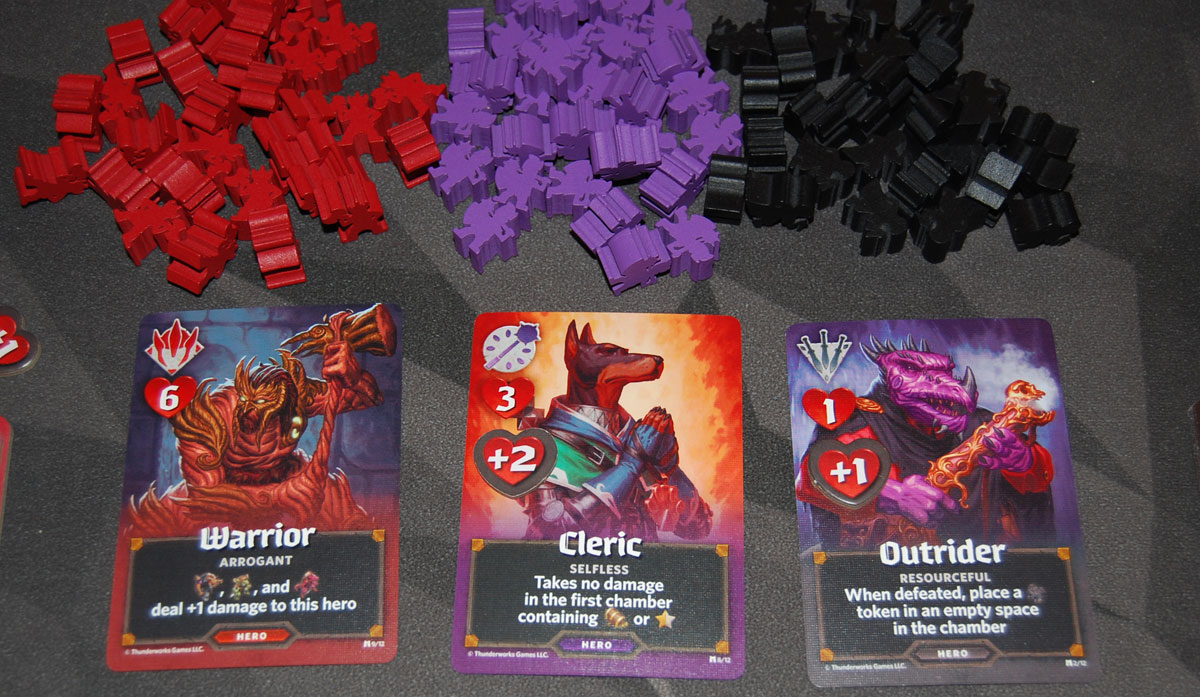
The heroes who break into your dungeon aren’t very smart, but they make up for it by being quite annoying. There are three general types, with different versions of each one. The strength hero has the most health but has a specific vulnerability; the dexterity hero is weakest but will reduce certain features in your dungeon to rubble; the magic hero has middling health but the ability to ignore certain chambers. Figuring out how to build your dungeon to address the three different heroes is key to gaining XP.
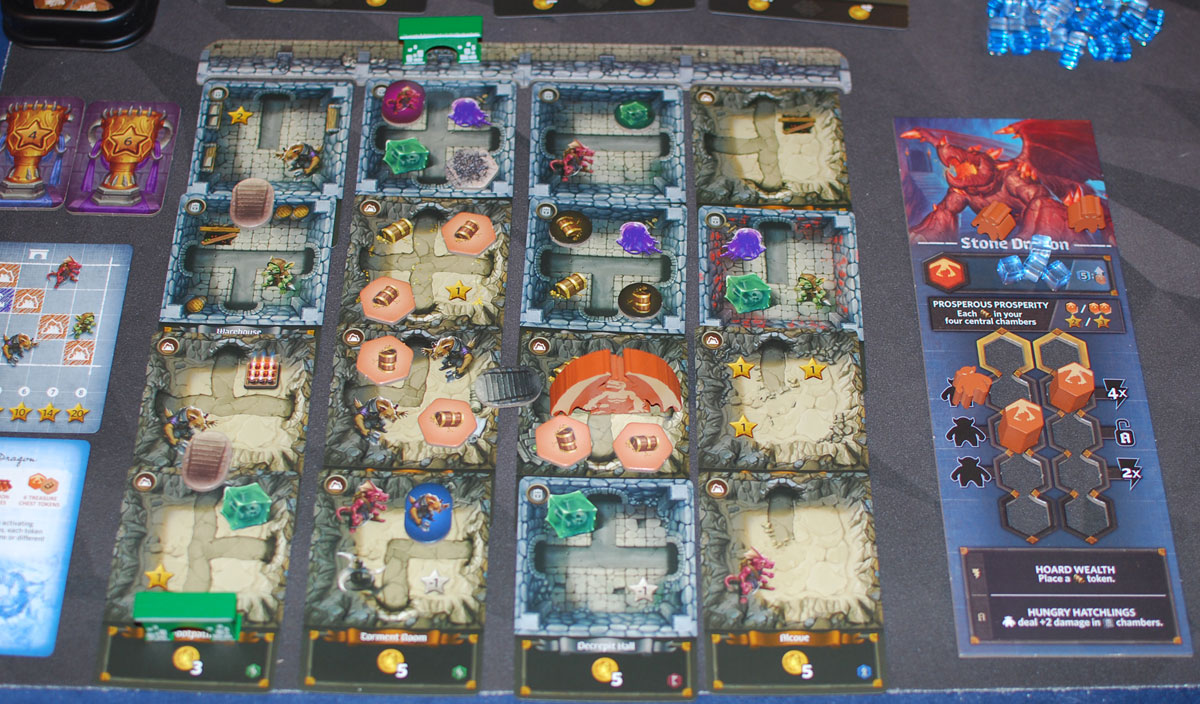
The guardians all have different abilities, which means you need to adapt your strategy to take advantage of your strengths. (Plus, there are two versions of each guardian for even more variety.) The Stone Dragon is all about gathering a hoard of treasure chests and victory point stars in the center of its dungeon. The Artificer Gorgon gets bonus damage to certain traps. The Giant Troll can move around during the invasion phase, but with a trade-off of turning a lot of its dungeon to rubble. Each guardian also has different ways to score bonus points, but only if you level up enough! So far I’ve only used the simpler side of the guardians, recommended for new players, but I’ve looked through their powers and I’m excited to give them all a try eventually.
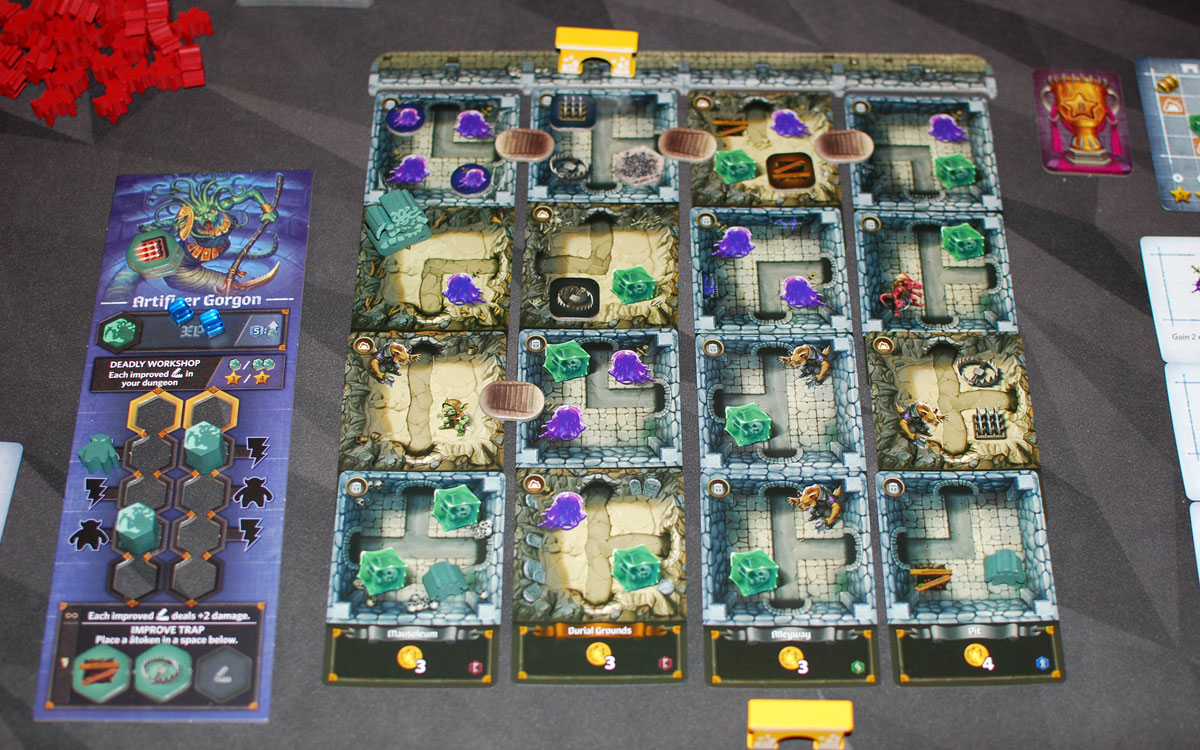
Stonespine Architects gave you the mission to build a dungeon; Invasion puts that dungeon to the test. It feels like a logical continuation of the theme, and I really enjoy the added depth. The one drawback is that it does make the game quite a bit longer. I mentioned at the top of the review that the box says “60 to 90 minutes,” but in my estimation it’s likely to take much longer. Although the dungeon building is simultaneous, the market phase is done in turns (based on who has the most gold), which means it has always been a game that takes a little longer for each additional player. And, of course, if you had a plan for the market but then somebody bought what you wanted, you have to make a new decision on the spot.
Invasion adds an entire new phase to the game, and it’s arguably one of the most prone to analysis paralysis. In the first round, you’re going to admit at most 4 heroes into your dungeon (or 5 if you’re just going for the extra XP along with a demerit), because only 1 hero can be defeated per room. It’s pretty easy to see if you could handle another single hero in an additional wave. But by round four, your dungeon could handle up to 16 heroes, and each one might have multiple paths they could take through your dungeon. On top of that, you could have 4 heroes in a wave, so you’re deciding not only how they move through the dungeon, but the order that they’ll enter. Because of their different abilities, the locations where each hero dies will impact the next hero’s survival.
When it comes time to decide whether to admit another wave of heroes, everyone is scrambling to calculate how far each of the three hero types would make it through their dungeon, then how many of each one they could handle, and then deciding whether they like the odds. Maybe you could handle 2 more heroes, but what if the dice give you 4 heroes instead? The decisions can get quite complex, and if you allow everyone to math out all the possibilities before progressing, it can really slow down the game. I don’t know if it makes sense to set a timer for deciding on additional waves.

That said, if you like the dungeon building aspect of Stonespine Architects, I think the extra time needed for Invasion is worth it. It really immerses you in the theme, and as long as you’re planning for it to be a big game, it’s a very engaging experience!
For more information or to make a pledge, visit the Stonespine Architects: Invasion Kickstarter page!
Click here to see all our tabletop game reviews.
 To subscribe to GeekDad’s tabletop gaming coverage, please copy this link and add it to your RSS reader.
Disclosure: GeekDad received a prototype of this game for review purposes.