
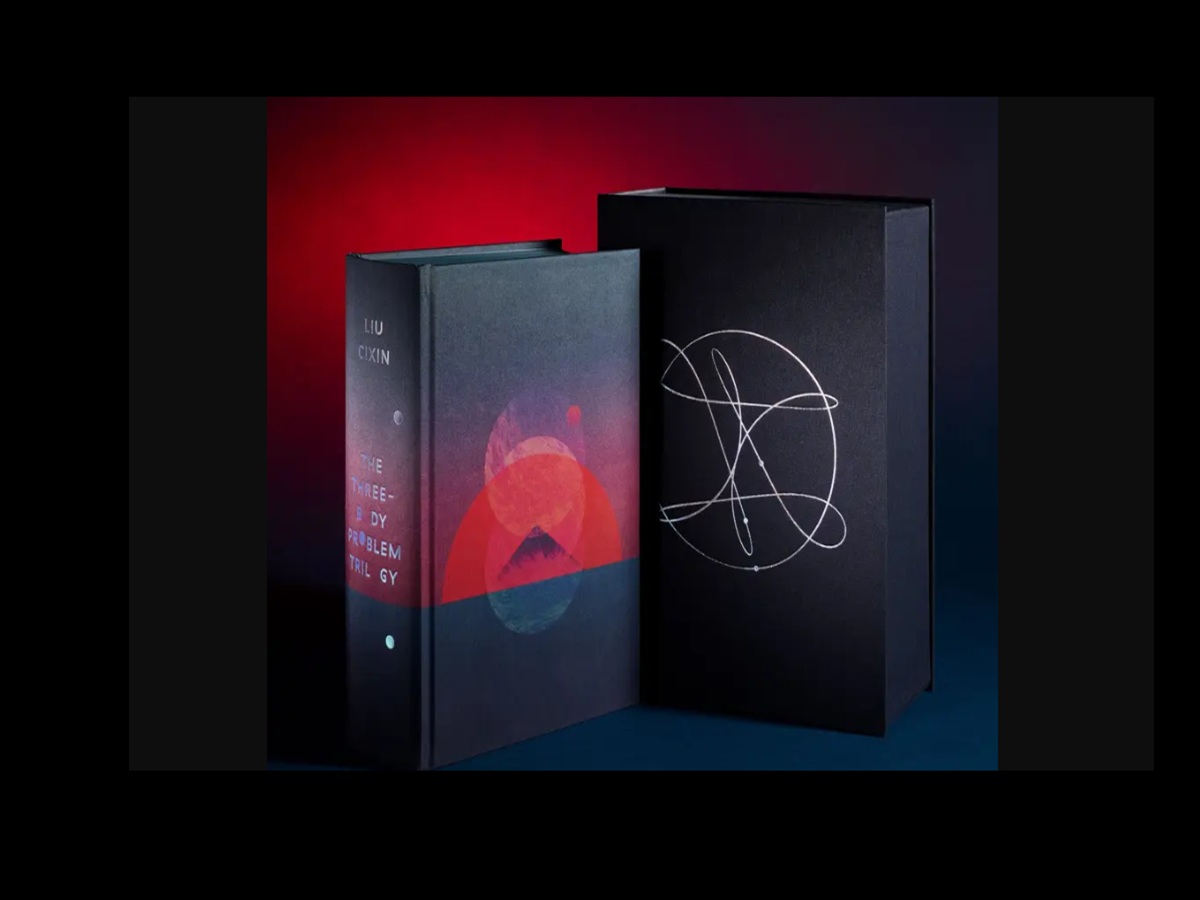
When I talk about these books, I do so with longing, as I am the sole Latina correspondent and, to top it off, I reside in a country with an almost non-functioning mailing service. Alas, a hefty copy is impossible for me to get, and worth a budget. However, I had the chance to read The Binti Trilogy last year, and reading this year′s new set of titles is always a thrill. These guys love a good book.
It is also a great excuse to talk about the trilogy as there are other digital and printed offers out there, especially since the Netflix series inspired by the Hugo Award and Locus winner (3 Body problem) has come out.
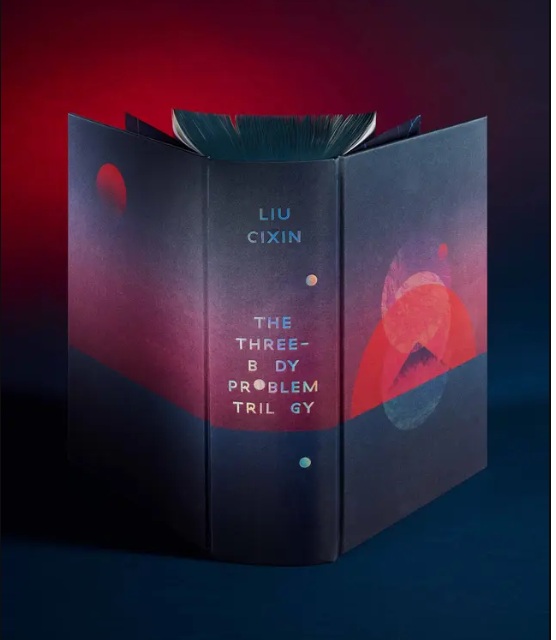
The Three-Body Problem Trilogy by Liu Cixin. With artwork by Matt Griffin
Liu Cixin recently said that if he knew how far-reaching his trilogy would be, he would have tried to put a brighter look at humanity at its core.
However, I seriously doubt it: the man does believe that we can survive (maybe) an encounter with an alien species, but that it would be delusional to think that we could just get along.
In his introduction, he says there may be many ways to think about a first encounter with an alien civilization (and in the second novel, The Dark Forest, he will propose two main principles for Cosmic Sociology), and that he only chose to describe the worst-case scenario. I am glad to have read Project Hail Mary by Andy Weir before this one, as it nicely balanced the desolate sensation the book may leave you with.
To say the first book is interesting is far too simple. It sits up there with the great postulates Asimov made: once you see what he means by sub-molecular dimensions, for example, you cannot unsee it. His majestic images seek to explain to us not only the reason why the Trisolarans must reach towards us, but how humanity can be seen as the sum of individual and global decisions, spanning unimaginable amounts of time.

After Ye Wenjie betrays humanity, Earth’s defense will be severely hampered by Trisolaran “sophons”, omnipresent but unobservable supercomputers that spy on all Earth activity and interfere with technological development. However, sophons cannot surveil human thought, and the United Nations appoints four “Wallfacers”: individuals tasked with developing defense strategies known only to themselves, provided with near-unlimited resources to do so. My favorite, of course, is the hedonistic one, Luo Ji.
The second book, The Dark Forest, takes place two hundred years into the future, and describes a beautiful Enlightenment Era, with many of the first characters able to make decisions because they have passed through the process of hibernation. The consequences of overconfidence will be clear to any human reading this in our era, as we are truly a suspicious race. The Space-Era humans, however, are a bit more trusting and will have a dramatic reckoning with war.
The third book, Death′s End, takes place far into the future, and invites us to imagine what life with us out there in the Universe could become. The implications are far-reaching and encompass multiple high astrophysics ideas, including self-contained universes.
The entire trilogy is known as Remembrance of Earth’s Past.
The Three-Body Problem Trilogy has (had) 750 copies available.


Mariana Ruiz

A Bolivian that writes children's books in Spanish, when she is not busy writing fiction or wondering about the Universe, she is playing games with her two sons and fantastic partner.


