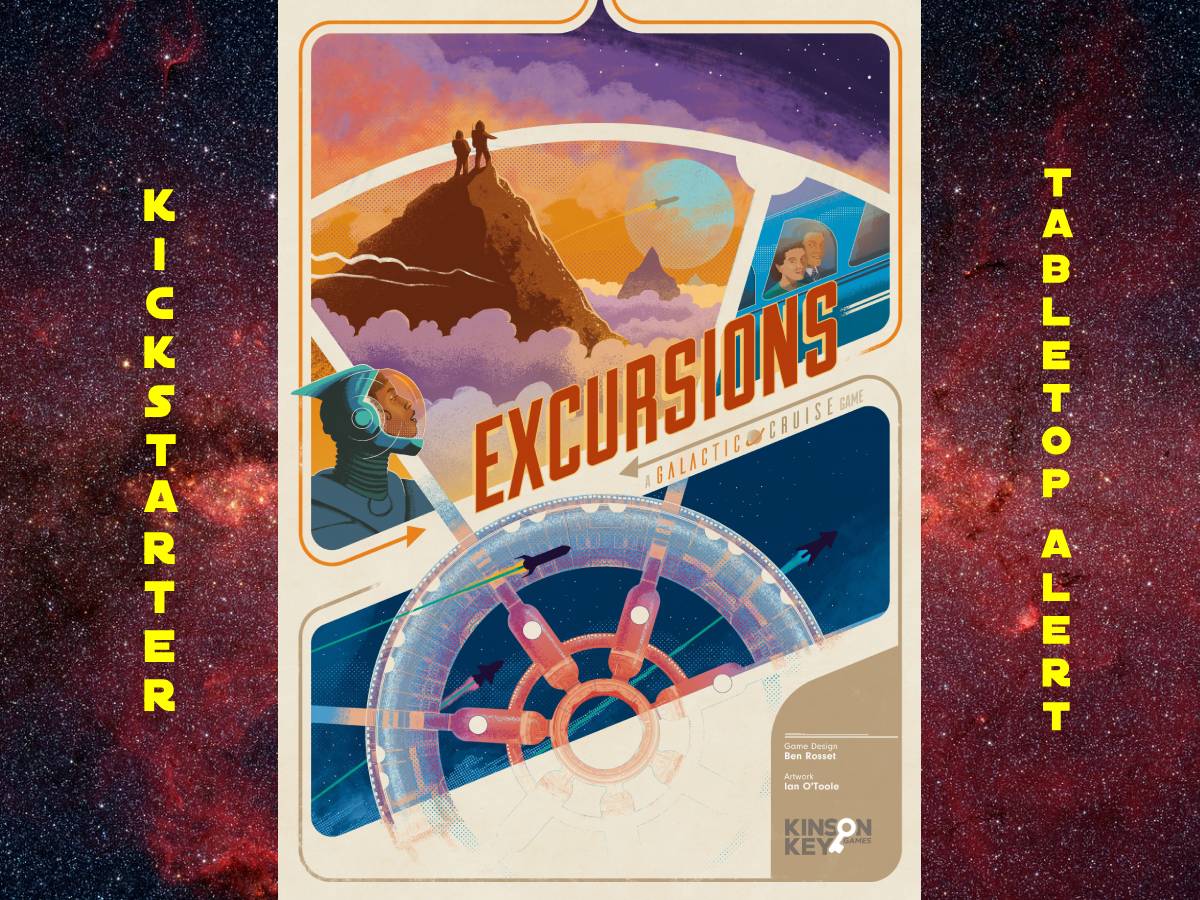
After a successful crowdfunding campaign in 2024, Kinson Key Games’ Galactic Cruise released last year to great critical acclaim, becoming GeekDad Approved and one of of our Game of the Year finalists amongst other accolades.
Now, Kinson Key Games is back on Kickstarter with a new game set in the Galactic Cruise universe, one set on a space station catering to the Galactic Cruise company’s passengers as they prepare to voyage into space. I got a chance to play the prototype before the new game’s campaign launched.
What Is Excursions: A Galactic Cruise Game?
Excursions: A Galactic Cruise Game is a variable setup, action selection game for 1-6 players, ages 10 and up, and takes about 60-90 minutes to play. It uses a rondel for action selection, and had simultaneous play which speeds up the gameplay time. It’s currently seeking funding on Kickstarter, with a pledge level of $39 for a standard copy of the game, or $59 for the deluxe edition. The prototype I was sent had a blend of components from both the standard and deluxe editions.
Excursions: A Galactic Cruise Game was designed by Ben Rosset and published by Kinson Key Games, with illustrations by Ian O’Toole.
New to Kickstarter? Check out our crowdfunding primer.
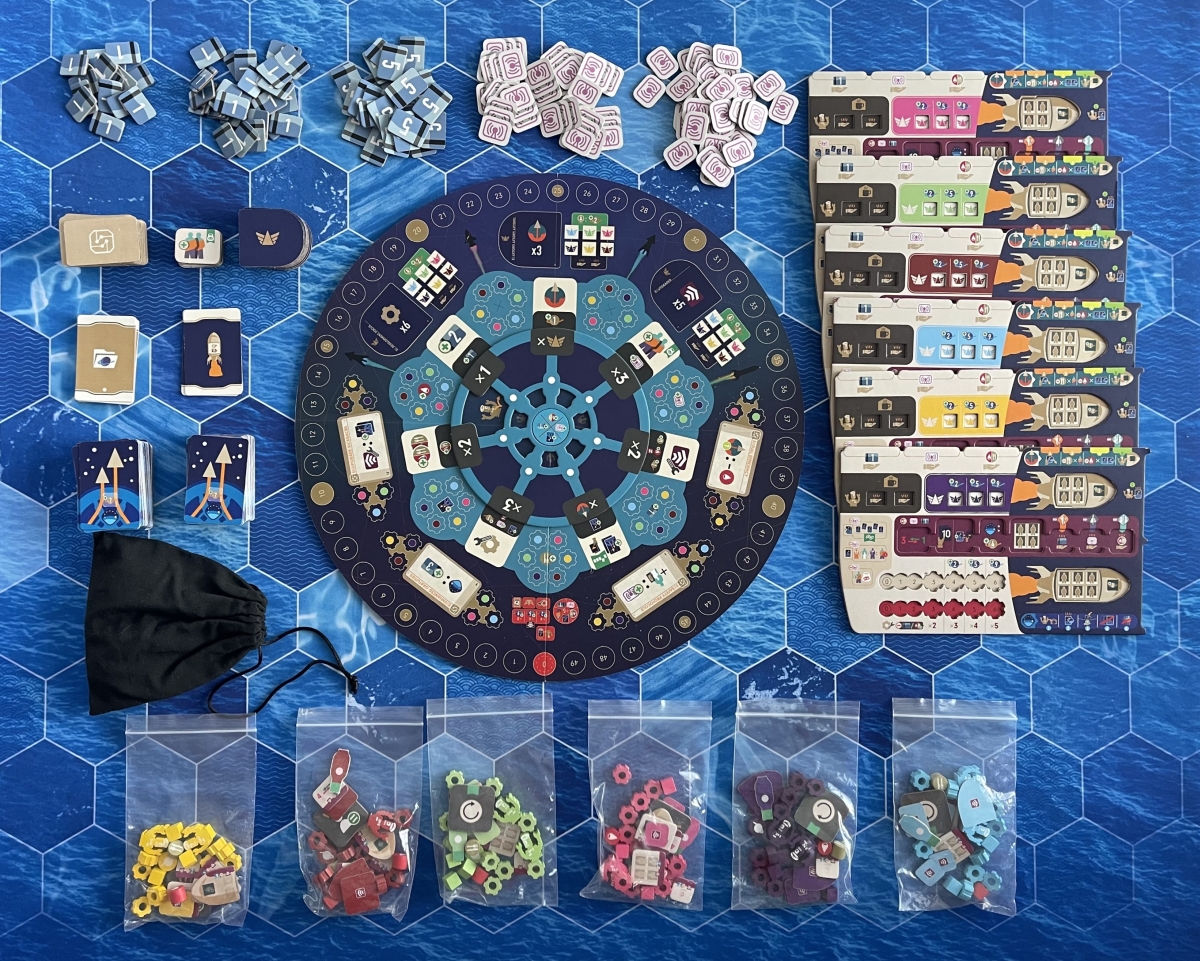
Excursions: A Galactic Cruise Game Components
Note: My review is based on a prototype copy, so it is subject to change and may not reflect final component quality. However, many of the components are quite polished, and some, like the money and ad tokens, are identical to those found in Galactic Cruise.
Excursions: A Galactic Cruise Game comes with the following components:
- Main Board
- Space Station
- Center Disk
- 16 Technology tiles
- 11 Company Goal tiles
- 6 Action tiles
- 140 Cruise cards
- 7 First Game cards
- 16 Secret Goal cards
- 72 Money tokens
- 54 Ad tokens
- 48 Guests (16 of each type)
- 1 Cloth Bag
- 6 Player Boards
- 12 Resource Trackers
- 54 Developments
- 12 Pilots
- 18 Cubes
- 54 Upgrade tiles
- 6 Player Aids
- 6 VP markers
- 6 Active Player tokens
- 6 Bonus tokens
Despite a rather sizeable list of components, the game box is actually quite compact, especially when compared to its “big brother,” Galactic Cruise.

The game board actually consists of 3 parts: The Main Board, the Space Station rotating around the middle, and the Center Disk. There are two sides to the Main Board: a “First Game” side, where all of the Actions, Goals, and Technologies are pre-printed, and a Standard side, which has blank spaces for those areas and are filled in using drafted tiles.

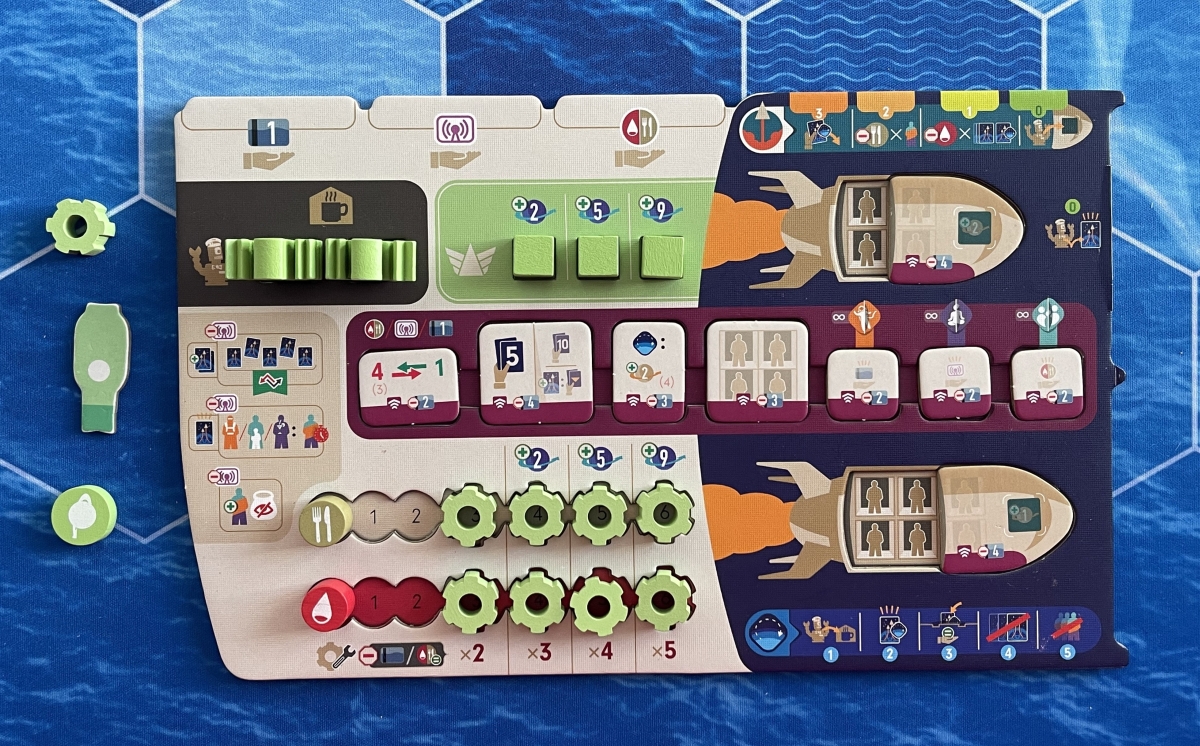
The Player Boards are made of thick cardboard, with a linen finish. The boards I was sent were dual-layered, which only come in the Deluxe Edition of the game.
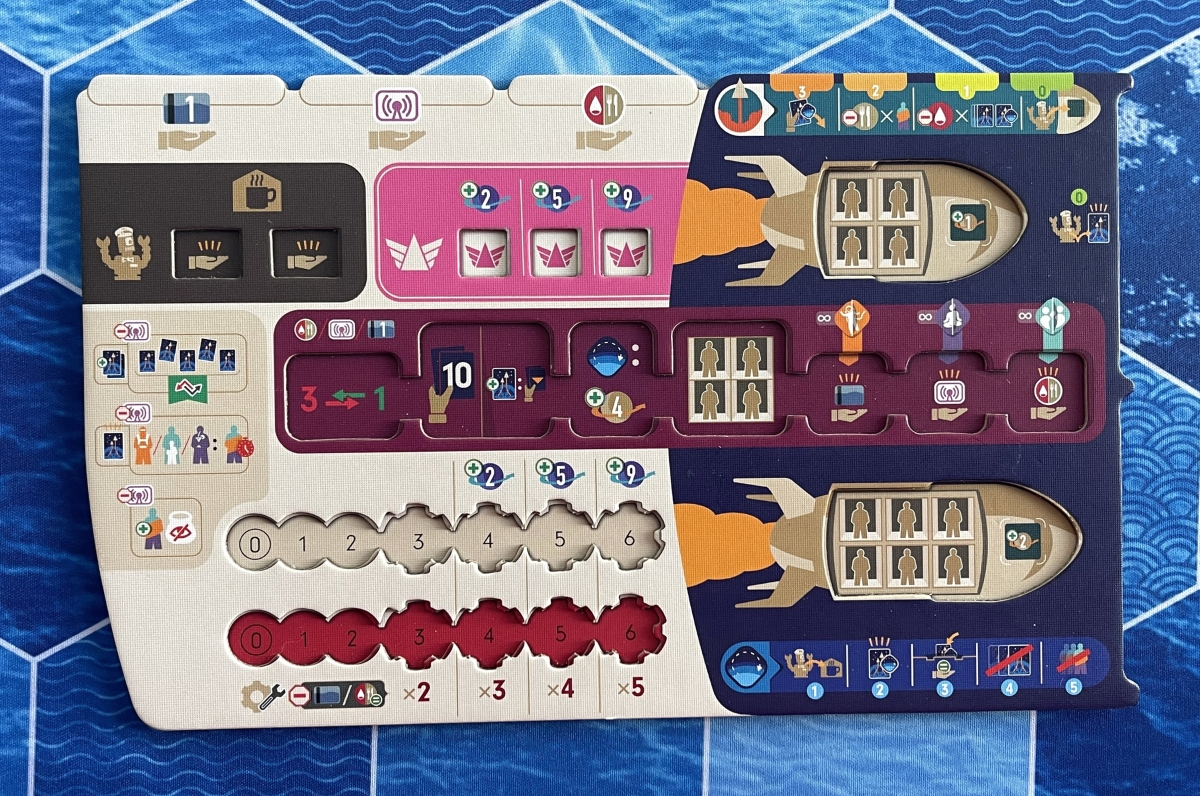
The Player Boards come in the 6 different player colors, but are otherwise identical. They also include helpful graphical reminders. For example, the top of the right side of the Player Board uses icons to show the steps you must take when launching a cruise, while the bottom of the right side of the Player Board illustrates the actions you undertake when returning home.
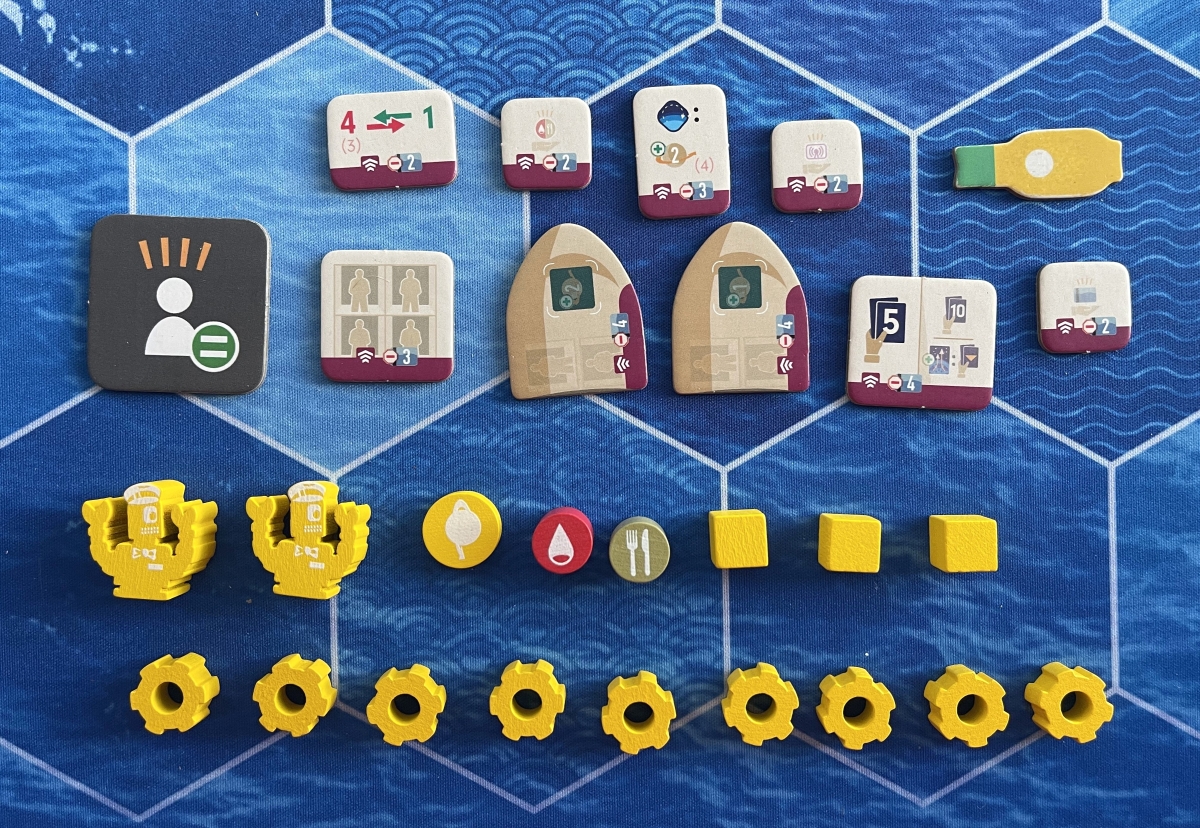
Each player also gets a number of tokens that they will use in conjunction with both their Player Board and the game board. The Developments (the gear-shaped tokens) are wooden in the Deluxe Edition of the game, but will be cardboard in the Standard Edition.
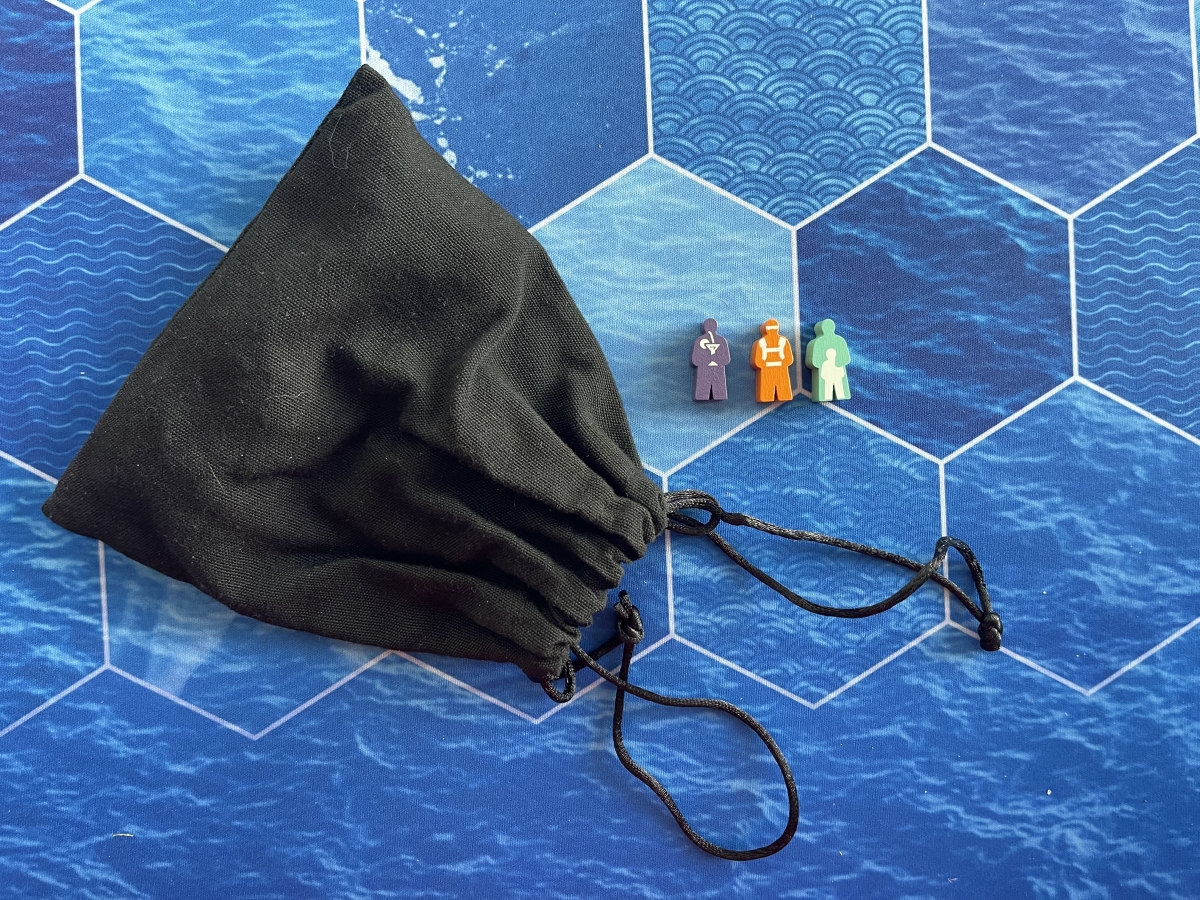
Excursions: A Galactic Cruise Game sees the return of the wooden token Guests from Galactic Cruise, but in this game, they will be drawn from a cloth bag, rather than selected from the game board.
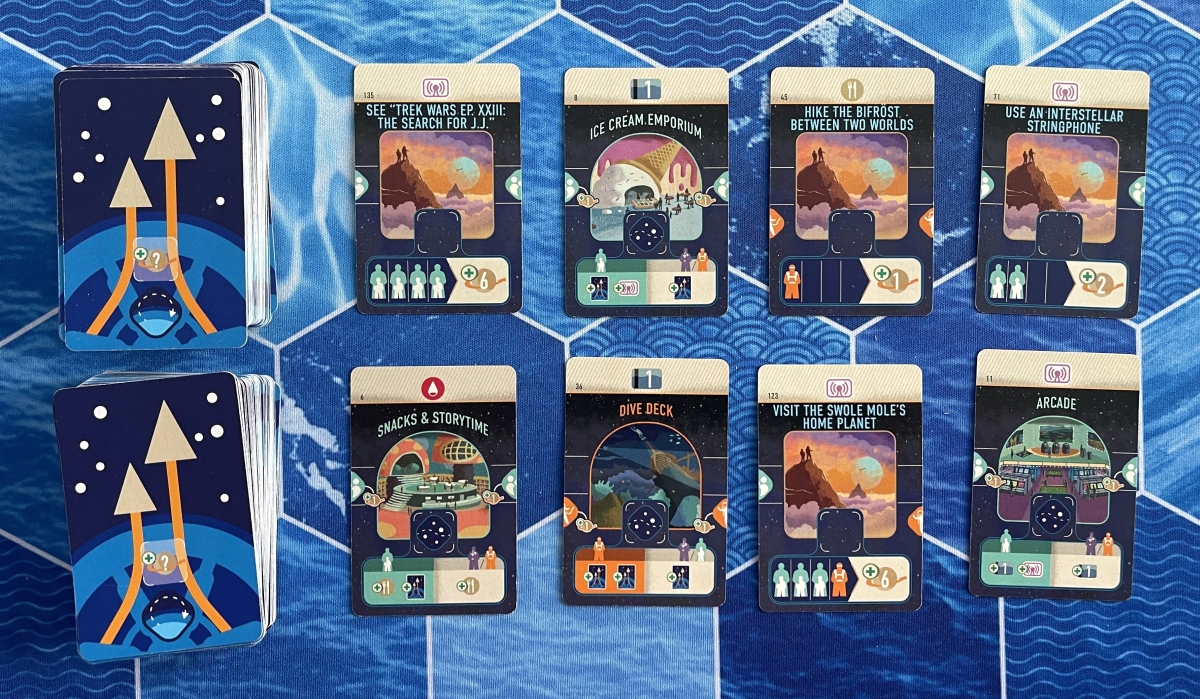
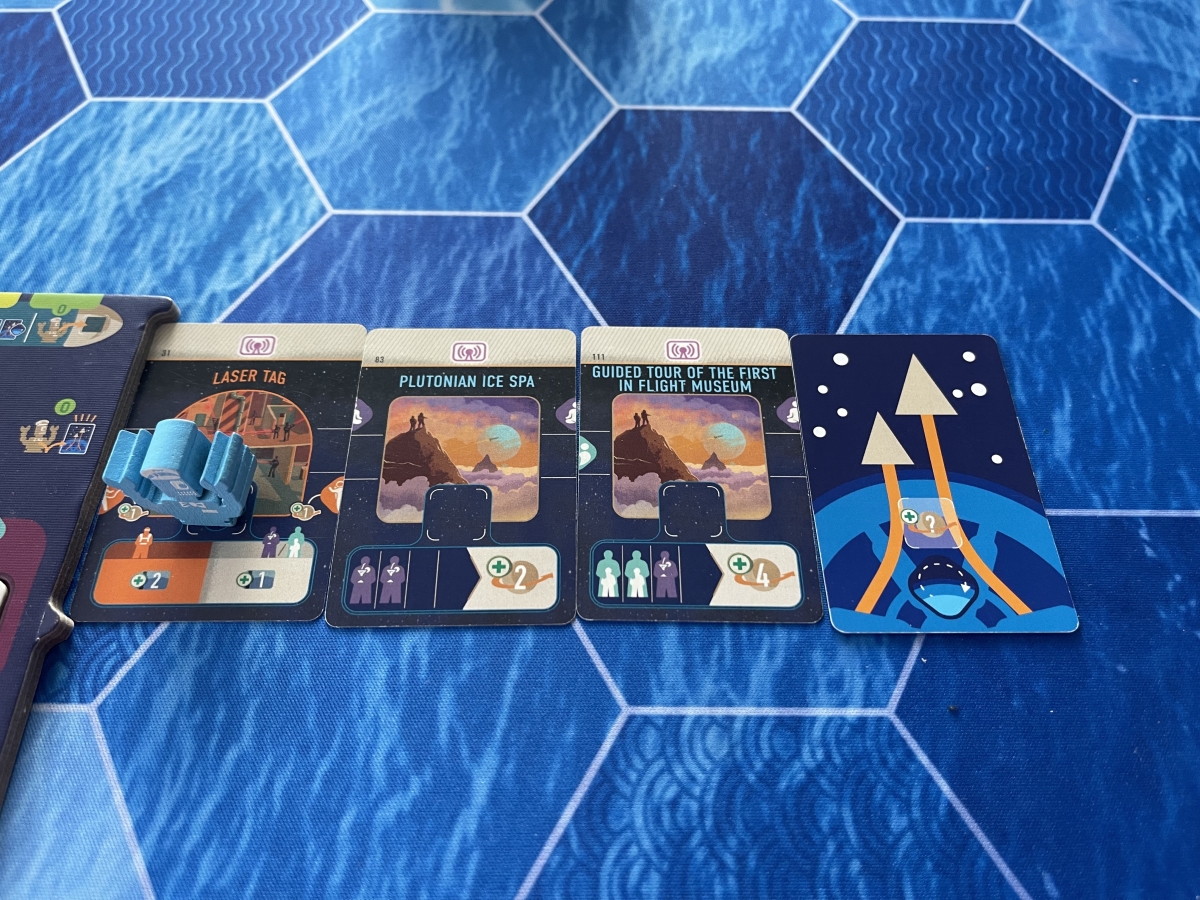
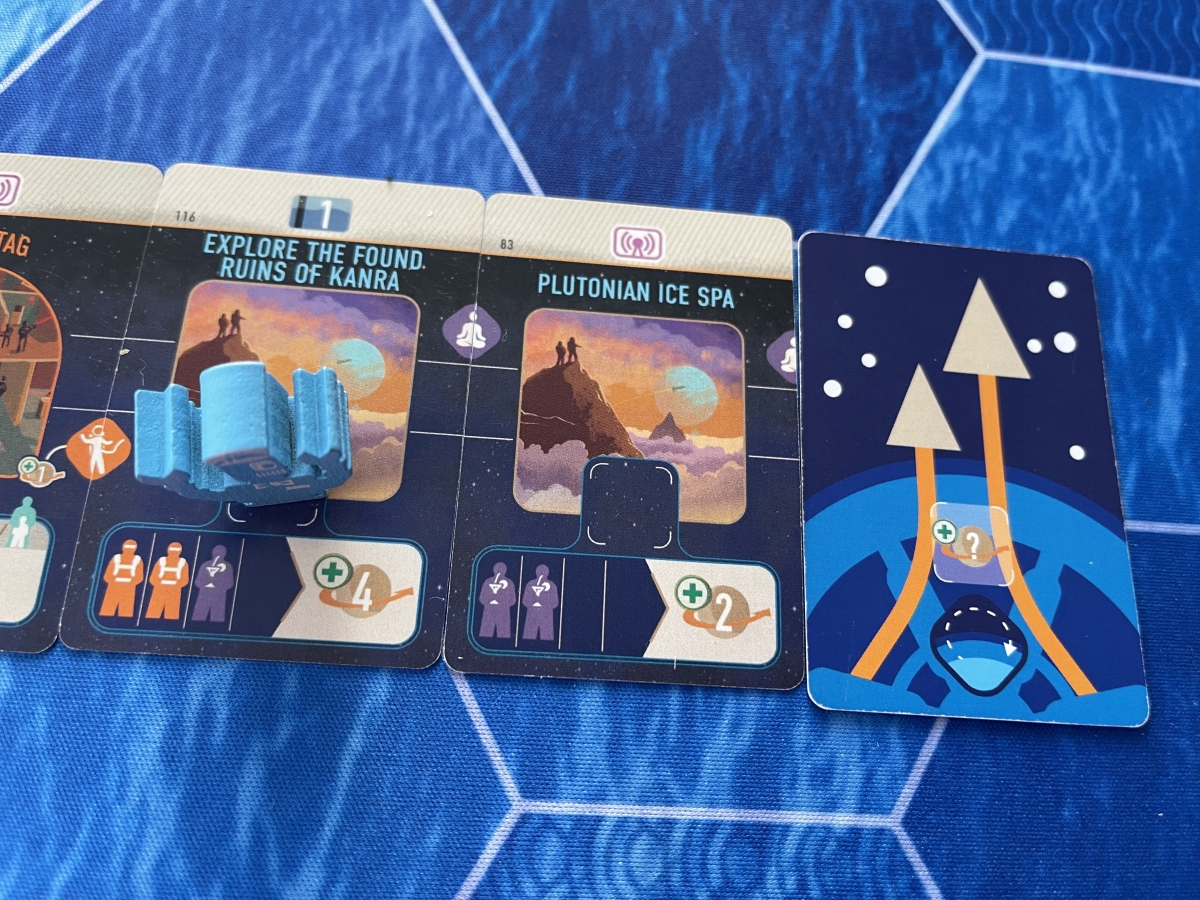
In Excursions: A Galactic Cruise Game, you’ll design your own cruises by playing out cards into a row next to one of your two spaceships on the Player Board. These cards have multiple uses, as you can always turn in one from your hand for the resource illustrated at the top of each card.
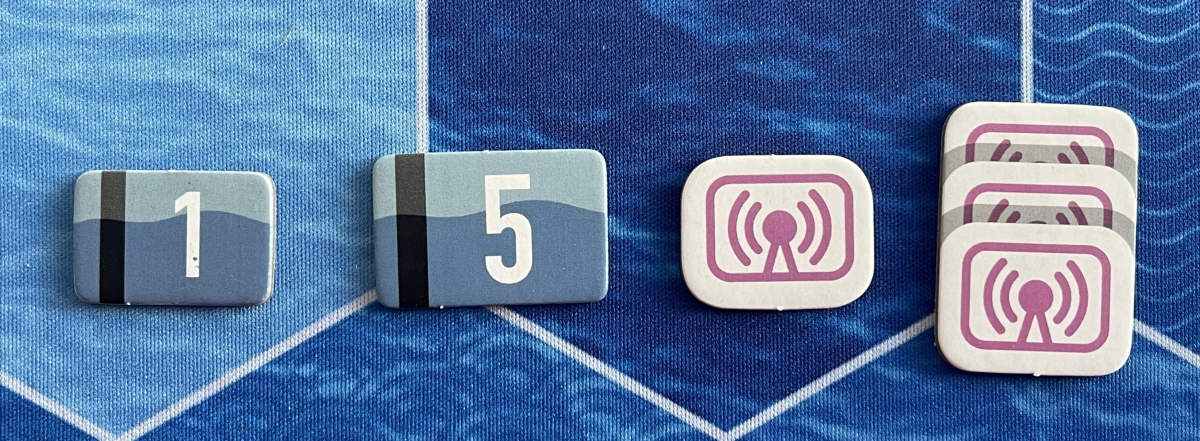
If you’ve played Galactic Cruise or read my review, the image above should look very familiar, as I’m pretty sure they’re the identical tokens in this game as they are in Galactic Cruise. Money is used primarily when purchasing Upgrades or Developments, while Ads can be used to draw Guests, or to temporarily change the type of Guest for the purposes of getting the bonus on a Cruise card.

If you are playing with the “First Game” setup, you’ll randomly get dealt a First Game card. These cards will show you what resources you get, where to place your first Development, and which Upgrade token to remove from your Player Board at the start of the game. These are not used in a Standard Game, but help to give everyone a bit of a head start while learning Excursions.
How to Play Excursions: A Galactic Cruise Game
You can download a copy of the rulebook here.
The Goal
The goal of the game is to score the most victory points, primarily by building Developments, purchasing Upgrades, and sending Guests on Cruises.
Setup
The setup largely depends on whether you are setting up a “First Game” or a Standard Game. Both setups are fairly similar, except that the First Game setup has less steps, thanks to several elements being already printed on the First Game side of the Main Board. I will only be explaining the setup for a Standard Game.
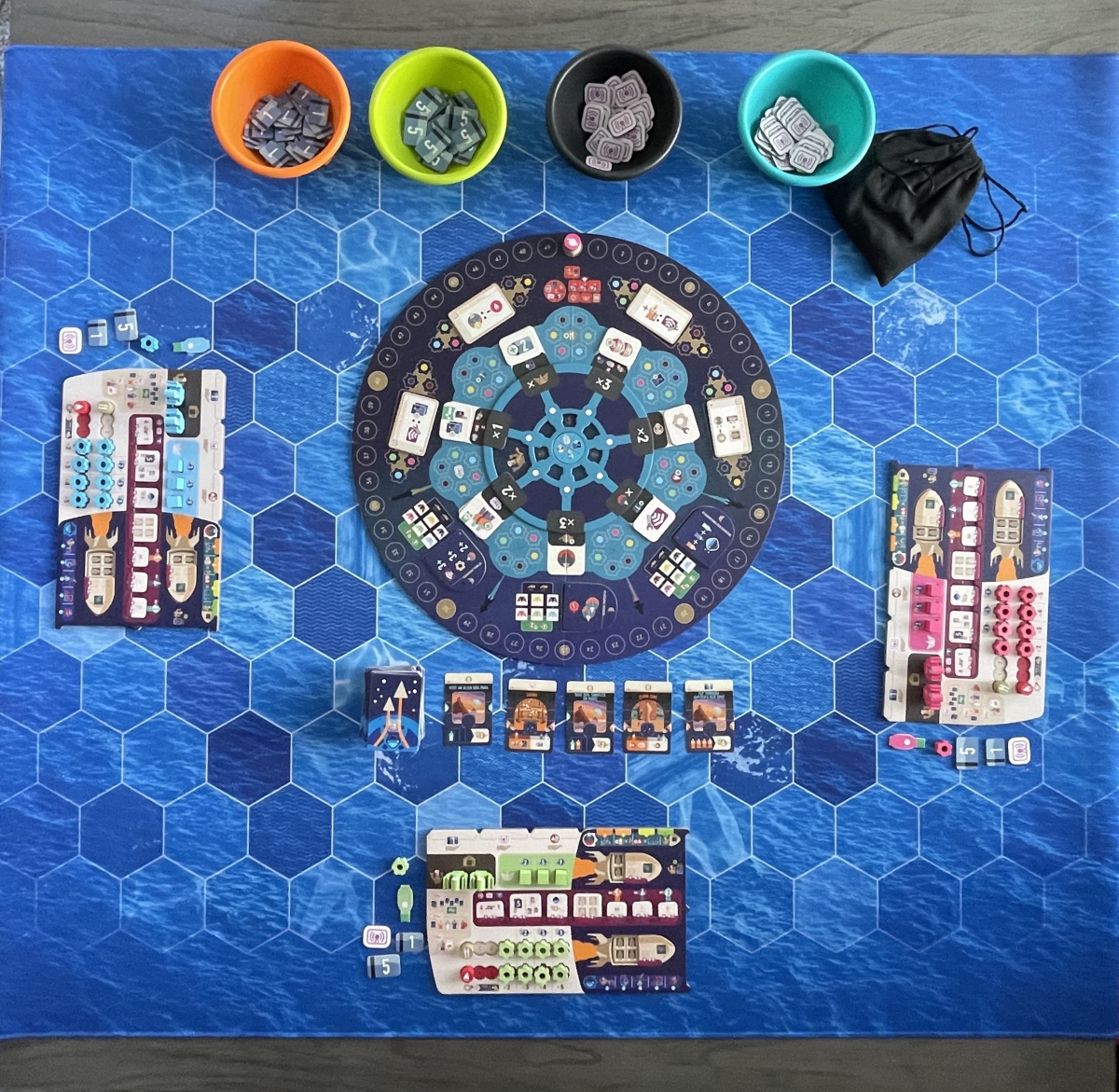
Standard Game Setup
Place the Main Board on the Standard Game Side, and place it in the center of the table. Place the Space Station on top of the Main Board in a random orientation, and place the Center Disk in the hole to connect the Space Station to the Main Board.
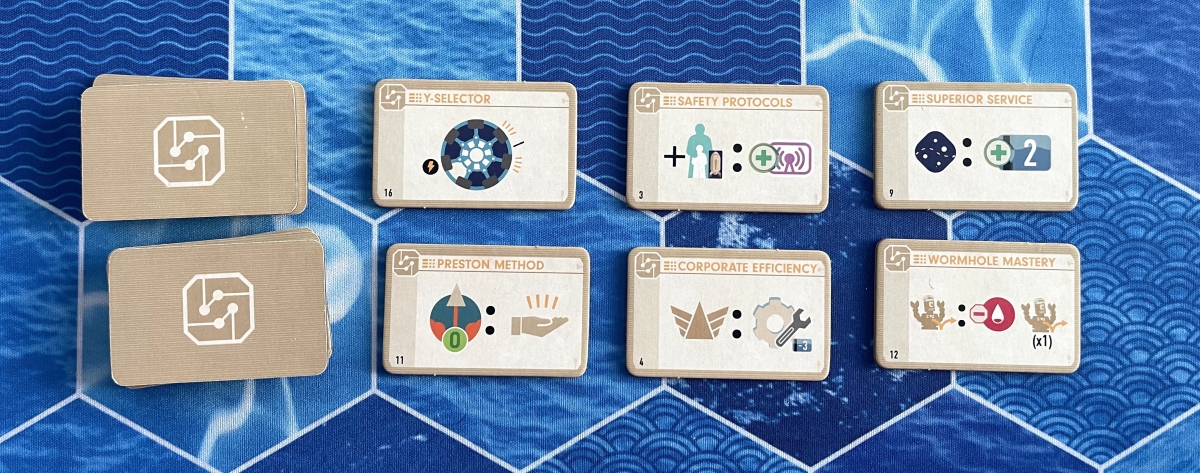
Shuffle the Technology tiles and then place 4 onto the Main Board in their designated spots.
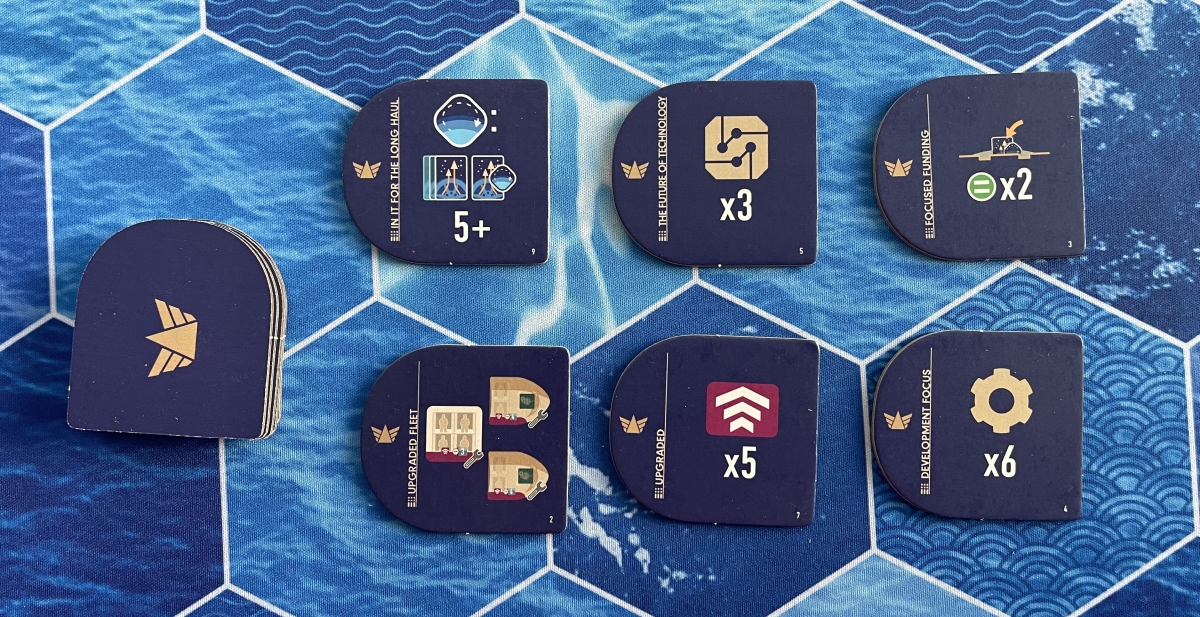
Shuffle the Company Goal tiles, and place 3 onto the Main Board in their designated spots.
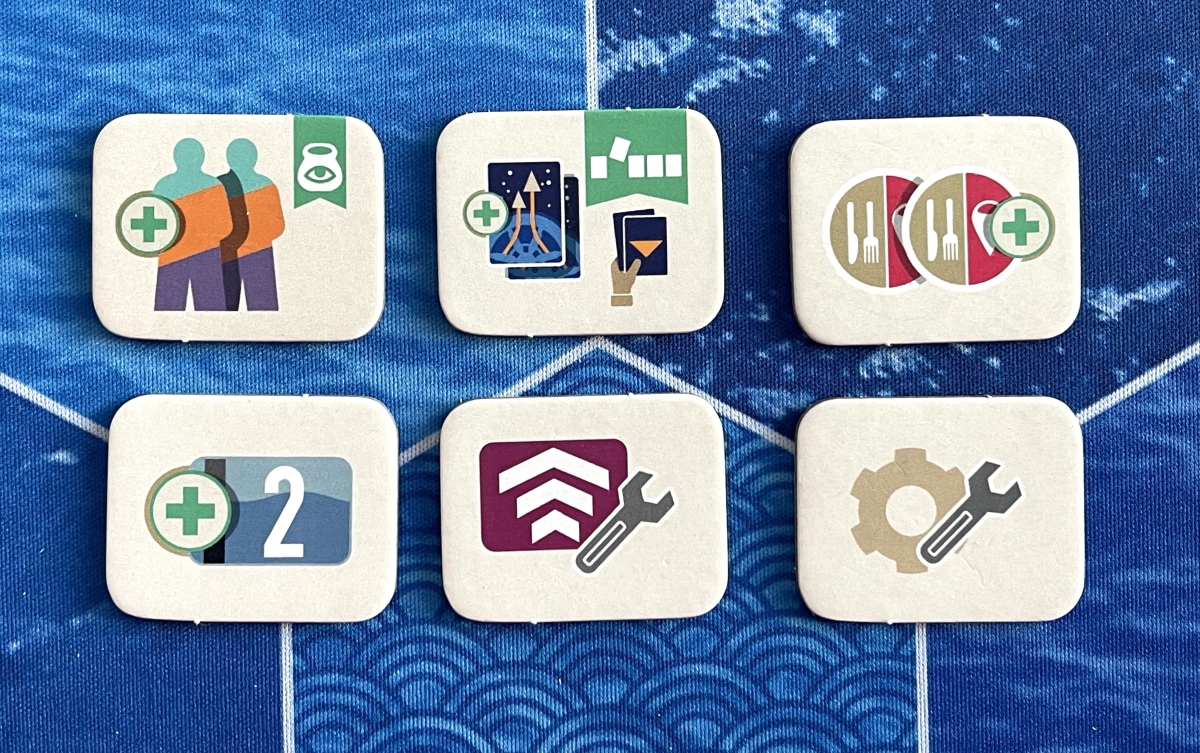
Shuffle the Action tiles and place all 6 onto the Main Board in their designated spots.
Shuffle the Cruise cards, flipping 5 over to form a display. Place the Guest bag (with all Guests inside), Ads, and Money tokens within reach of the players.
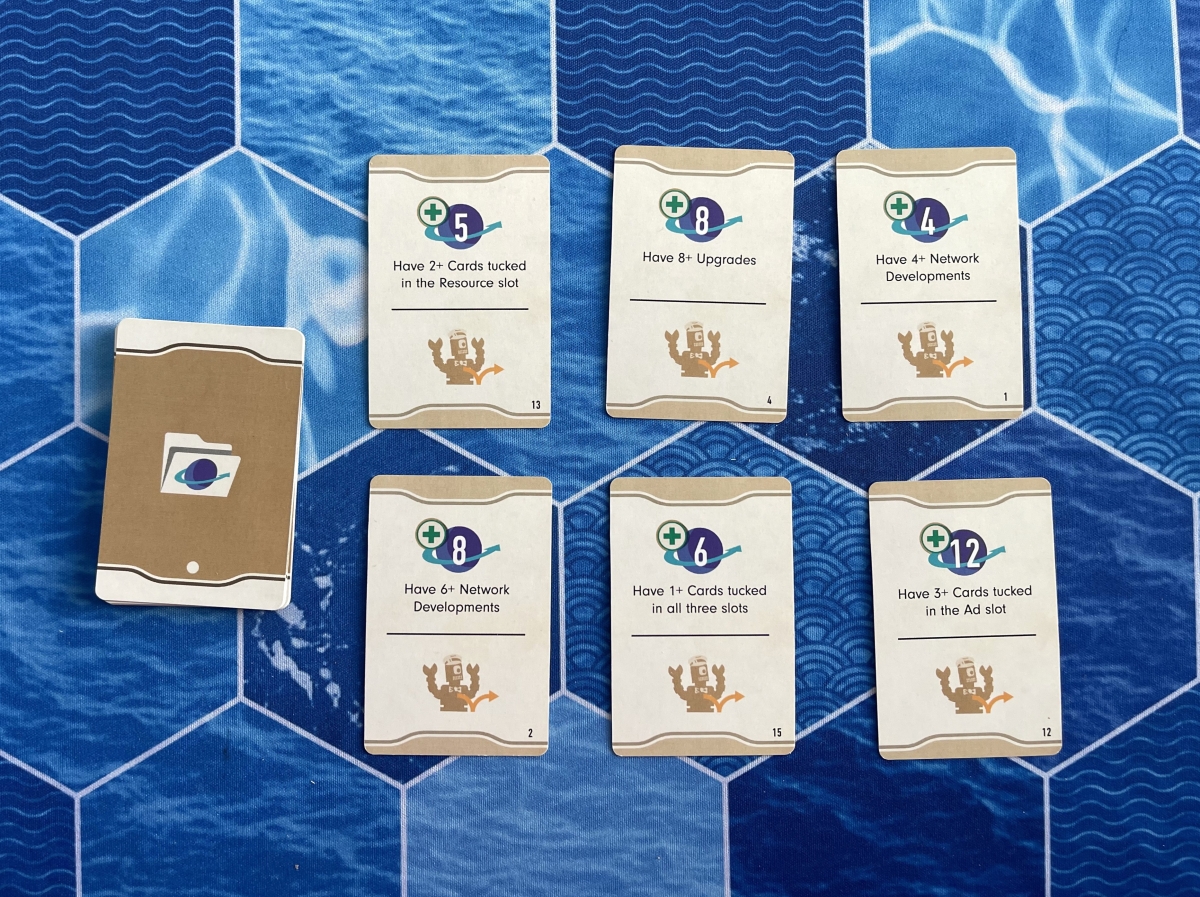
Separate the Secret Goal cards into two stacks based on their level, then shuffle each stack and deal one from each stack facedown to each player. Randomly choose a starting player.
Individual Player Setup
Place your Food and Fuel trackers on the “0” spaces of their tracks. Place 8 of your Developments into the gear-shaped spots on your Player Board, setting aside the 9th Development.
Place the 3 cubes on their spots, and the 2 Pilots into the Break Room. Place all Upgrade tiles on their designated spots.
Take 1 Ad and 6 Money from the supply. Draw 6 Cruise cards from the top of the deck, choosing 4 and discarding the other 2.
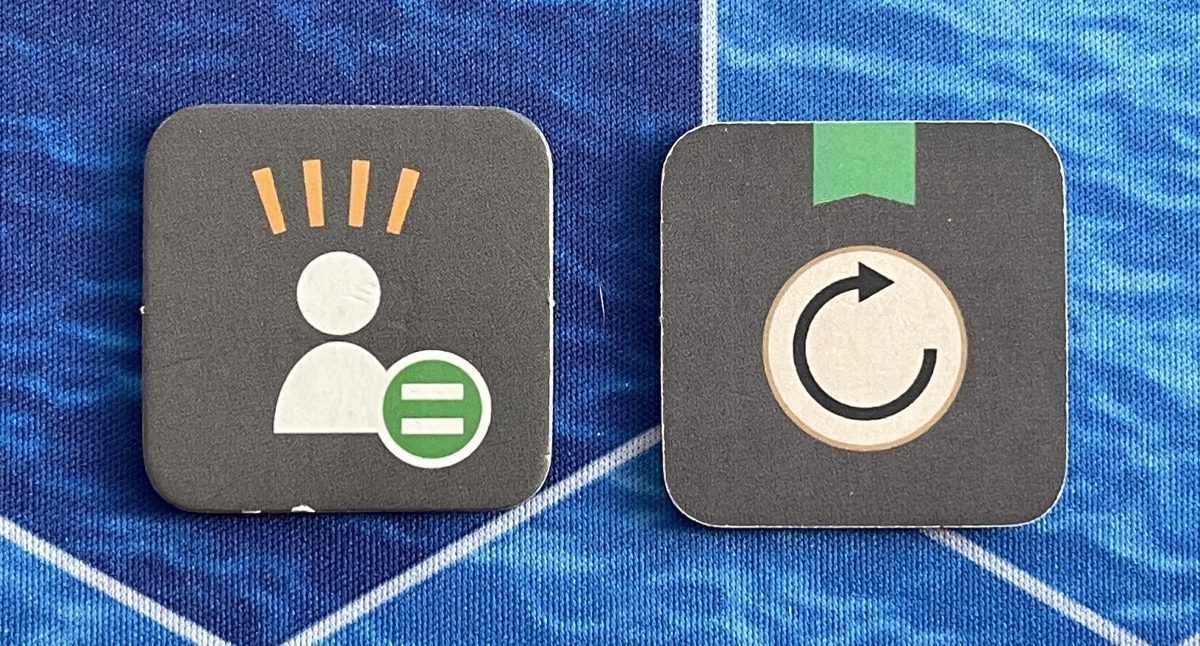
Stack your VP marker on the “0” space on the VP track, and place your Active Player token in your playing area. In a 5+ game, also place the Bonus token in your play area. The active player will have it on the active side, and all other players will have it on the inactive side.
Starting Draft
In reverse turn order, starting with the player to the right of the Active Player and going counter-clockwise, each player can either build their set-aside Development into the Network for free, or unlock a single Upgrade by paying its cost and removing the Upgrade tile. You may not build a Development in the same area that someone else has already built in, or unlock an Upgrade that someone else has already unlocked.
Once everyone has completed one of these actions, each player, in the same reverse order, will then choose the action not taken the first time, with the same limitations. At the end of the Draft, each player should have a unique Development built and Upgrade unlocked.
Finally, each player takes one Guest of their choice from the Guest bag and places it onto one of their ships, or into the Lounge if they had unlocked that Upgrade.
Gameplay
This is a simultaneous action game, where the Active Player will choose the action that everyone takes each turn. The Active Player takes the first turn, and then play proceeds clockwise. The turn structure is as follows:
- Advance Ships, if applicable.
- Active Player chooses action, and optionally gains bonus.
- All players take an action.
- Active Player gains bonus if hasn’t already.
- Accomplish Company Goal.
- Active Player rotates Space Station.
Advance Ships
If one of the three Pilot icons is showing on the Space Station, this will trigger an Advance Ships step. All players with an active Cruise will advance one stop, performing all steps at the stop. There are 3 types of stops: Days in Space, Excursions, and Return Home.
Days in Space
For each Guest on the ship that matches the ones on the card, you will gain 2 bonuses shown on the card. For each non-matching, you will gain 1 bonus shown on the card.
Excursions
Score the VP on the Excursion card if you have the matching Guests on your ship. You may spend 1 Ad to temporarily turn a non-matching Guest into one of your choice, and you may repeat this as many times as you wish. However, there is a limit of using each Guest once per Excursion.
Return Home
Score the VP printed on the Return Home side of the card. Then, take the following steps in order:
- Return Pilot to the Break Room and gain a Funding Bonus. This can be either Money, Ads, or Food/Fuel.
- Flip your Return Home card and gain the discard bonus on it.
- Tuck your Return Home card under the matching slot on your Player Board, with only the bonus icon visible. When you choose that funding bonus in the future, you will receive an extra resource for each card tucked.
- Discard all the remaining cards from the completed Cruise.
- Return all Guest from the completed Cruise to the Guest bag.

Guest Icon Bonuses
If, during the Advance Ships step, your Pilot crosses over a complete Guest Icon, you will gain additional bonuses as long as you have the matching Upgrade unlocked on your Player Board.
Active Player Chooses Action
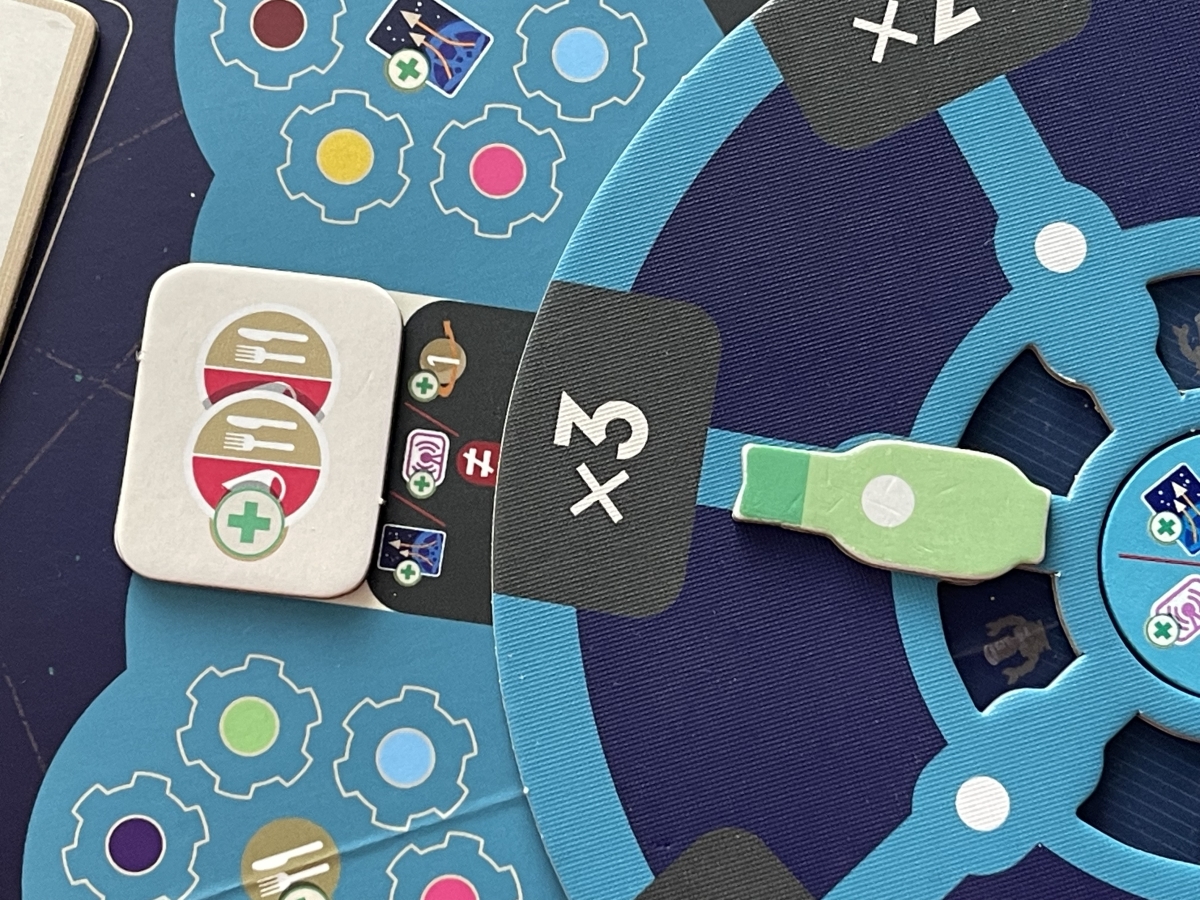
The Active Player chooses one of the 7 available actions and places their Active Player token next to it. They can also choose to gain their bonus at this point, which is shown under the action. The multiplier applies to the bonus, not the action.
All Players Take an Action
The Active Player takes the action that they have chosen. All other players take the same action, or an adjacent action if they have previously built a Development in the space between those actions. Alternately, you can always choose the central action, which allows you to take a single Resource, Ad, Money, or Cruise card from the deck.
The actions available are:
- Fund. Take 2 Money from the supply.
- Acquire. Take 2 resources of your choice (food and/or fuel), as long as they are not blocked on your board by unbuilt Developments.
- Develop. Take the leftmost Development from either row on your Player Board and place it onto the Main Board, paying the cost in either Money or the Resource associated with the row the Development was on. Take the indicated build bonus if one is shown at the spot you’ve built.
- Schedule. Take 2 Cruise cards from the top of the deck. The Active Player may take one or both of the cards from the 5-card display if they wish. They may also spend an Ad to discard and refill up to the entire display. After taking the cards, you may play as many cards from your hand as you wish, either for their resource or next to one of the Ships to form a Cruise. With the Excursion cards, you may choose to tuck a card under a previously placed Excursion card, showing the bottom section of the card only (maximum of 2 cards to the stack). Once you have placed a card, it is locked and cannot be rearranged.
- Upgrade. Pay the cost shown on one of your Upgrade tiles and remove it, revealing the upgraded version on the board.
- Advertise. Take 2 random Guests from the Guest Bag. The Active Player can choose their Guests instead. Guests must be immediately placed into either a ship or the Lounge, if unlocked. If you don’t have any room for Guests, you may not take this action.
- Central Action. Take one of either a Resource, Ad, Money, or Cruise card.
- Launch. In order to launch, you must have the following:
- 1+ Cruise card(s) scheduled, with at least 1 in hand.
- 1+ Guest(s) on a Ship.
- Access to the Resources to launch.
- Available Ship and Pilot.
Launch Steps
- Schedule a Return Home. Take a Cruise card and place it facedown to the right of all of the cards on the selected Cruise.
- Pay Food. Pay 1 Food per Guest on the Ship being launched. Food can come from your Food Storage, discarding Cruise cards with Food on them, and/or by Exchanging Supplies.
- Pay Fuel. Pay 1 Fuel per Stop on the Cruise, including the Return Home card. Two cards stacked count as a single stop. As with Food, Fuel can be paid for from storage, discarding Cruise cards with Fuel on them, and/or by Exchanging Supplies.
- Liftoff. Place your Pilot in the Cockpit of the Ship, scoring VP shown. If launching your small Ship, immediately advance to the first Stop, performing all steps at that Stop.
Free Actions
You can take any number of Free Actions at any time during your turn, and can take the same Free Action multiple times. These are:
- Gain Supplies. Discard a Cruise card in your hand to gain the bonus shown at the top of the card.
- Exchange Supplies. Discard any 4 supplies to gain 1 supply of your choice. This can be upgraded to 3:1.
- Board Guests. Move a Guest from your Lounge to one of your Ships.
- Ad Campaign. Spend an Ad to draw a random Guest from the Guest Bag. The Guest must be immediately placed in a Ship or the Lounge.
- Targeted Ad. Spend 1 Ad to convince a non-matching Guest to go on an Excursion.
- Refresh Display. The Active Player can spend an Ad to discard any number of the cards from the Cruise card display, refilling to 5.
- Bonus Advance. Discard one of your Secret Goal cards to advance all of your Ships on a Cruise. This card can no longer be scored at the end of the game.
Active Player Gains Bonus
If they hadn’t already done so, the Active Player gains the bonus attached to the action they selected, or an adjacent bonus if they have a Development that connects them to it. The bonus is multiplied by the modifier shown under it.
In a 5+ player game, if you are not the active player but have your Bonus token on the active side, you can switch it to the inactive side and gain the same bonus as the Active Player. Whenever you become the Active Player again, you’ll flip the token back over to its active side.
Accomplish Company Goal
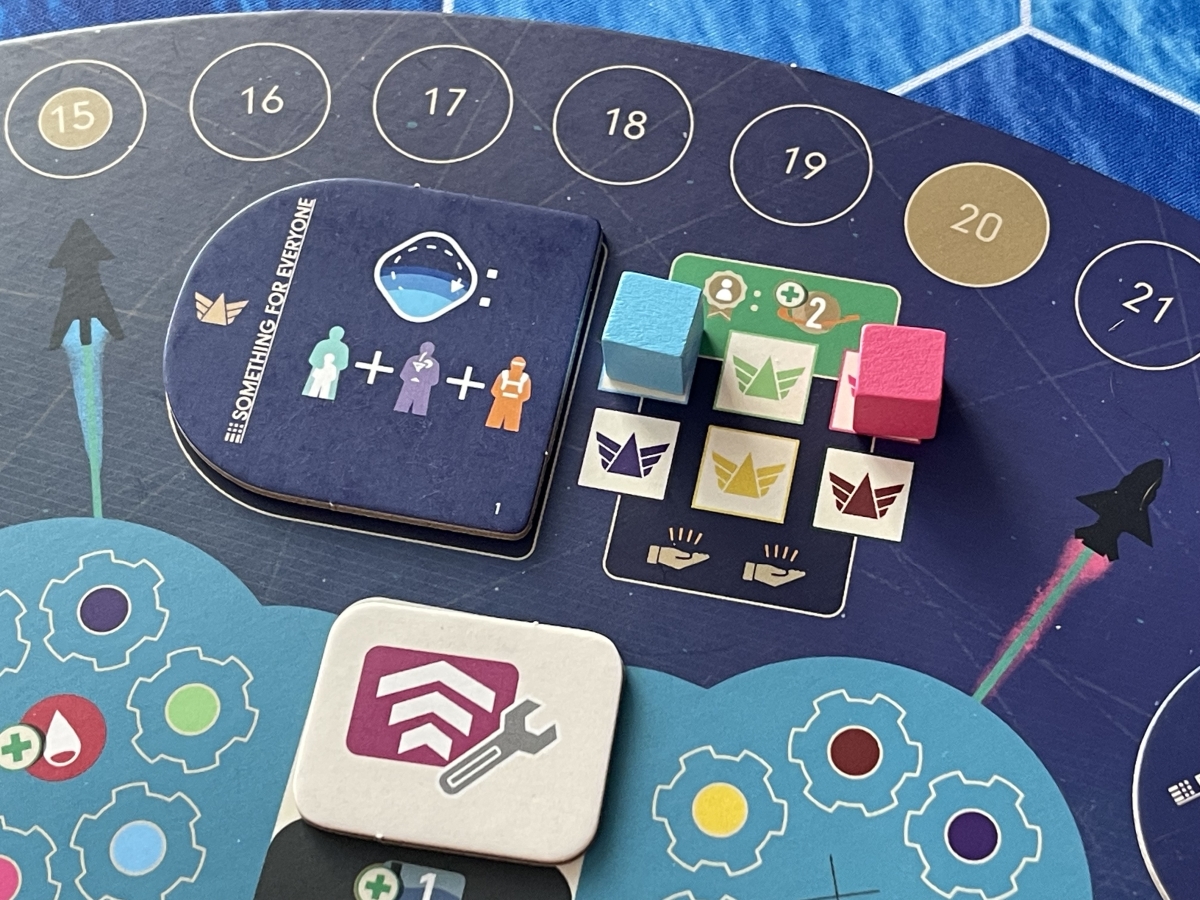
Any player that has met the requirements of a Company Goal may now place their cube next to it and gain 2 Funding Bonuses. The first player to accomplish each goal gains 2 VP. If multiple people accomplish the goal on the same turn, they all receive 2 VP.
Rotate Space Station
The Active Player rotates the Space Station one step clockwise, and takes their Active Player token back. The next person in clockwise order becomes the new Active Player.
This step is skipped on the final turn of the game.
Game End
The game end is triggered when one or more players reaches or crosses over the 50 VP mark. You will finish that turn as usual, including the Active Player rotating the Space Station.
Then there is one final turn where all players act as the Active Player, choosing whichever action they want, and also gaining their Active Player bonus. However, no one can draw cards from the Display or choose the Guests they draw from the bag should they choose the Advertise or Schedule actions.
Final Scoring
Advance all Ships you have on Cruises one final time, but each to any one remaining Stop on the Cruise. Complete the steps of that Stop as usual. For the purposes of bonuses, you are only considered to have crossed over the Guest Icon immediately to the left of the Stop you triggered.
Add up all remaining Food, Fuel, Ads, Cruise card (in hand in on an unlaunched Cruise), Money, and Guests (in Lounge and on any unlaunched Ships). Divide the total by 5 and score that many VP.
Score VP as shown for the number of Upgrades unlocked. Score VP as shown for the rightmost empty column in the Development area on your Player Board.
Score VP as shown for the number of Company Goals you accomplished. Score VP for the Secret Goal cards if you accomplished them.
The player with the most VP wins! Ties are broken by highest combined Launches and accomplished Company Goals.
Why You Should Play Excursions: A Galactic Cruise Game
At first glance Excursions bears a strong resemblance to its older brother Galactic Cruise. To keep that sibling metaphor going, while both games share some DNA in common, both games stand on their own as individuals.
If you’ve played Galactic Cruise, then you’ll find that Excursions: A Galactic Cruise Game has some of the same game concepts, but the gameplay itself is mostly different. I say mostly, because you will still be taking some very familiar actions such as building Developments, and going on Cruises. But it’s in the game mechanics themselves that you’ll notice the difference.
Galactic Cruise is a heavyweight Euro-style worker placement game. Excursions: a Galactic Cruise Game is a mid-weight, action selection game with simultaneous play. The use of the rondel brings a bit of randomness into play, as does the Active Player choosing the action everyone can take for the turn. Building Developments can help to mitigate both of those, but there will still be situations where you’re not going to be able to take an action that you want on your turn.
The good news is, with simultaneous play, you won’t have to wait long for the next turn. Excursions is a game where you’re constantly engaged as a player, because you’re always taking actions. And even better, the simultaneous play also helps cut down on game time. You’re looking at a game of Excursions taking roughly half the amount of time as one of Galactic Cruise. And that’s even with the full 6 player count.
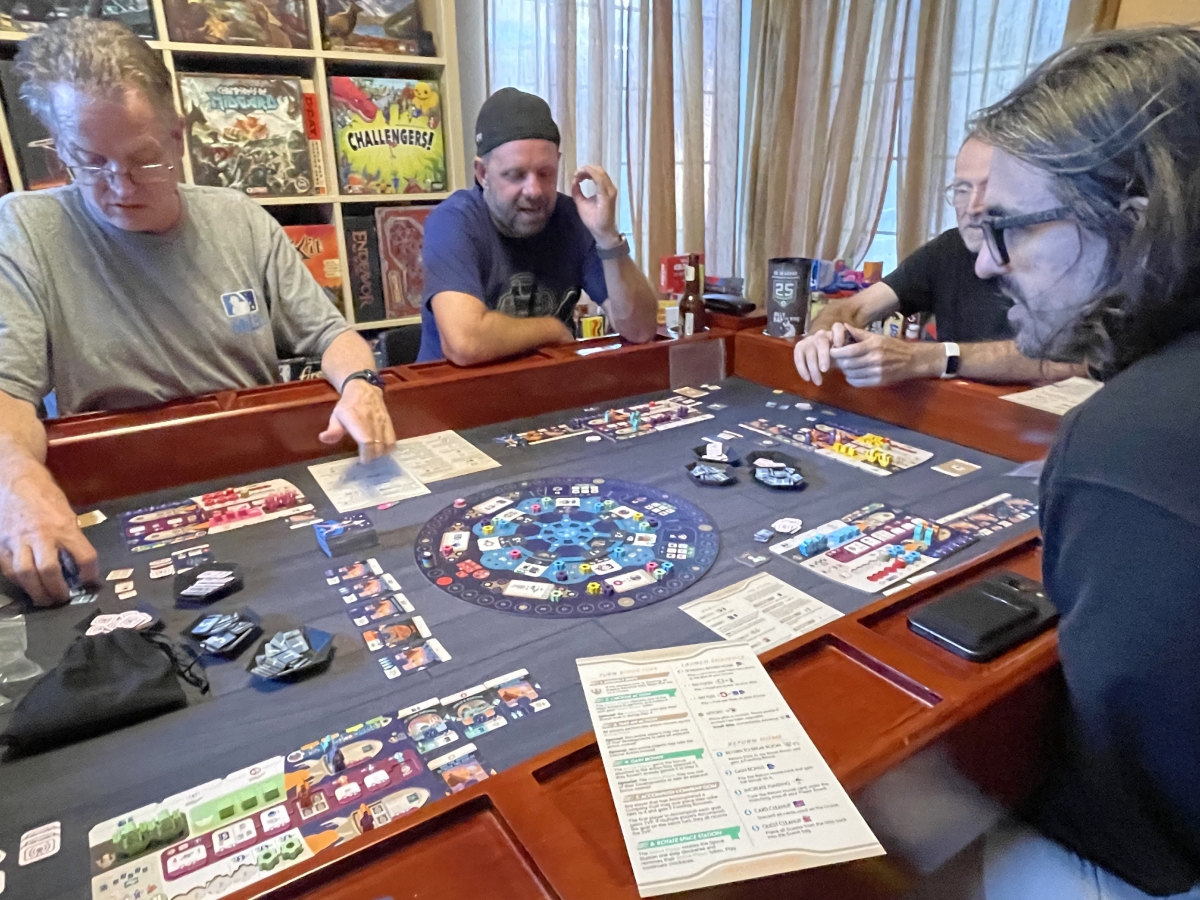
Not only does Excursions take less time to play, it also has a much smaller footprint on the table. I could easily play a 3-4 player game of Excursions around my square kitchen table. Galactic Cruise, on the other hand, is a notorious table hog. I say that in the best way; there’s a lot going on in that game.
Excursions: a Galactic Cruise Game is also surprisingly affordable. If you want the Standard Edition of the game, you’re looking at pledging only $39. And you’re still looking at a high quality of components for that price.
For people that have played Galactic Cruise, you’re getting a game that will feel familiar, yet scratch a different itch. In both games, you’re performing similar actions, and accomplishing similar goals. But it’s how you perform those actions and goals that’s different. Galactic Cruise is a game of careful deliberation, while Excursions feels like a race to the 50 VP finish line. Don’t be fooled, though- there’s still plenty to think about and strategize. But with Excursions, you’re often thinking about how best to take advantage of someone else’s choice of action during their turn.
I’ve enjoyed my all too short time with Excursions: a Galactic Cruise Game. It doesn’t replace Galactic Cruise for me, nor should it. Excursions allows me to be in familiar territory, but with a game that’s less expensive, easier to learn, and faster to play. There’s a lot more table talk and interaction at the game table with Excursions, which to me is always a good thing. Galactic Cruise’s little brother carves its own path, bringing some new tricks to series. I’m definitely looking forward to playing Excursions: A Galactic Cruise Game when the final product delivers.
For more information or to make a pledge, visit the Excursions: A Galactic Cruise Game Kickstarter page!
Click here to see all our tabletop game reviews.
 To subscribe to GeekDad’s tabletop gaming coverage, please copy this link and add it to your RSS reader.
Disclosure: GeekDad received a copy of this game for review purposes.

Paul Benson

Paul is a comic book writer, screenwriter, an avid board and tabletop gamer, reader of comics and collector of statues and figures. He is the creator of the webcomic "Heroines for Hire" and co-writer of "Disaster!: The Movie." He currently writes "E.I.: Earth Invasion" for Wunderman Comics.