
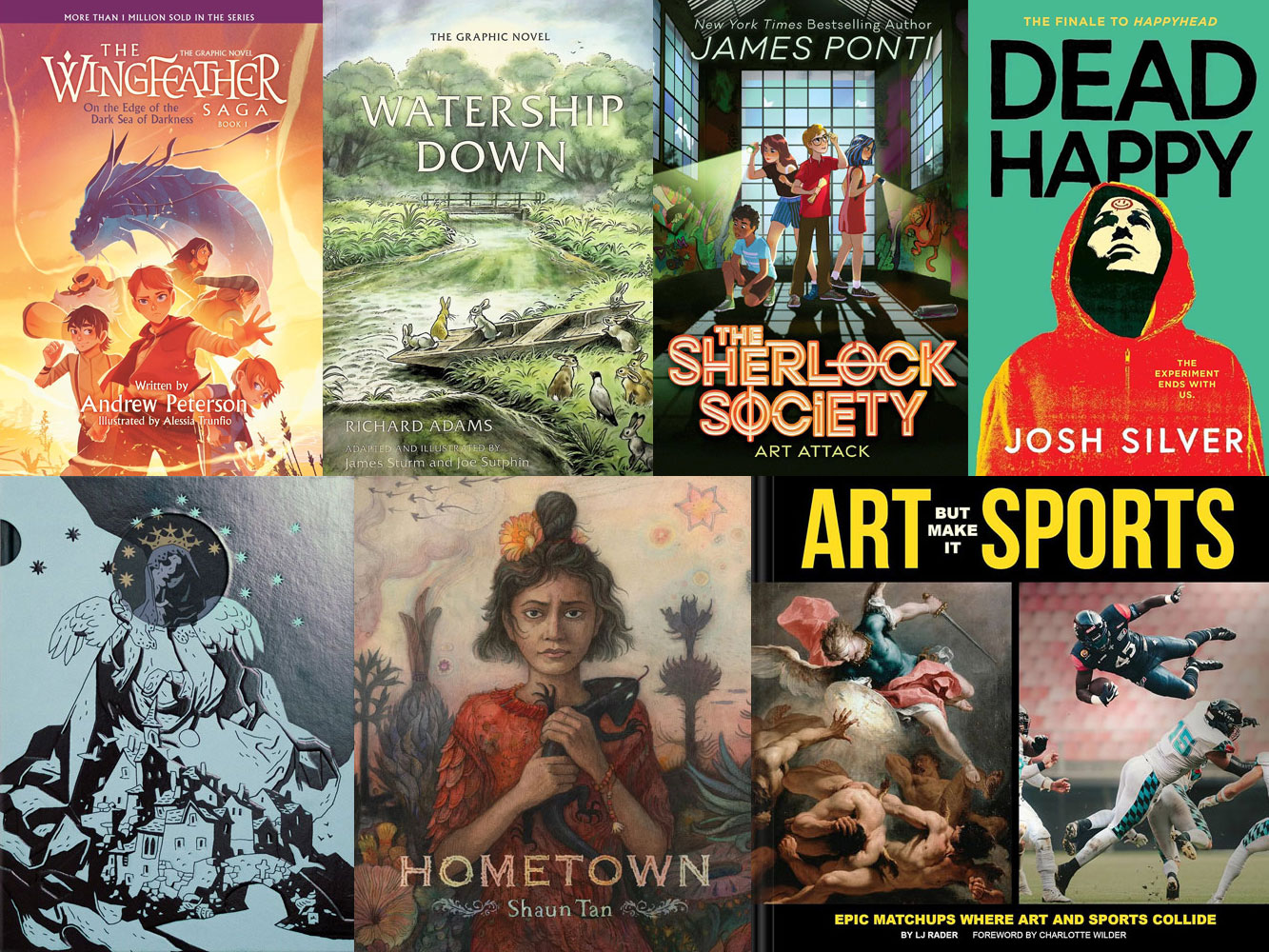
No, this week’s stack isn’t actually about weddings, but it does include something old, something new, and one of them also happens to be blue. (But none of them were borrowed, so that’s where everything falls apart, I suppose.) It’s a bit of a grab-bag of my latest reads.
Disclosure: I received review copies or galleys of the books covered in today’s column. Affiliate links to Bookshop.org help support my writing and independent booksellers!

The Wingfeather Saga: The Graphic Novel Book 1 written by Andrew Peterson, adapted by Matt Mikalatos, illustrated by Alessia Trunfio
Let’s start with something new: The Wingfeather Saga is a middle-grade fantasy series that has also been turned into an ongoing animated series, and has now become a graphic novel series, with the first book releasing this week. The three Igiby siblings—Janner, Tink, and Leeli—have grown up in a world that is ruled by the reptilian Fangs of Dang. They don’t remember their father, who passed away when they were very young, and have been raised by their mom and grandfather. But as the book opens, there are some secrets coming to light: Janner discovers an old portrait of his father. Tink finds a map that refers to the “Jewels of Anniera,” a land that the Fangs insist never existed. And Leeli finds herself singing a song that she can’t remember learning, one that has a strange connection to the big dragons that live in the sea.
I was not actually familiar with The Wingfeather Saga so I don’t know how the comic compares to the other formats, but there does seem to be a good bit of tongue-in-cheek fantasy humor in it. For instance, the subtitle of this first volume is “On the Edge of the Dark Sea of Darkness,” and the leader of the Fangs is “Gnag the Nameless One.” Among the dangerous beasts that live in the forest are the toothy cows—literally fanged cows. The comic book is narrated by Armulyn, the town’s bard, who appears briefly within the story but is often depicted outside of the panels, recounting to us the story of the Igibys.
This first volume is mostly setting the stage, introducing us to the various characters and filling in a bit of backstory. Gnag has been searching for the Jewels of Anniera himself, believing that they could restore the people to power so he must find them first. Meanwhile, the kids finally find out some of the old family secrets that their mom and grandfather have been hiding from them all these years. (Why is it that parents are always hiding secrets from their kids to protect them, but then it turns out that keeping things secret is what gets them into trouble anyway?)
Unfortunately the advance galley I received was in black and white, so I didn’t get the full effect of the illustrations. It’s aimed at middle grade readers, so my teen wasn’t quite as invested in this one, though I imagine that fans of the original novels would be excited to see it in this new incarnation.
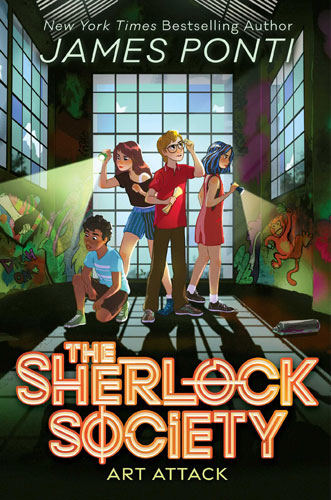
The Sherlock Society: Art Attack by James Ponti
Here’s another new one, also coming out this week: this is the third volume in the Sherlock Society series (follow these links for book 1 and book 2). The four kids (plus Grandpa) gained some local fame after solving the “Hurricane Heist” of the second book, and now they’ve been approached for a real, paying job. A real estate developer wants to contract a local street artist, Funky Munky, to paint a mural on the side of their new, eco-friendly high-rise. The problem: nobody knows the real identity of Funky Munky, who has been tagging buildings in Miami (often with anti-corporate messages). So the Sherlock Society has been recruited to find Funky Munky to pitch the job, while keeping their identity under wraps, all in time for the upcoming Miami Art Week.
But as the kids start to investigate, several more Funky Munky pieces appear around town, often linked to burning buildings. Is Funky Munky the arson? If not, who’s trying to frame them? The Sherlock Society has to make some tough decisions about how to proceed without helping the wrong person … even harder when they don’t know who they can actually trust.
I always really enjoy James Ponti’s kid detective books (another favorite is his City Spies series), and he does a good job of leaving clues for the reader and building up a good mystery, while also introducing us to a topic that may be unfamiliar. In this case, we get a window into the world of graffiti artists, as well as conversations about the revitalization and gentrification of neighborhoods.
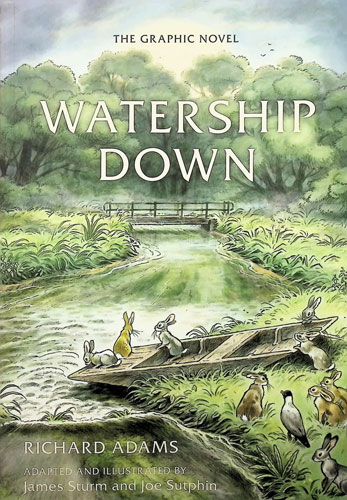
Watership Down: The Graphic Novel written by Richard Adams, adapted and illustrated by James Sturm and Joe Sutphin
Watership Down is one of my favorite books. Somehow I never read it in school the way many of my peers did, and I didn’t grow up traumatized by the 1978 animated version. It’s one of those books that I’d heard the name of, but really had no idea what it was about until I picked it up in college. I’ve since read it multiple times, watched the old animated film and the 2018 animated series. I even tried my hand at making a board game based on Watership Down with a friend of mine who was equally enchanted by the story, though that hasn’t panned out yet.
This graphic novel, published a few years back, is an impressive adaptation. There is, as the artists explain, some abridging required to turn a 500-page novel into a comic; for instance, in some instances several minor characters were combined into a single character, and in many cases narration is omitted and replaced by visuals. Even so, I loved the way that the graphic novel captures the heart of the story and brings many of the key scenes to life: Fiver’s visions of doom, the escape down the river, the terrifying warren of Efrafa.
What I didn’t know before (or had forgotten?) was that all of the locations of the story are real places: the authors had the chance to visit England and took reference photos of the woods, the churchyard, the railroad trestles. Knowing that the landscape we see in the illustrations is what Richard Adams was looking at when he wrote the story adds an extra bit of authenticity.
The style is not overly cartoony, but done in a way that you can distinguish the rabbits (at least the main cast). I also really liked the storybook illustration style used when Dandelion tells stories about El-ahrairah, the rabbit folk hero. They weren’t able to include all of the stories that are in the original book, but I like the way the images shift in tone during the storytelling. (I’d love to see a book of more of the rabbit folktales!) There’s also a shift whenever we see Fiver’s visions, sometimes shifting to a color palette that is mostly blues and reds.
The graphic novel is a large format that really showcases the artwork, and at about 380 pages it’s a hefty tome, but the story is so engaging that I sat down and finished it in almost one (long) sitting. It’s a fantastic way to experience a wonderful story, and it reminded me that maybe it’s time to read the original with my teen sometime soon.
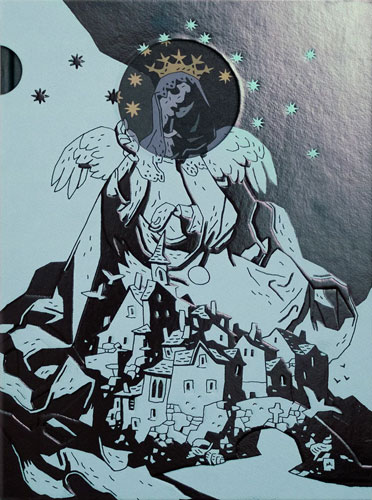
The Adventures of Pinocchio: An Illuminated Edition written by Carlo Collodi, illustrated by Mike Mignola, annotated by Lemony Snicket
Now for something old and blue: the classic tale of Pinocchio, but in a gorgeous, oversized edition (with a blue cover). This illuminated edition from Beehive Books is more of a coffee table book, a large hardcover with a an embossed slipcase. Throughout the book are illustrations by Mike Mignola (of Hellboy fame), though they usually aren’t of Pinocchio himself—instead we see little details from the story: fish, bells, dark townscapes. Most of them are in black and white, but there are a few full-color pages too. And they’re definitely not the Disneyfied versions: when Pinocchio finds Gepetto in the belly of the terrible shark (spoiler!), the full-page illustration is more Gollum than cheerful Grandpa. The book also includes a full-color print of Pinocchio, as well as an embossed bookmark featuring Pinocchio with the long nose. (Mariana Ruiz covered this a couple years ago when it was first released, but it’s just taken me a while to get to it myself!)
It occurred to me while reading this that I actually had never read Pinocchio, at least not a version that had been adapted and abridged, and what struck me the most is how bizarre it is. It still has a lot of the familiar elements: the nose that grows when he lies, the Land of Toys, the transformation into a donkey, the Blue Fairy. But the story is also full of abrupt surprises and strange commentary, and the plot feels less like something that was planned out in advance and more like a rambling stream-of-consciousness. There are parts that are quite violent or gruesome, and some characters die or vanish—and only some of them inexplicably reappear later. It reminds me a little of when I first read Peter Pan (maybe after college?) and realized that the version I grew up with had been sanitized, because the original text by J. M. Barrie is full of snark and he really doesn’t seem to like kids at all. Each chapter has a long descriptive title, usually spelling out exactly what is going to happen in it—though there is one in particular that only gives you a hint and challenges you to guess.
A lot of the strangeness is further enhanced by Lemony Snicket’s notes. In the introduction, he explains that anyone who has read Pinocchio has fallen into lunacy, and his own plan is to annotate this story that he has never read, “elegantly reproduced in the footnotes, if I have managed to stay sane, or, if madness has overtaken me, typed repeatedly on old stationery and stuffed haphazardly between the pages.” Well, you probably won’t be surprised to hear that there’s exactly 1 footnote printed in the book, and the rest of Snicket’s notes are indeed typewritten on Beehive stationery and stuffed between the pages, with “handwritten” numbers scattered throughout the text. When characters are endangered or particularly nonsensical events occur, Snicket faints and there’s a gap in the notes for a while, and the stationery (and sometimes the pages of the book) get more and more random ink stains and blots. Mind you, much of the strangeness is in Collodi’s original story, but Snicket does a great job of pointing out the absurdities.
I thoroughly enjoyed reading this one, though the size of the book meant I generally had to read it spread out on the floor—it’s not one for holding in your lap!
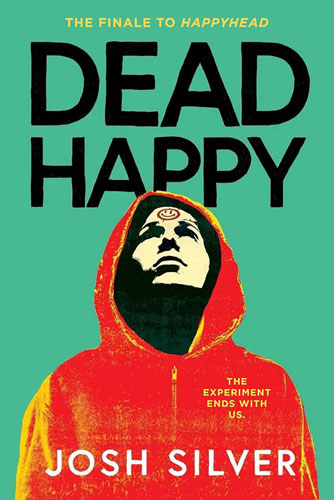
Dead Happy by Josh Silver
Last year I wrote about Happy Head, the first book of this young adult duology about a dystopian mental health center. Sebastian finds himself participating in various activities that pit the other patients against each other, and the exercises get increasingly disturbing. In the first book, he eventually uncovers some documentation of the plan that explains what Doctor Manning has in mind, and it’s disturbing enough that he plans an escape—but that is thwarted in the first book.
In Dead Happy, Sebastian—who somehow manages to keep his true feelings hidden—has been selected as one of the Ten: ten patients who have managed to rise to the top of Manning’s scoring system, paired off in couples. They’ve been taken to an island for the next phase, where they will supposedly find happiness through more tests and rituals, this time led by a mysterious young couple named Ares and Artemis. Even as Sebastian tries to keep up appearances with his assigned partner, the ultracompetitive Eleanor, he’s trying to figure out what happened to Finn.
This volume of the book really leans into the Hunger Games-ish dystopia; it feels like we’ve definitely left any sort of pretense that a real mental health expert would be able to set up something so elaborate, so twisted, and also secret from any sort of oversight. The Ten are subjected to physically and mentally grueling tests, all in the service of “happiness,” but we also discover what happens to the “Bottom Percentile” from the center, which includes Finn.
There were a couple of good twists that I didn’t see coming, but for the most part it just seemed like psychological torture that wasn’t particularly pleasant to read. Maybe my taste for YA dystopia has waned a bit in the past decade or so—I used to read a lot more of it. I have to admit that I didn’t really enjoy this one, in part because of how over-the-top it seemed, but also because I had a hard time believing that Sebastian was so good at fooling everyone, when his own narration seemed to describe him as constantly in fear of being found out.
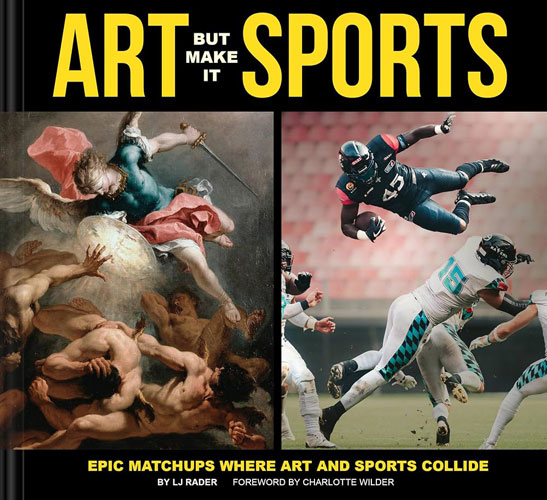
Art But Make It Sports by LJ Rader
You might be familiar with the social media accounts of ArtButMakeItSports—LJ Rader started off posting sports-related memes illustrated with artwork, but these days the majority of the feed consists of sports photos juxtaposed with artwork. Paintings and sculptures mirror the poses or colors of intense sports moments frozen in time by the camera. Raised hockey sticks are paired with a crowd of lances; an aerial view of a baseball player sliding into home perfectly matches an abstract painting with blocks of color.
The book is a chance for Rader to explain a little more about his process and show off some of his favorite pairings. He explains that in some cases it’s not specifically the pose but simply the vibes of a piece that match a photo, but in many instances there are multiple connections that go beyond just the visual. I’m not even much of a sports fan myself, but I enjoyed every page of this book.
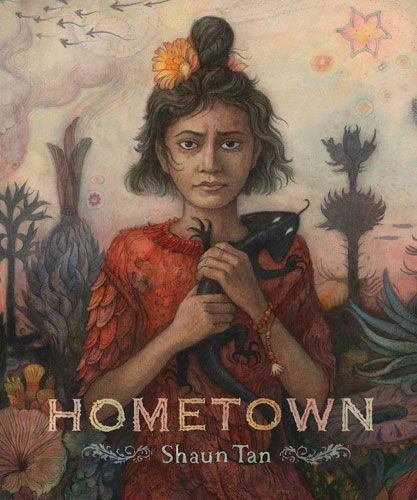
Hometown by Shaun Tan
Back in 2009, Shaun Tan published The Arrival, a wordless graphic novel that envisioned immigration by depicting a man traveling to a world in which everything was literally alien. Signs are in indecipherable glyphs; everything is unfamiliar, from the shape of buildings to modes of transportation to the animals that roam the streets or float in the skies. He encounters other people who tell their own stories of why they came, with flashbacks to their own homes, just as strange. By making everything as alien to us as the character, Tan allows us to feel the disorientation, the struggle to make sense of a new home.
Hometown is so new that it’s coming out next week. It isn’t exactly a sequel to The Arrival, but I’d consider it a companion book. Like The Arrival, it’s a picture book format, but more of a graphic novel length (and also has many pages with multiple panels, like a comic book). A girl introduces us to her life: her family and friends, her daily tasks—but everything is strange, almost monstrous. She’s the only human: her mother is a large oval-headed being and her father looks like an abstract stone sculpture with vine-like tentacles. One of her sisters is so enormous that you can only see a single clawed foot. It’s reminiscent of the new world in The Arrival, but with no other humans in sight.
Then, one day, the sky opens up and a traveler falls from the sky—somebody who looks a bit more like her. But she can’t communicate with the traveler, and can’t seem to explain anything. He’s helpless and gets in trouble, so she finally pities him and takes him home, where he reacts to the family’s hospitality with fear and hesitation. Eventually, though, he manages to communicate and explains that the girl doesn’t belong here—she belongs on another world, far away, where millions of other people like her live.
It’s a strange story, gorgeously illustrated, but it feels a little more open to interpretation than The Arrival. That one was more clearly an allegory for immigration. Hometown is maybe about belonging and understanding who you are, even if the place you belong seems strange to other people. Maybe it’s about the way that there’s more than one way that we can be alike or different. Maybe it’s about figuring things out for ourselves instead of being told where we belong. It’s beautiful and haunting, and one that bears reading multiple times to soak in all the details and ponder the story.
My Current Stack
I’ve got a couple of books in progress at the moment. The Art Thieves by Andrea L. Rogers is one that I’m reading to add to my time travel stack. It’s written from an Indigenous perspective and features a mostly Indigenous cast, and it’s set in the near future and touches on climate change, but so far nobody has brought up time travel yet, so we’ll see where that comes in. I’m also reading The Score: How to Stop Playing Somebody Else’s Game by C. Thi Nguyen, a nonfiction book on the philosophy of games that hooked me in the first chapter. It talks about the way that metrics and scores are often based only on what’s easy to measure, not what’s actually important, and what that does about the way we approach them. And, as always, I’m working through my overflowing stacks of comics—I always think to myself that I can read them really quickly, but then I overcommit.
Jonathan H. Liu

Jonathan H. Liu is a stay-at-home dad in Portland, Oregon, who loves to read, is always up for a board game, and has a bit of a Kickstarter habit. I can be reached at jonathan at geekdad dot com.


