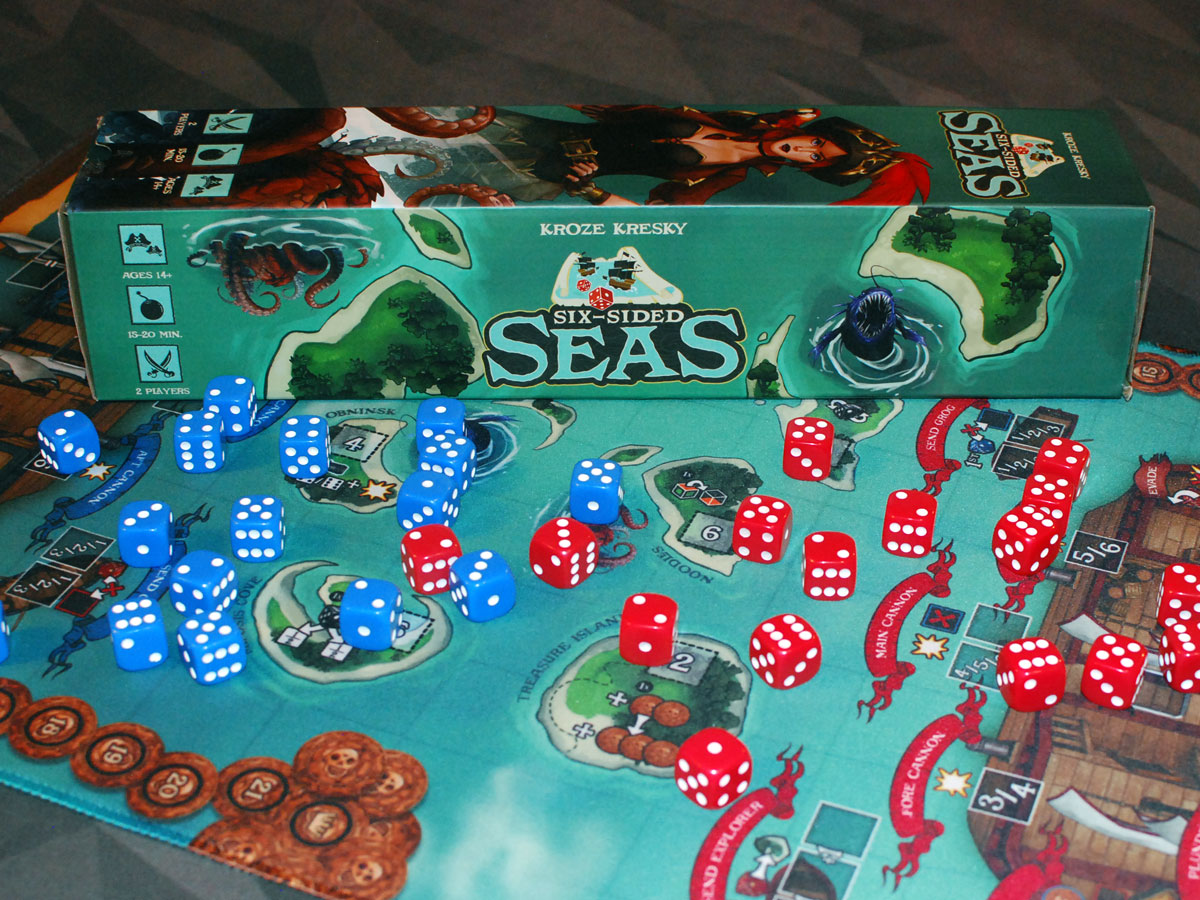
Plunder the loot, blast your opponent with cannons, and find the hidden treasures!
What Is Six-Sided Seas?
Six-Sided Seas is a pirate dice game for 2 players, ages 14 and up, and takes about 20 minutes to play. The game retails for $24.95 and is available in stores or directly from the publisher. Although the box says ages 14 and up, I think you could play this with younger players as well—mostly they just need to be able to add dice together. Also, if you get two copies of the game, you can expand it to 3 or 4 players.
Six-Sided Seas was designed by Kroze Kresky and published by Solis Game Studio, with illustrations by Megan Stojanova.
Six-Sided Seas Components
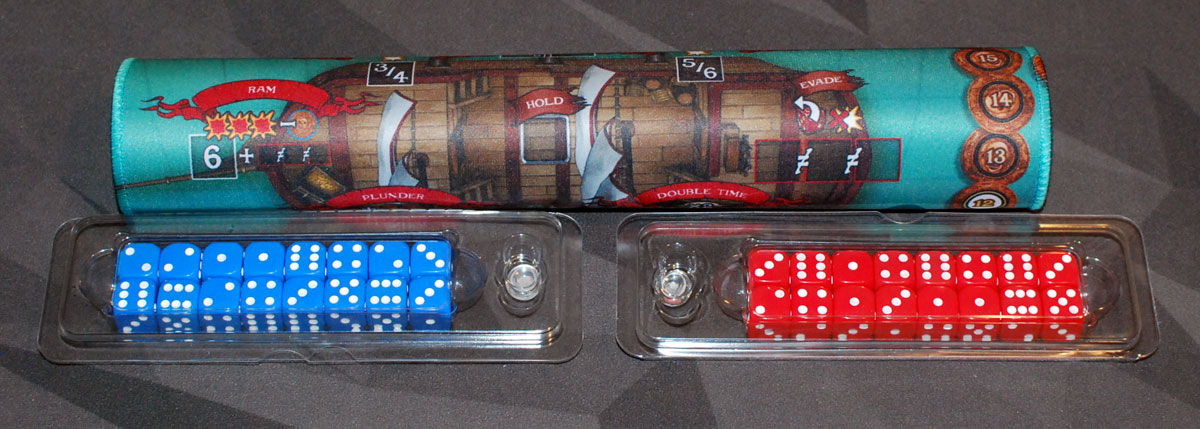
Here’s what comes in the box:
- Neoprene Game mat
- 32 Six-sided dice (16 red, 16 blue)
- 2 Glass beads
That’s basically it! The whole thing comes in a long cardboard box, and the dice and glass beads have simple plastic cases for storage.
The dice themselves are standard-sized dice, pretty straightforward and nothing fancy. The glass beads are used to track your coins on the mat.
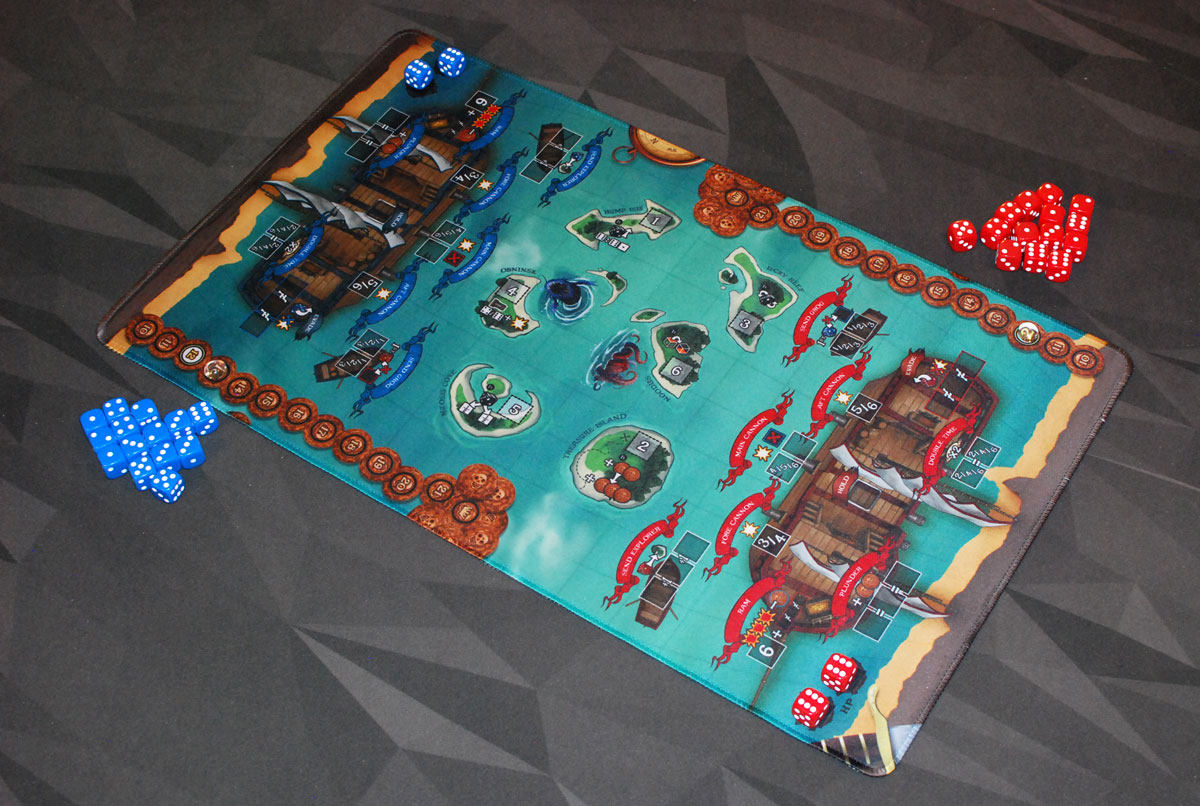
The mat itself is 14″ x 24″: a nice size that doesn’t take up too much table space but doesn’t feel cramped as you’re placing dice on it. Each end of the mat has one of the ships with its various actions, and then there are six islands in the center region that you can explore. (The one odd thing to me is that the islands aren’t arranged in numerical order—they just jump around seemingly randomly.) The iconography on the actions is mostly pretty easy to read, though there are a few that you’ll definitely need to refer to the rulebook the first time you play.
How to Play Six-Sided Seas
You can download a copy of the rulebook here. I’ll just explain the 2-player rules here, but with two copies of the game you can increase the player count.
The Goal
There are three ways to win: reduce your opponent to 0 Hull Points (HP), reach the top of the coin track, or control 4 or more islands at the start of your turn.
Setup
Give each player a set of dice and a glass bead, and set up the playmat so each player is sitting on the end matching their player color. Each player places two dice set to 6s on the two HP spaces. Roll dice to see who goes first: the first player starts with 12 coins, and the second player starts with 13 coins.
Gameplay
Each turn has a roll phase and and order phase.

Roll Phase: roll dice one at a time until you decide to stop or go overboard. If the total value of your dice is more than your coin level, you go overboard, and you may only place dice into your Evade spaces and then your turn ends. (All three dice in the Evade section must have different values.)
If you roll exactly your coin limit, you’ve hit the jackpot! Either increase your coin limit by 1, or roll an additional die and add it to your pool—it doesn’t count against your limit this turn.
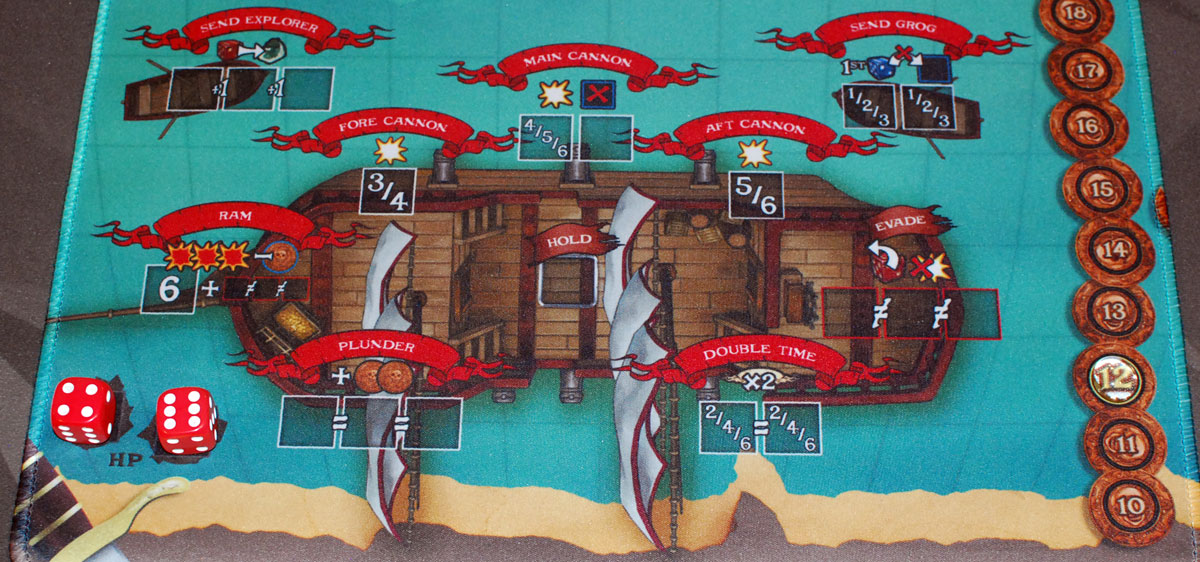
Order Phase: place your dice onto spaces in your ship to take actions. As soon as you have taken an action, the dice are removed and returned to your supply, so you can use the action again. Some actions have multiple spaces—dice remain in those spaces until you fill the action and clear the dice.
There are two smaller cannons that do one damage each, reducing the opponent’s HP. If they have any dice in their Evade section, they must discard one to negate a point of damage. The main cannon also does 1 HP damage—if the enemy does not Evade this, then you place one of your dice on any space on their ship, blocking it for their next turn. (At the end of their turn, remove your die.)

You can Send Grog to get your opponent’s crew drunk: on their next turn, the first die they roll still counts against their coin limit, but cannot be placed anywhere.
The Hold is where you can store one die for future use.
Plunder requires three dice of the same value and increases your coin limit by 2.
Ram is a special attack that requires a 6 and all three Evade dice—it does 3 points of damage that cannot be evaded, and also reduces their coin limit by 1.
Double Time lets you double the effect of your next action (cannot be used on Hold, Evade, or Send Grog).
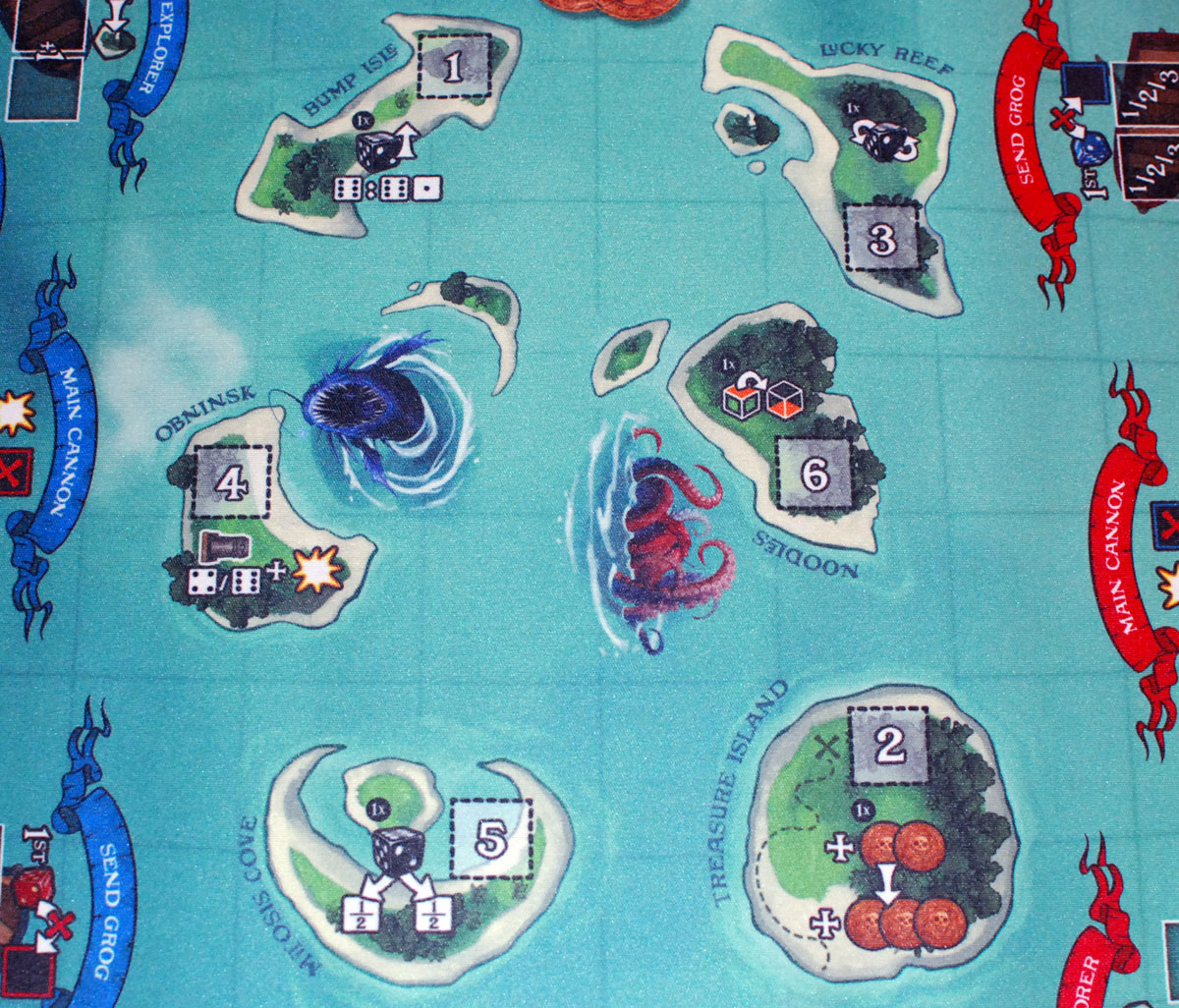
If you have a sequence of three dice, you can use the Send Explorer action to place one of those three dice on its matching island (bumping the opponent if they’re present). Each of the islands gives you an ongoing ability:
- Bump Isle: once per turn, increase one of your dice by 1 (6 wraps to 1)
- Treasure Island: once per turn, when you plunder, gain 3 coin limit instead of 2
- Lucky Reef: once per turn, reroll a die (may be done during the Roll Phase to avoid going overboard)
- Obninsk: whenever you do damage with a 4 or 6, you do one extra point of damage
- Mitosis Cove: once per turn, split a die into two dice as evenly as possible
- Noodles: once per turn, flip a die to its opposite side (may be used during the Roll Phase)
Game End
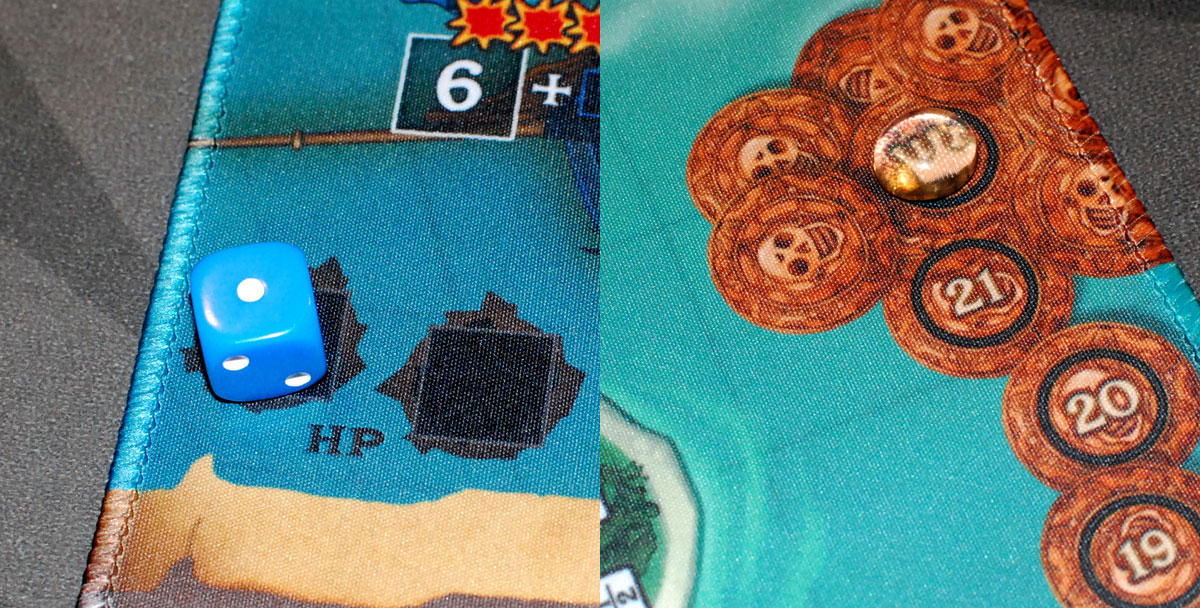
If you get to the top of the coin track, reduce your opponent to 0 HP, or have control of 4 islands at the start of your turn, you win!
Why You Should Play Six-Sided Seas
Six-Sided Seas is a quick-playing game that feels like it would be right at home at a pub: it’s easy to learn and quick to play, and the components are durable and wouldn’t get totally ruined if somebody spilled a drink on them. In fact, as Chris Solis (the publisher) shares, he was inspired by seeing laminated game boards at a shop in Thailand, and issued a design challenge for a game that was primarily a playmat. Kroze Kresky’s design, with its mashup of blackjack and dice and worker placement, was the winner of the challenge. (I noticed the box has a “Quick Playmat Games” logo on one side, so I imagine if Six-Sided Seas does well we may see more of this type of game in the future.)
The press-your-luck part of the game comes in the roll phase: how many dice can you roll without going overboard? At the start, your limit is pretty low and often you’ll approach it in just two or three dice. In this game, low numbers are valuable because you get more workers, though the higher values are the ones that do damage if you want to take the battle approach. Is it worth rolling one more die to try for a jackpot? That bonus die may be tempting, but increasing your coin value is a great long-term strategy, too.
As soon as a player manages to plunder and raise the coin limit, things really start to accelerate: more dice per turn to pursue the various victory conditions. Throw in the Treasure Island and you can plunder more quickly—I’ve seen somebody gain 5 coins in a single turn! There can be a little bit of the “rich get richer” phenomenon here, as the player who plunders first can start having runaway turns. But don’t forget the power of the main cannon! With just two dice, you can block an action for an entire turn, which means you could prevent somebody from plundering. Or, say you’ve explored your fourth island—you could use your main cannon to block their exploration, locking in your victory.
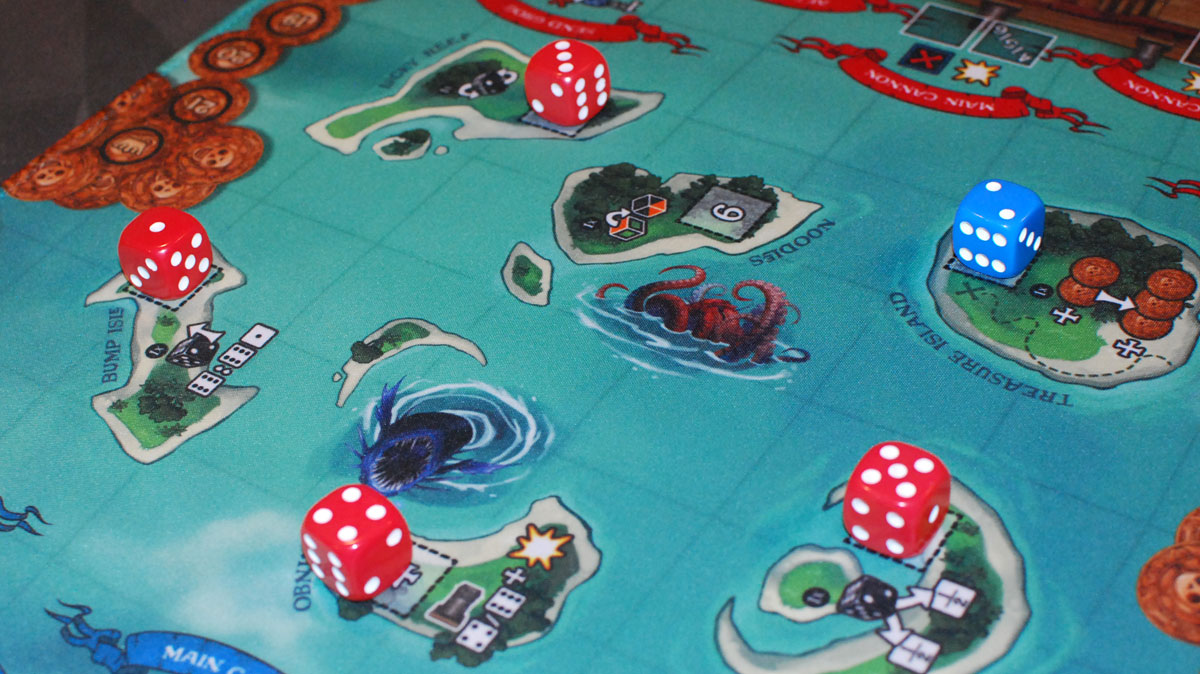
Even if you aren’t going for the island control victory, it’s still worth going after an island or two for the powers they give you. One of my favorites is Mitosis Cove, which lets you split a die in half. I’ve found it particularly useful for getting the values I need to plunder or send explorers. The other dice-manipulation abilities—bump, re-roll, and flip—are also very helpful for getting specific numbers, but can also save you from going overboard.
I personally haven’t seen as many games that end in the HP victory—we often take shots at each other, but most of the folks I play with seem to prefer the pursuit of treasure to the battle. However, going on the offensive can be a useful tactic if you’re unable to get the other numbers you want. In particular the Ram action that can’t be evaded is extremely effective: three damage and reduce their coin value! Throw in the Double Time and you can wipe out half of somebody’s entire HP in one shot.
The one thing I ran into (and I’ll note that I’ve only played 8 times myself so far) is that it feels like the 1-coin advantage for the second player is a bigger deal than I’d expect. It feels like just a minor handicap, a single coin for going second, but for the longest time it felt like the second player was always winning. Starting with 13 instead of 12 gave just enough buffer that the second player often felt comfortable enough to roll a third die, while the first player had to weigh the risks of going overboard. With fewer than 10 plays, I’m not going to claim it’s statistically unbalanced, but I did wonder whether there was a smaller bump that wouldn’t feel quite as powerful—maybe starting with an evade die in place, for instance. Or it may simply be the types of strategies that my gaming group has been using, or our levels of risk aversion.
At any rate, I’ve really enjoyed the game! It’s been a fun one to break out when I’ve just got two players, and the components make it an easy one to just take for on-the-go gaming, too.
For more information or to order a copy, visit the Solis Game Studio website!
Click here to see all our tabletop game reviews.
 To subscribe to GeekDad’s tabletop gaming coverage, please copy this link and add it to your RSS reader.
Disclosure: GeekDad received a copy of this game for review purposes.