
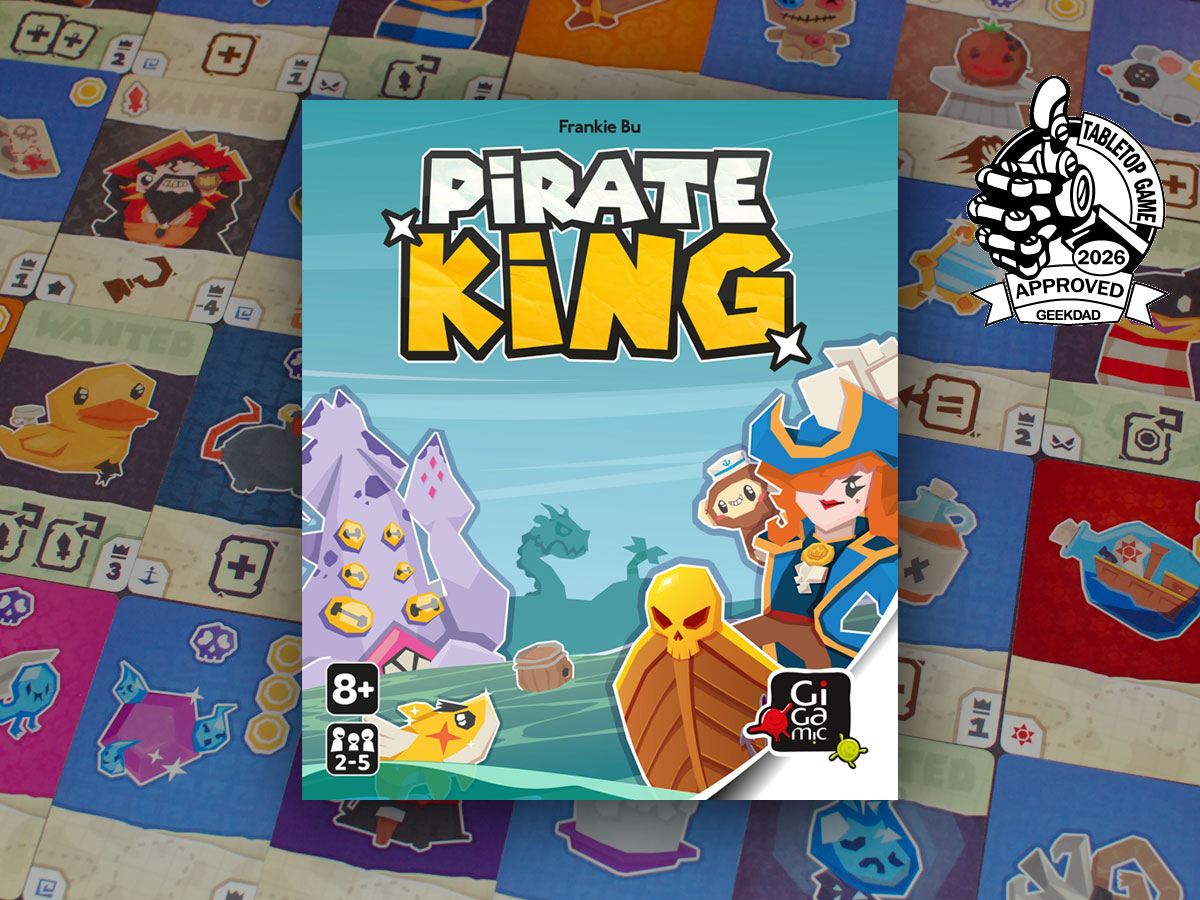
Compete with rival pirates to battle monsters and claim treasures, but beware of the curses!
What Is Pirate King?
Pirate King is a press-your-luck, deck-building game for 2 to 5 players, ages 8 and up, and takes about 20 minutes to play. It retails for $16.99 and is available in stores or directly from Hachette Games. The game includes light deck-building and doesn’t require reading, but will need somebody who can read to explain the various icons and abilities on the cards. Otherwise, you could play this with kids younger than 8.
Pirate King was designed and illustrated by Frankie Bu and published by Gigamic. It is distributed in the US by Hachette Games, who provided me with a review copy.
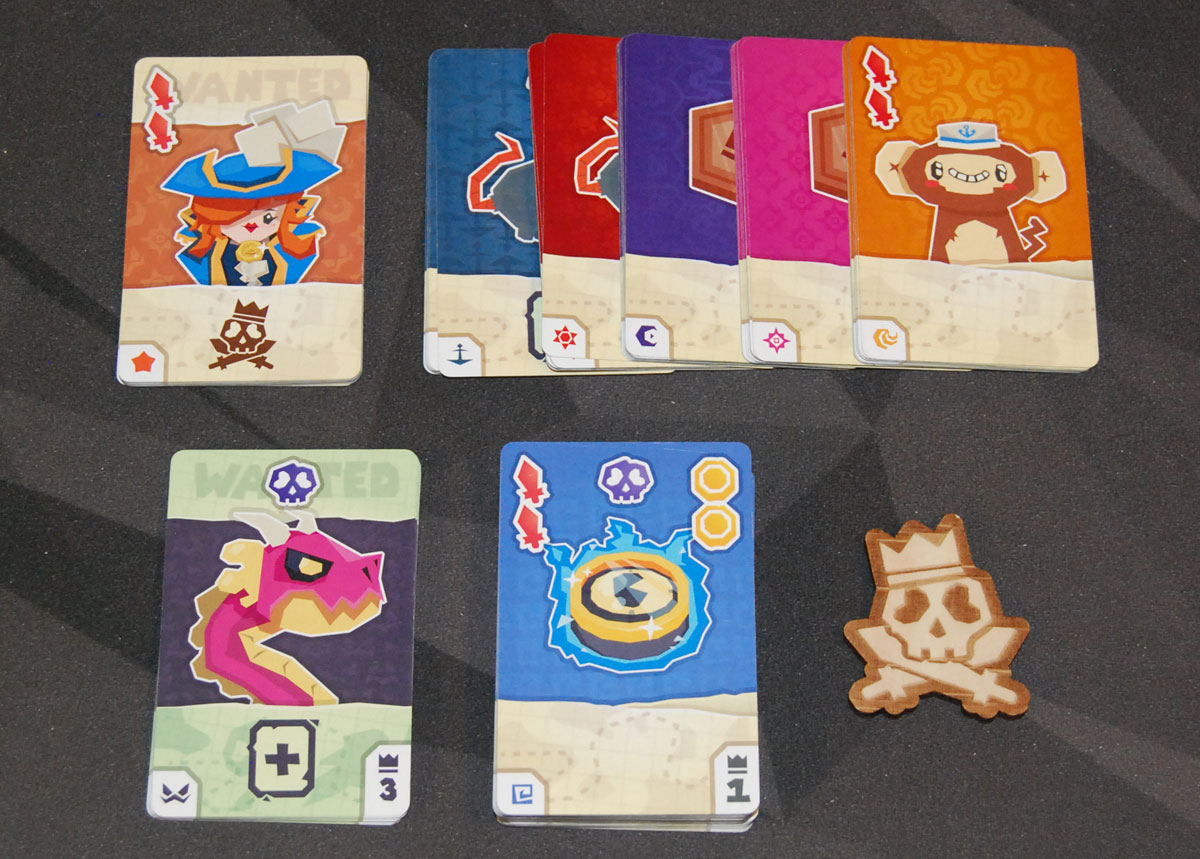
Pirate King Components
Here’s what comes in the box:
- 10 Pirate cards
- 45 Loot cards
- 14 Monster cards
- 5 Starter decks (8 cards each)
- Captain Token
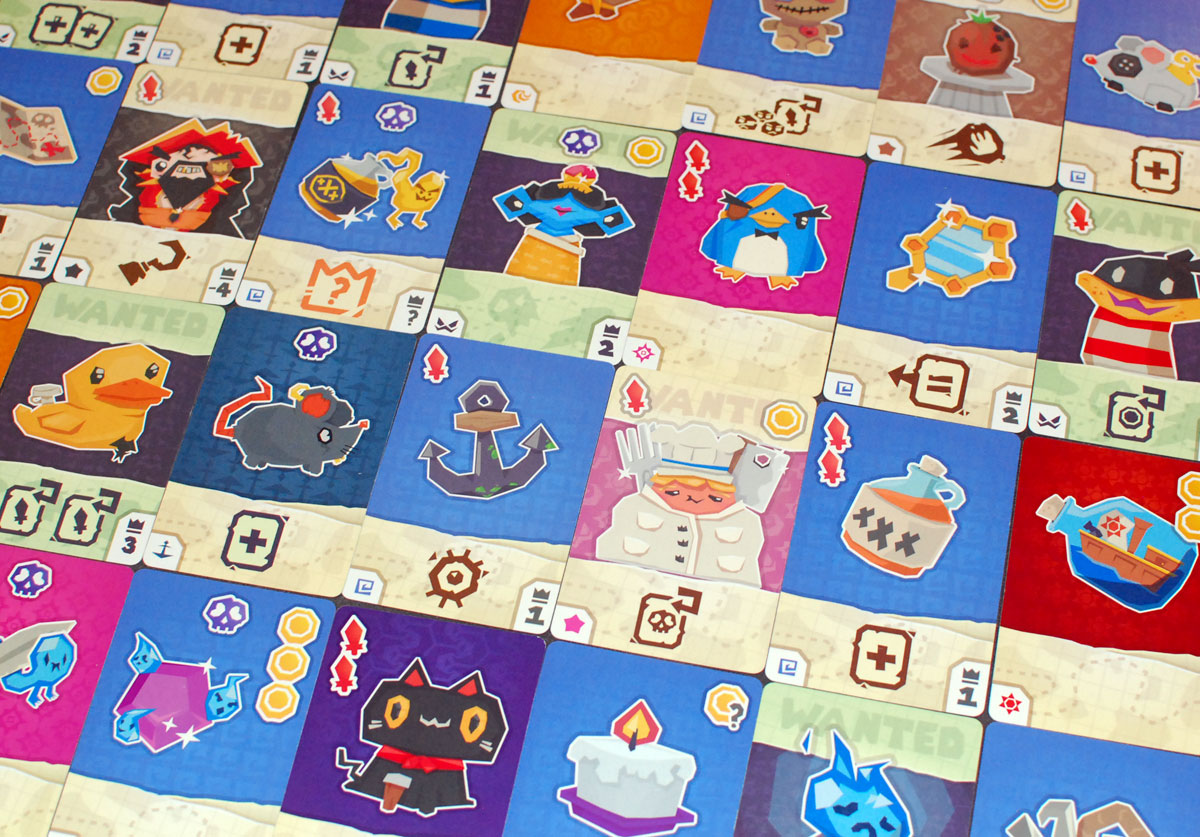
All of the cards have the same back (since they get shuffled together as you collect them), but they have different background colors for the illustrations as well as small icons at the bottom left corner to help you sort them out when you’re done playing. The illustrations are fun, with a kind of blocky cartoon style, and I liked how the illustrations often have some sort of connection to the card effect. For instance, the special set-collection cards look like shiny gold with jewels, while cursed loot often has little ghosts surrounding it. Many (all?) of the pirates are fun references: there’s a guy who looks a lot like Luffy from One Piece, and a coconut “castaway” named Wilson, for instance.
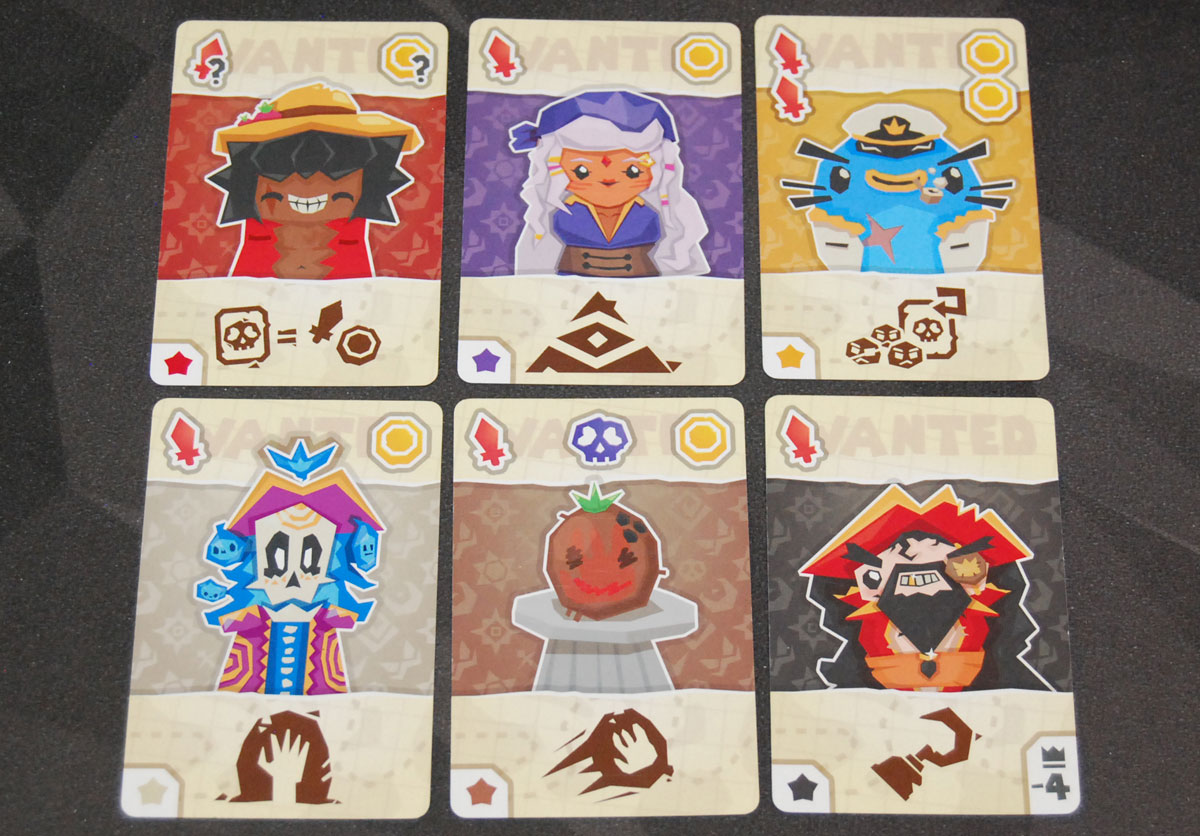
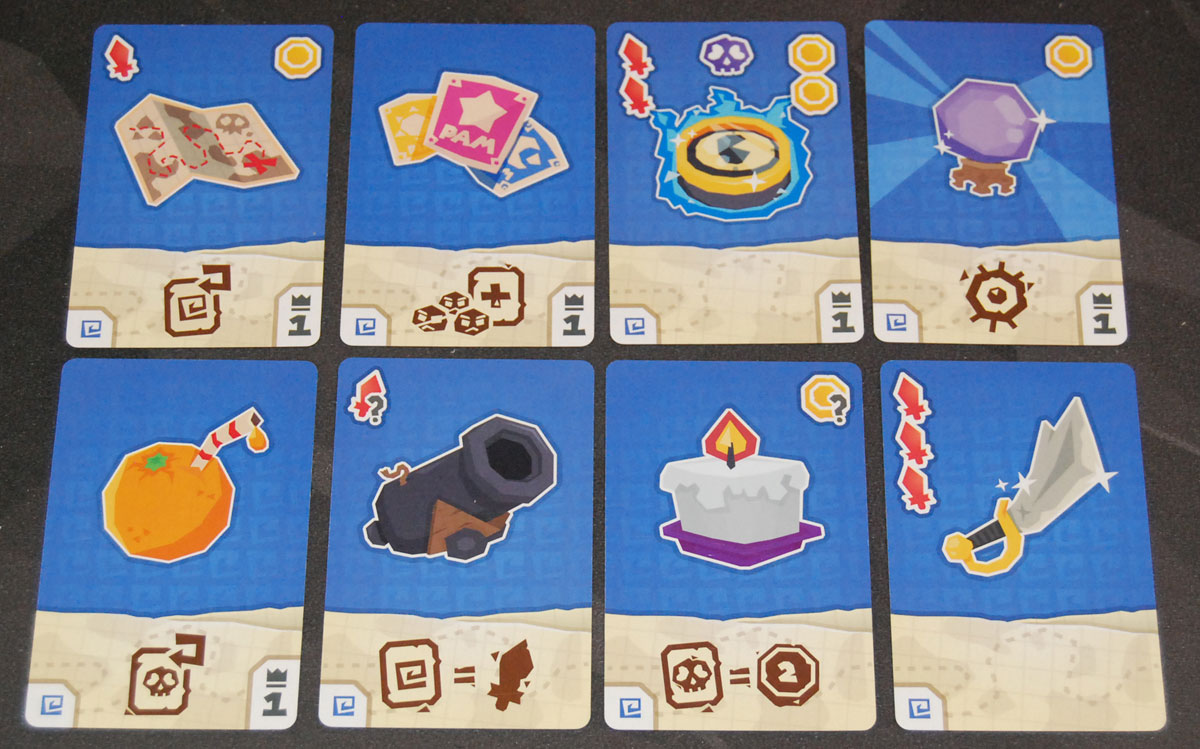
There’s no text on the cards at all unless you count the point value that appears on some cards. Instead, there are three common icons at the top of the cards (swords, curses, and coins) and various actions and effects at the bottom of the cards. Most of these are easy to figure out, but some of the pirate captains have unique effects that you’ll just have to refer to the rulebook until everyone learns them. (Fortunately, each player has one captain per game, so everyone really only needs to remember one of them at a time.)

The captain token is a skull with crossed swords, and it appears to be laser-cut and engraved, which feels a little odd, mostly because I associate that more with prototypes and indie publishers who are making their own game pieces out of a garage workshop. But it’s large and perfectly functional, so I don’t have any real complaints about it.

How to Play Pirate King
You can download a copy of the rulebook here.
The Goal
The goal of the game is to score the most points by defeating monsters and collecting loot over the course of 7 rounds.

Setup
Give each player a matching set of 8 starter cards and 1 random pirate card. (I like to deal 2 pirates to everyone and let them choose one.) Shuffle your starting cards and pirate cards to form your ship deck. Note that everyone maintains their own ship deck and their own discard pile—there is no common discard pile.
Shuffle the monster cards and place them in a face-down deck. Shuffle the loot cards and place them in a separate face-down deck.
The player who most recently touched water is the starting captain and takes the captain token.
Gameplay
Each round, there are 5 steps: Ahoy! Set Sail! Fight! Loot! Swab the Deck! (Yes, they all have exclamation points.)

Ahoy! Reveal 2 monster cards and 1 loot card per player from the decks.
Set Sail! The captain counts to 3 and everyone reveals the top card of their ship deck, placing it in front of them. Some cards have effects, which are resolved immediately. Then the step is repeated, with the captain counting to 3 again.

Many cards have swords or coins, which will be used to determine player order for fighting and looting. The skull icons are curses, which are bad. If there’s an effect at the bottom of the card, then it triggers immediately after you play your card: these can cause you to flip cards over (which cancels whatever is on them), play extra cards, or even affect other players.
You may say “drop anchor” and stop playing cards—you are done sailing for this round.
If you have 3 or more curses at the end of a turn (after all effects have been resolved), you sink. Stop revealing cards, and discard all of your revealed cards.

If you ever need to draw a card but you have no more in your ship deck, shuffle your own discard pile to form a new ship deck.
Fight! The player with the most swords chooses a face-up monster card and places it in their discard pile. Then the player with the second-most swords takes the second monster.
Loot! From most to least gold, players choose loot cards until everyone has taken one, placing them in their discard piles.
Note: If there is ever a tie for most swords or loot, the captain decides the selection order, and the player who goes last gets the captain token. Also, if you sink, you are considered to have -1 sword and -1 gold, which means you go after people who have 0 but didn’t sink.
Swab the Deck! Everyone places their played cards into their own discard piles, and prepares for the next round.
Game End
The game ends after 7 rounds: the monster deck will be depleted.
Count all the crowns in your deck. The captain token is worth 1 crown.

There are five cards with an orange question mark crown icon—you score points based on how many of them you collected: 1 point for 1 card, 4 points for 2 cards, 8 points for 3 cards, and 13 points for 4 cards. If you collected all 5, you win the game automatically!
The player who has the most crowns is the winner. If there’s a tie, the player with the captain token decides which tied player wins.
2-Player Variant
For two players, the game is almost the same, but you lay out 4 loot cards each round. When you take a loot card, you discard one of the remaining cards, so each player still only claims one each round, but there are more to choose from.

Pirate King is GeekDad Approved!
Why You Should Play Pirate King
Two of my favorite types of games are deck-building games and press-your-luck games, so it’s no wonder that Pirate King clicked for me right away. It’s a light game so it doesn’t really replace the deeper deck-building games for me, but it’s fantastic for a quick session, and is another one I’d recommend as an intro to the genre (a bit like Abandon All Artichokes from 2020).

Unlike many deck-building games, the pace of the building is pretty steady: every player will get one loot card per round, and the amount of gold you have simply determines the order that you get to select them from the market. Only the top two players with swords will get monsters, though, and that’s where the majority of the points are. However, monster cards also tend to have more downsides: curses, flipping down other swords or gold, and so on. While there are certainly some cards that I favor more than others, I think the overall value of the cards is pretty even: cards worth more points tend to have weaker (or even negative) effects, and the cards that have better effects are often worth no points at all.
Everyone’s starting deck is identical (though with different illustrations) with the exception of the unique pirate card, and that can nudge you toward a particular approach. Some pirates give you more gold or swords, but their effects actually help your opponents. There’s one that lets you steal the captain token every time you play it; another one is played in another player’s area, giving them a coin, a sword, and a curse! One of the most chaotic lets you play the top card of the loot deck, so you’re amassing loot cards faster than everyone else—that’s usually great, which is why that pirate is worth -4 points.
The game does have a slightly different feel depending on player count, but I’ve enjoyed it no matter how many players we have. The main shift is that the number of monsters per round doesn’t change based on player count—it’s always two. So in a 2-player game, everyone gets a monster and a loot every round. In a 5-player game, you have to be much more aggressive with swords to get a monster. There are still plenty of points in the loot cards, but it’s not as consistent—so for me, the player count sometimes affects how much I lean toward swords vs. gold in my deck.
The press-your-luck aspect of the game is easy for most players to grasp. Your deck starts off with 4 curses total, so it’s usually easy to tell when you’re at risk of sinking. But because of the “extra draw” effects, the danger zone is expanded a little. Two of your curse cards have the extra draw, which means you can go from no curses to three in a single turn if you get unlucky. Of course, as you start getting loot and monster cards, it helps to remember how many curses you’re adding to your deck.

Why would you push? Well, because you want to have first crack at those monsters and loot. It’s easy to look around and see how many swords and gold other players have, and since the “set sail” phase is simultaneous, it can often turn into a game of chicken: will the other player keep sailing? Should you drop anchor now and let them risk sinking … but what if they surpass you? Depending on the current available monsters and loot, there are times when you feel like you really need to push your luck as far as you can. And, of course, there are also times when maybe you don’t mind if someone else gets the monsters because the negative effects are just too much, like the double-curse kraken. Is it worth 4 points for two curses on a single card?
Because Pirate King comes in a compact box—about two poker decks side by side—it’s very portable, and is one of the games I took with me to teach my brother’s family on a recent visit. It ended up being his 7-year-old’s favorite game, and he picked up on it really quickly (and managed a few impressive wins!). As I said earlier, it doesn’t unseat some of my favorite deck-builders like Clank!, but its portability and speed mean that it’s gotten a lot of play since it arrived, and it’s been one of my go-to games to take with me to game days for the past few months.
If you’re looking for a beginner-friendly intro to deck-building games, or you love a bit of press-your-luck, set your sights on Pirate King! For more info, visit the Hachette Games website.
Click here to see all our tabletop game reviews.
 To subscribe to GeekDad’s tabletop gaming coverage, please copy this link and add it to your RSS reader.
Disclosure: GeekDad received a copy of this game for review purposes.


Jonathan H. Liu

Jonathan H. Liu is a stay-at-home dad in Portland, Oregon, who loves to read, is always up for a board game, and has a bit of a Kickstarter habit. I can be reached at jonathan at geekdad dot com.


