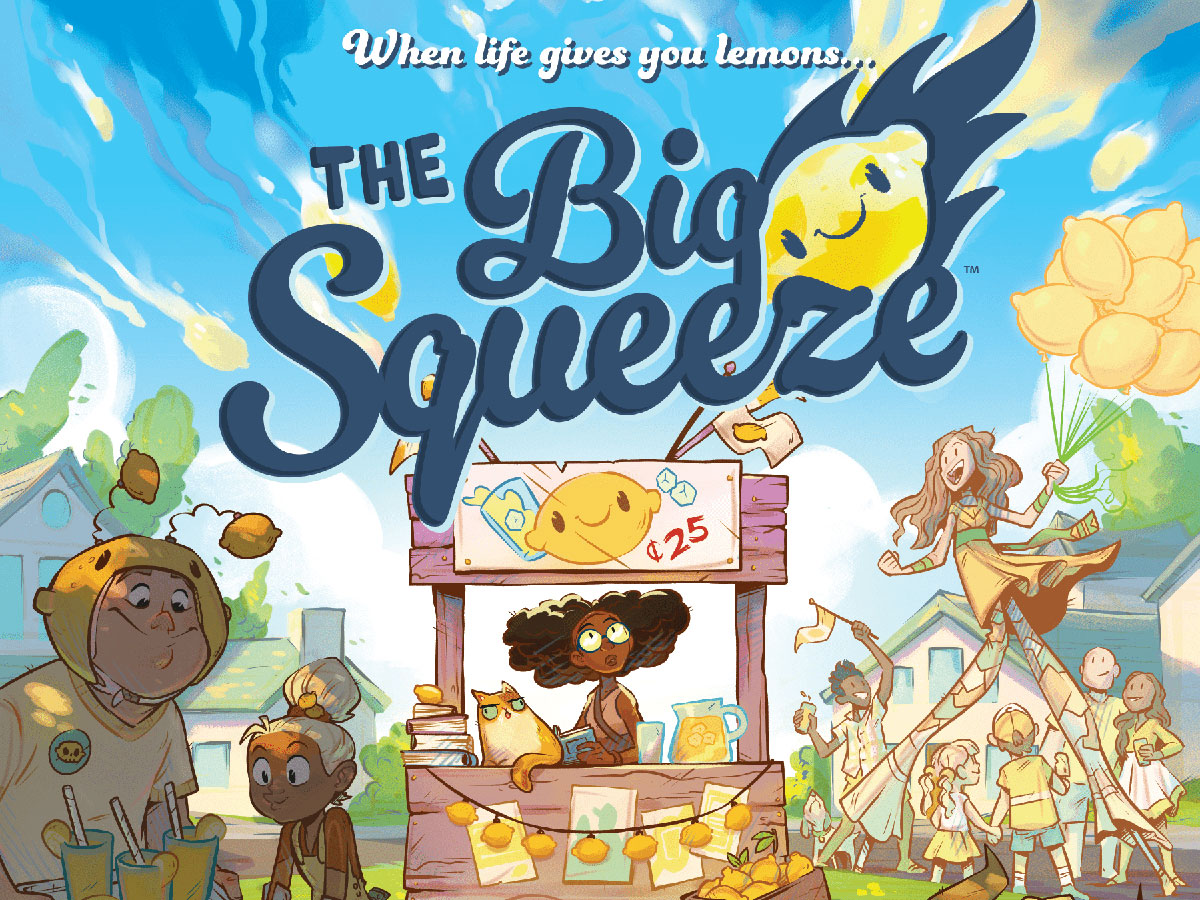
The end of the world has never been more sweet—just be sure you’ve stocked up on lemons ahead of time!
What Is The Big Squeeze?
The Big Squeeze is an apocalyptic worker placement game for 1 to 4 players, ages 10 and up, and takes about 60 minutes to play. It’s currently seeking funding on Backerkit, with a pledge level of $39 for a copy of the game. (Higher tiers are available for the Launch Edition and Collector’s Edition.) Although the game is centered around the apocalypse, it’s done in a funny, cartoonish way; the rules aren’t too complex so I think the 10+ age rating seems about right.
The Big Squeeze was designed by AC Atienza and published by Wiggles 3D, with illustrations by Maximilian Gotthold and Cam Kendell.
New to Backerkit? Check out our crowdfunding primer.
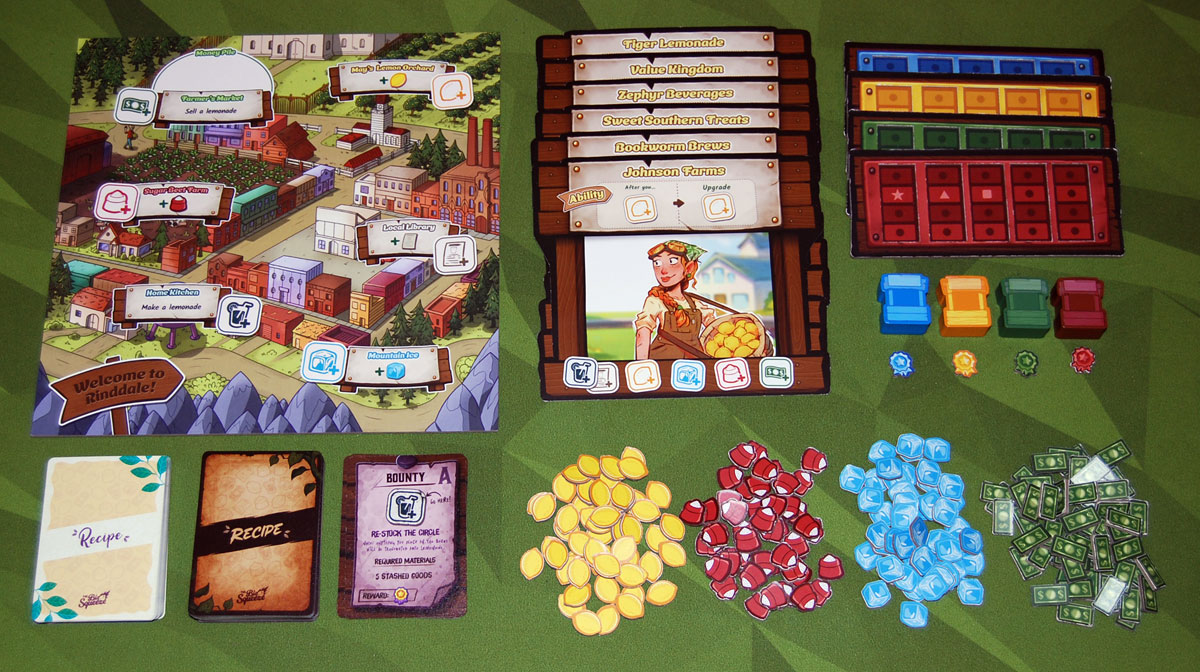
The Big Squeeze Components
Note: My review is based on a prototype copy, so it is subject to change and may not reflect final component quality.
Here’s what comes in the box:
- Game board
- 6 Lemonade Stand mats
- 4 Upgrade boards
- 4 Player pawns
- 4 Fame tokens
- 36 Recipe cards
- 54 Forbidden Recipe cards
- 6 Bounty cards
- 140 tokens (lemons, sugar, ice, and money)
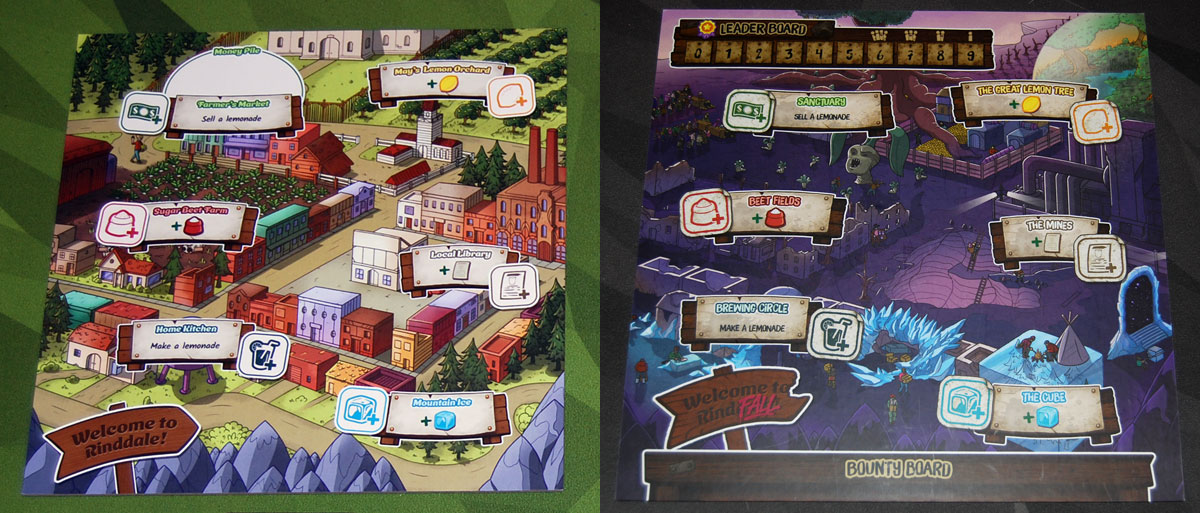
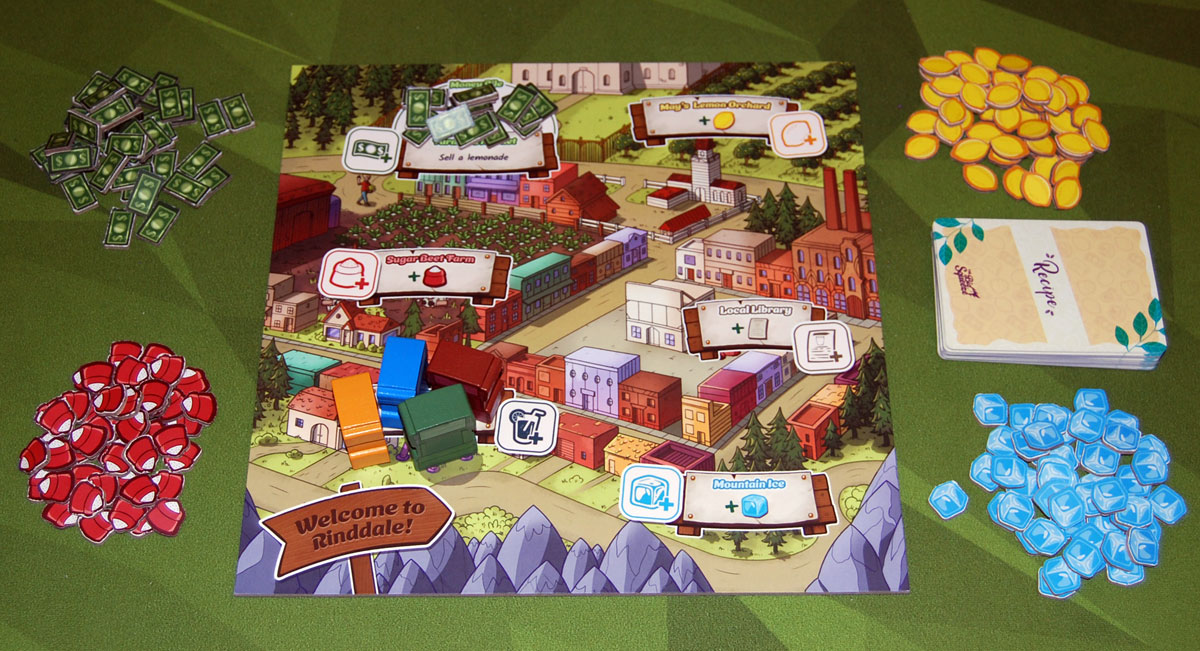
The main game board is pretty small and simple compared to a lot of games—it’s just the size of the game box and depicts 6 locations in the town of Rinddale, with a space for a money pile at the Farmer’s Market. The board is double-sided, and the reverse side shows the post-apocalyptic version of the town, now named Rindfall; it’s mostly a fun cosmetic change, showing monster sugar beets and some folks chipping away at a giant ice cube. The main game-relevant changes are the removal of the money pile and the addition of the fame track and bounty area. The board has been kept pretty simple without much text, but I think it would be nice to have some reminders—for instance, when you make lemonade there are rules about substituting ingredients, but if you miss that in the rulebook or forget it, there aren’t any reminders anywhere else.
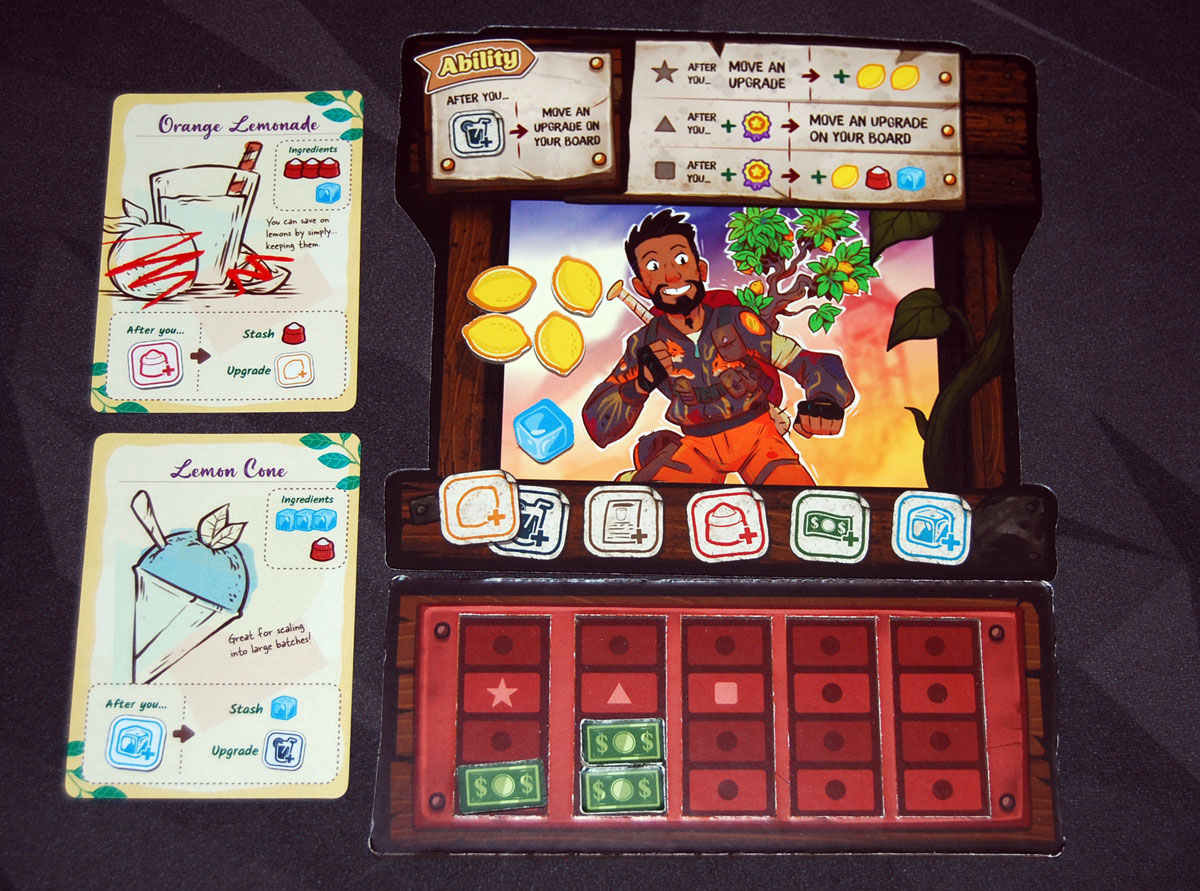
The lemonade stand mats pair with the upgrade boards to make a full lemonade stand, and each one has an illustration of a character. The backside shows the same character a few years into the apocalypse (along with some new character abilities). I really love these illustrations—it shows that the characters have been through a lot but are still squeezing away. The upgrade boards are dual-layered cardboard, designed so that the dollar bill tokens slot into them to upgrade the action slots. Since the actions themselves are printed on the lemonade stand mats, everyone has actions printed in a different order so your starting abilities aren’t the same.
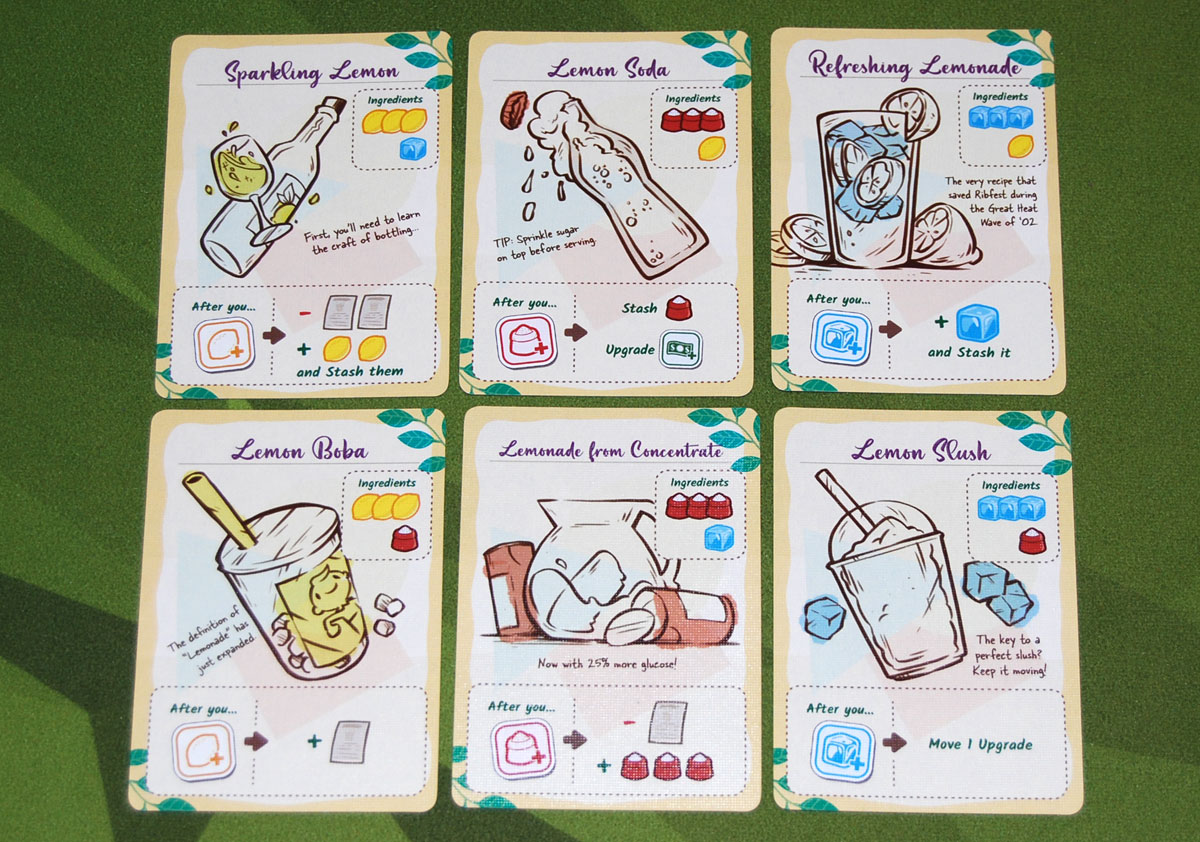
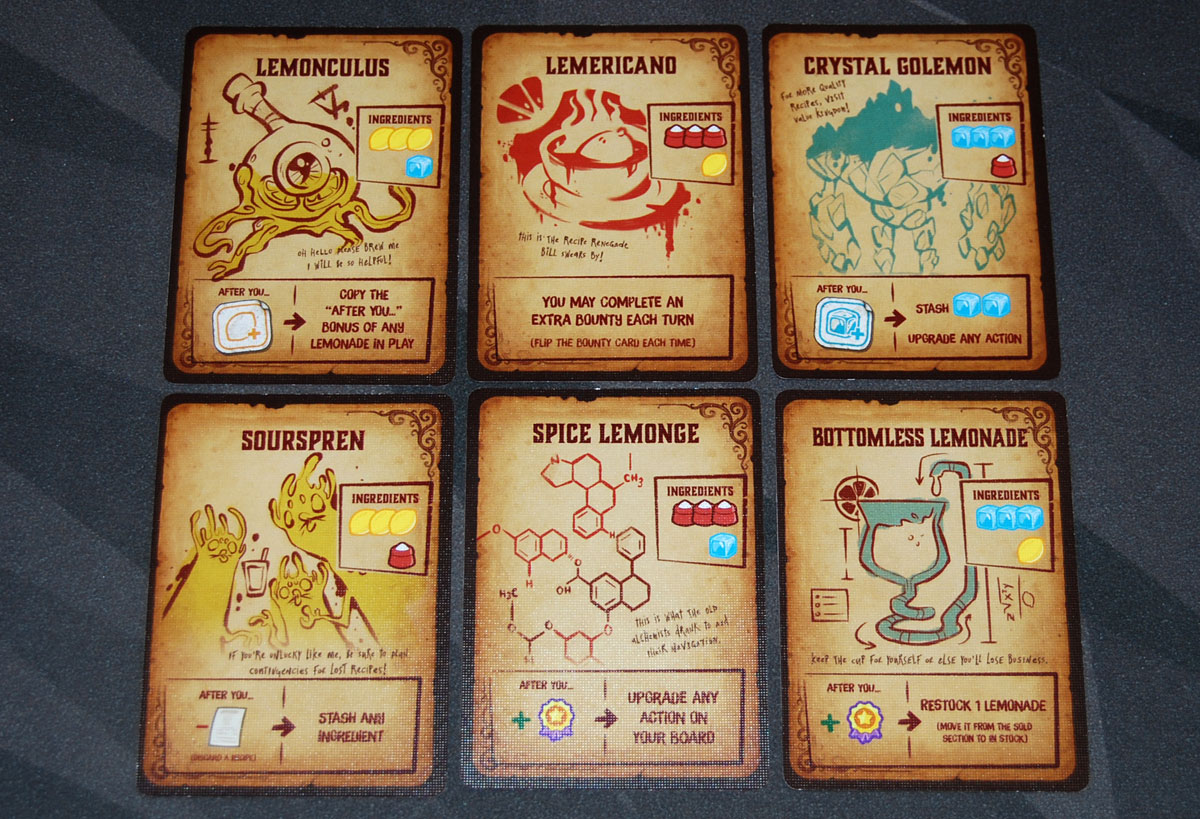
There are two sets of recipe cards, with the forbidden recipes set reserved until after the apocalypse hits. The regular recipes are a mix of lemonade and lemon-based drinks; the forbidden recipes have a lot of punny names (like the “Lemonculus”) and more powerful abilities. There are a lot of fun references in the illustrations, too.
The one thing that bugs me a little is that the four player colors match four resources (yellow lemons, blue ice, red sugar bags, green money) even though the player colors don’t have a specific tie to those resource. Some of the characters have special abilities tied to the resources, but since any player can be matched with any character, it could mean that you got the yellow player board but your character has a particular expertise with ice. I always prefer if the player colors and resource colors are totally distinct unless there’s some sort of actual connection between the two.
How to Play The Big Squeeze
You can download a draft of the rulebook here.
The Goal
The goal of the game is to score the most fame.
Setup
Place the game board, Rinddale-side-up in the center of the playing area and make a supply of the tokens nearby. On the money pile area, place 6 dollars plus 2 dollars per player. (The rest of the money should remain in the supply.)
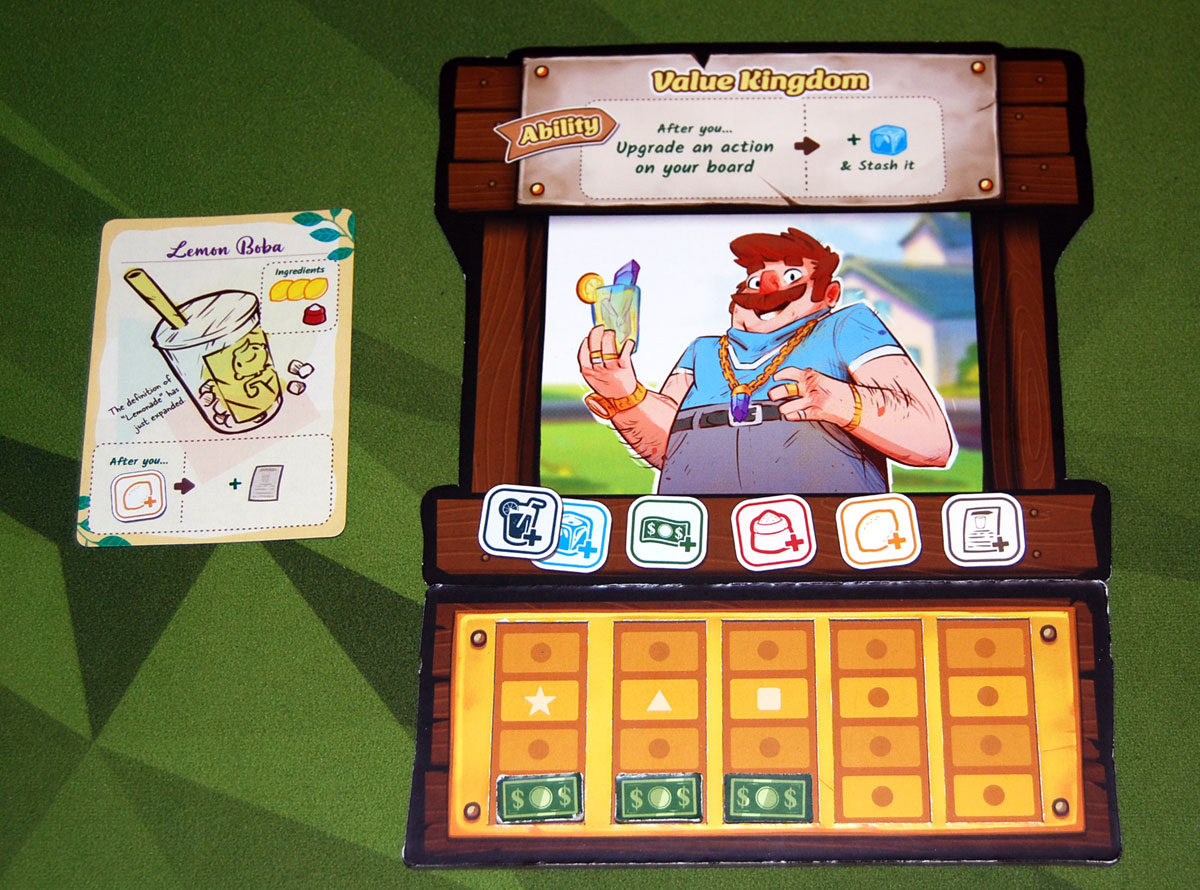
Each player takes a character and an upgrade board, and places their pawn on the Home Kitchen space of the board. Everyone gets 3 dollars, placed at the bottom of the first three slots of their upgrade board.
Shuffle the recipe cards and deal 3 to each player. Each player chooses 1 recipe to put “in stock” on the left side of their lemonade stand, and keeps the other two in their hand. Set the rest of the deck next to the board.
The player who most recently drank lemonade goes first. (The last player in turn order gets 1 extra dollar to place on their leftmost slot.)
Gameplay
On your turn, you must move your pawn from your current space to a different space on the board, and then take the action there. If the space is already occupied, you must pay one of the players there a resource of your choice. (If you have no resources, you may still go there and pay nothing.)
Three of the spaces let you take resources—lemons, sugar, ice—which you put into your personal supply, and the Local Library lets you draw recipe cards from the deck (with a max hand size of 5). At the Home Kitchen, you may spend resources matching a recipe in your hand to make that lemonade, putting it in stock. (You may substitute 2 of any ingredient for 1 of another if needed.) Finally, at the Farmer’s Market, you can sell a lemonade that you have in stock, moving it to the right side of your stand and gaining a dollar, which can either be placed into your upgrade board immediately or stashed below your upgrade board for after the apocalypse.
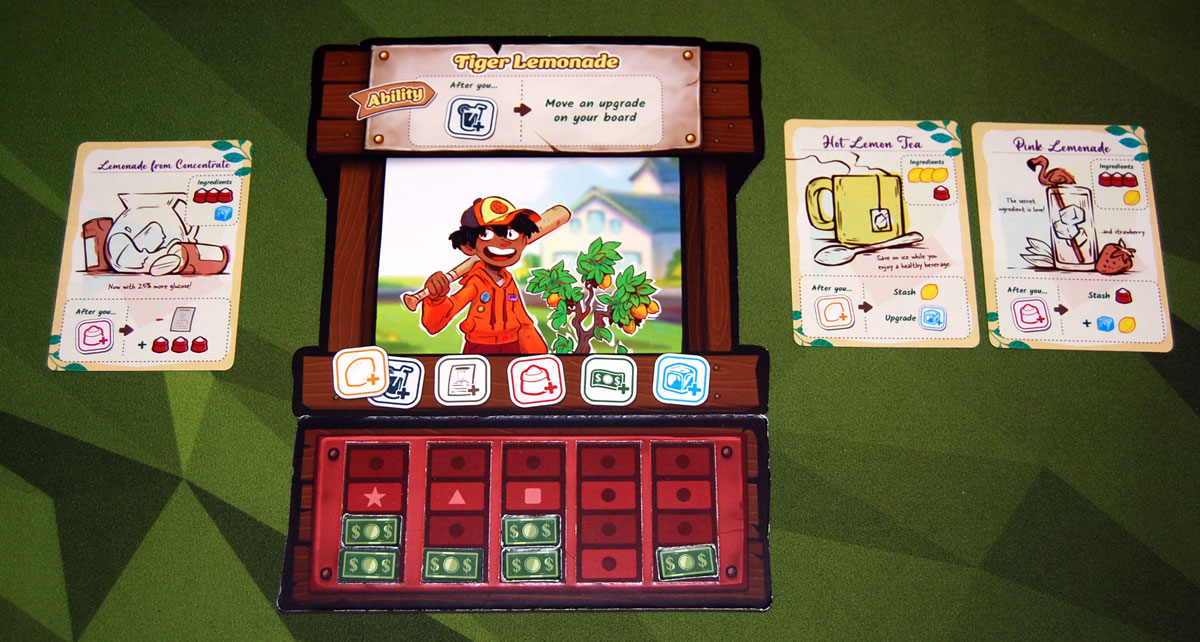
Typically, each action space lets you do that action once—take one lemon, make one lemonade, and so on. However, each upgrade you have increases the effect by one. So if you have 2 dollars on your sugar upgrade, each time you get sugar you can take 3 instead.
Also, each recipe you have in play—whether it’s in stock or sold—and most of the characters have special abilities tied to particular actions. Every time the Tiger Lemonade player makes lemonade, that player can move an upgrade on their board. If you’ve made Hot Lemon Tea, then every time you get lemons, you can also stash one and upgrade your ice action. If you have multiple abilities for the same action, you may use all of them.
Stashed resources go in an area below your stand, and typically cannot be used until the apocalypse happens—you’ve put them in your bunker! You can only stash ingredients using special abilities, not just whenever you take them.
The Apocalypse
When the dollars on the Farmer’s Market run out, finish that round (so that everyone has had the same number of turns). If more dollars are needed in the meantime, take them from the supply. At the end of the round, the apocalypse hits!
Everyone gets to stash two of the lemonade recipes they have in play (whether in stock or sold). Then, everything that is not stashed is returned to the supply: ingredients, recipes, upgrades. It’s all been destroyed!
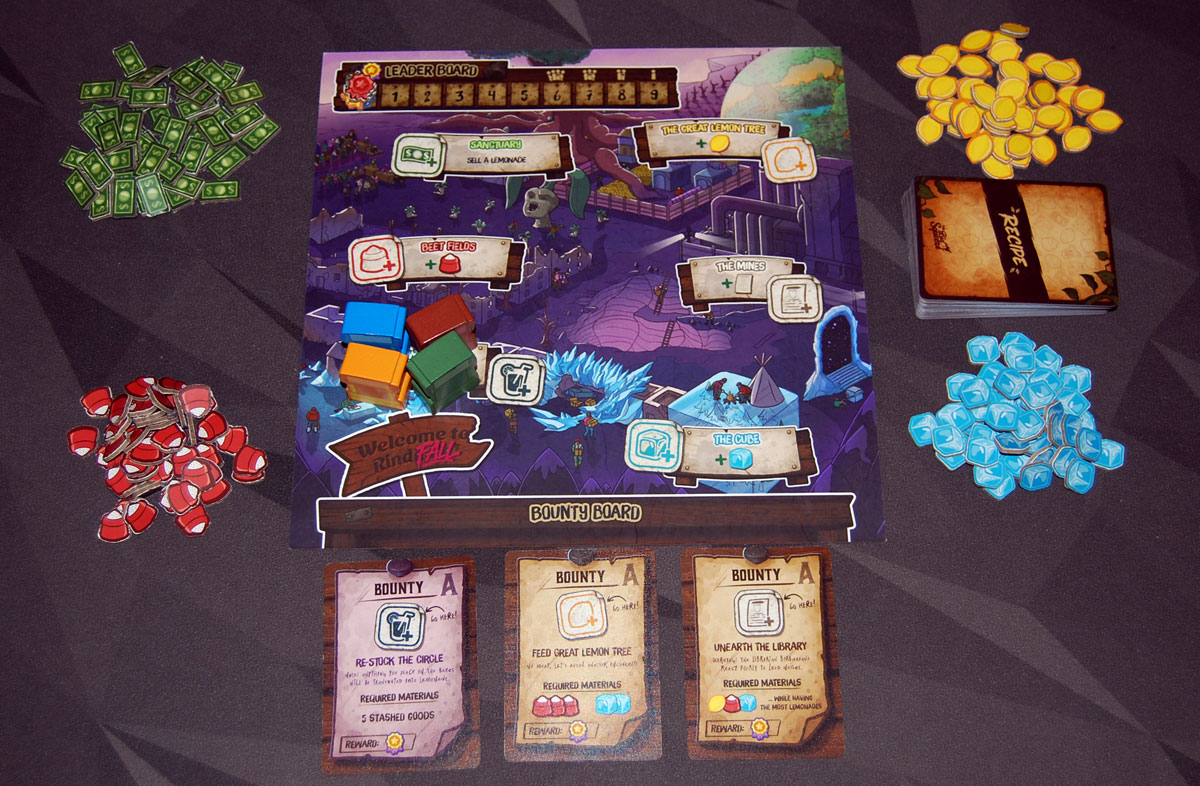
Flip the board over to the Rindfall side, and place the fame tokens on the starting space of the fame track. Place the “Restock the Circle” bounty below the board, and then shuffle the remaining bounty cards and deal 2 more to the bounty area. All bounty cards should be turned to the A side. (Remaining bounty cards are returned to the box.) Place all players on the Brewing Circle.
Remove the regular recipe cards from the game, and shuffle the forbidden recipe cards and place them nearby. Deal 2 forbidden recipes to each player.
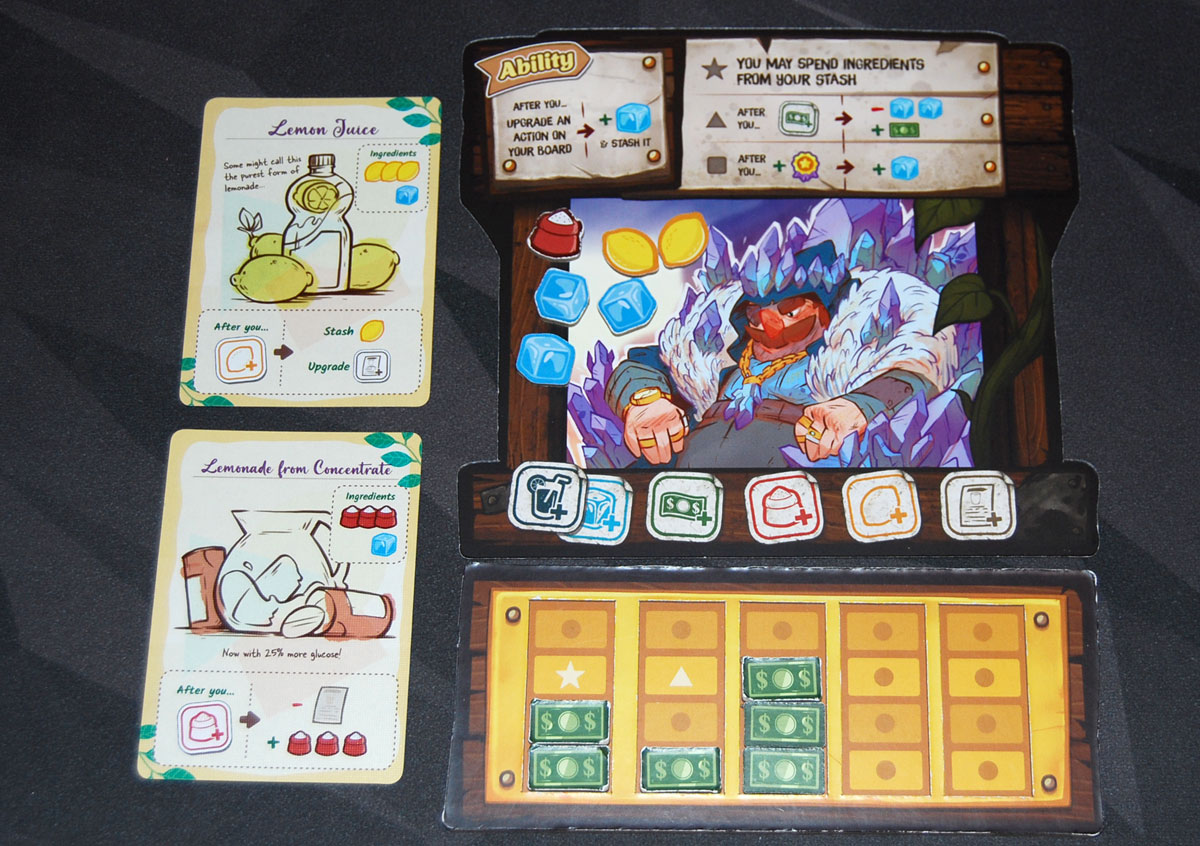
Players flip over their characters to the apocalypse side. Take everything out of your stash. Ingredients are placed in your supply, and money is put into whatever upgrades you want. Your two stashed recipes are placed in stock.
The apocalyptic portion of the game plays much like the first portion, but with a few key differences. The back of your character mat shows three more abilities in addition to your starting ability, marked with a star, triangle, and square. These abilities are unlocked when you have upgraded the three leftmost abilities to level 3, showing the corresponding icon. If your upgrade level drops below the icon, then you lose the ability.
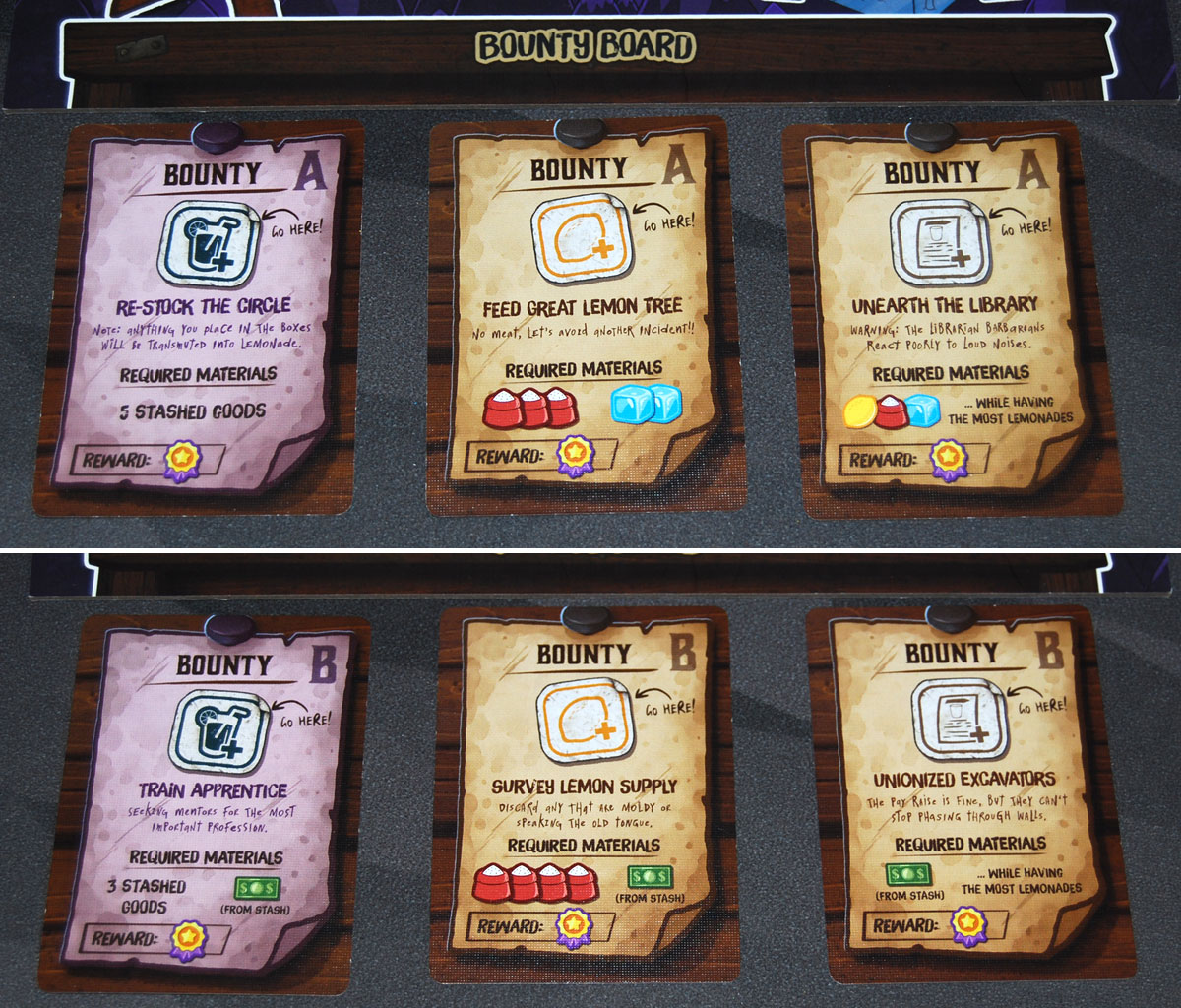
The forbidden recipes function similarly to the originals, but have more powerful effects. And now you’re not just collecting ingredients to make lemonade, but you’re also delivering much-needed bounties to gain fame. To deliver a bounty, you go to the action space shown on a bounty card. Before or after taking your action, you may spend the resources indicated to earn 1 fame, and then the bounty card is flipped over to its other side. Note that you cannot use the 2:1 substitution for bounties, and you may only deliver one bounty per turn.
Game End
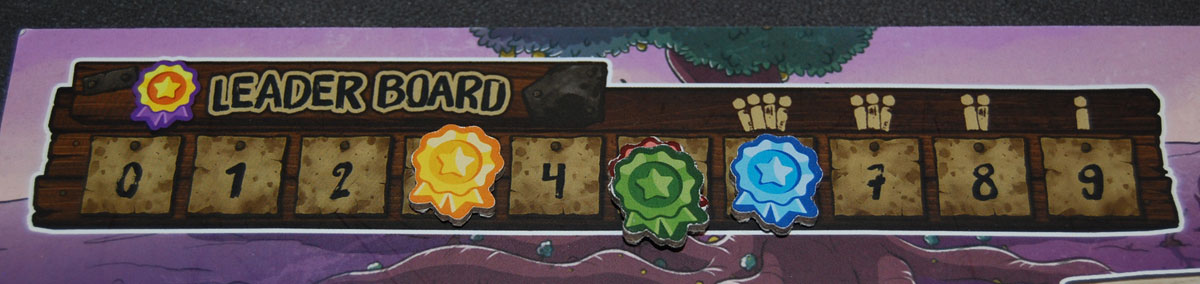
The game ends when a player has reached the fame threshold marked by the number of players on the fame track. Finish the round, and then the player with the most fame wins! Ties go to the player with the most sold lemonade.
Solo Mode
The solo mode is played against an automated rival; you use all four player pawns, placing them one at a time and taking their actions (and discarding an ingredient if you visit a place you’re already occupying). Each time you’ve placed all four, the rival takes a turn based on a cycle, often making you discard resources or recipes, or even downgrading your character abilities, and they slowly advance the game (by removing dollars from the money pile in the first half, or by advancing their fame token in the second half). Your goal is to reach 9 fame before the rival!
Why You Should Play The Big Squeeze
Wiggles 3D is also the publisher behind games like 5-Minute Dungeon and 5-Minute Mystery, which are both fast-paced, fairly light games. The Big Squeeze is a bit more involved, but even so it’s not a very complicated game, and could work well as an introduction to worker placement games. With a limited number of actions available on the board and no blocking spaces, it’s not as overwhelming or as confrontational as some worker placement games can be.
Another thing that keeps the game fairly simple is that the actions are also straightforward, either gathering resources, drawing new recipe cards, or selling lemonade you’ve made for dollars. Each recipe requires 3 of one ingredient and 1 of another, so although there are lots of different recipes, the pattern is the same. That frees up your brain space to figure out how best to use your character’s abilities and the lemonade abilities to build up your lemonade-making engine.
And that’s the tricky part of the game: what’s the best approach? In the first half of the game, whenever you make money, do you spend it on powering up your actions? Maybe that will help you stash ingredients more quickly to get you a head start in the second half. On the other hand, maybe you stash your dollars instead, so that you start the second half with an already upgraded board. The question is which tactic will end up with more things in your stash, because whatever engine you build up in the first half gets reset for the second half.
A similar question crops up in the second half, too: should you spend time building up your upgrades and hope that you’ll be able to build up a bunch of points quickly once your engine gets going? Or do you just take the slow but steady route, trading in all your stuff for bounties instead of making lemonade? In my plays, I did see one player with almost no upgrades whatsoever get a slow-but-steady lead, and he ended up triggering the end game (but one other player managed to catch up and win on the tie-breaker). I’ve also seen a player with a completely filled upgrade board come in last (full disclosure: it was me). So while it’s probably pretty good to upgrade enough to unlock a couple of your apocalypse character abilities, if you spend too long just building up the game might end in the meantime.
When I’ve taught the game to new players, I’ve usually followed the structure of the rulebook, which gives you the pre-apocalypse setup and gameplay first. I explain what triggers the apocalypse, but then I don’t go into too many details about what happens after, other than that you’ll lose what’s not in your stash. I tell them that you win by getting the most fame … but there isn’t any way to get fame yet. There’s not even a fame track! Then when the apocalypse hits, we flip the boards over and I see a light click on in their minds—the new forbidden recipes, the additional character powers, the bounties to deliver.
The forbidden recipe abilities are a little more complicated, and can make for some really interesting combos. The Bottomless Lemonade can be restocked so you can sell it over and over again. The Assemblemon Line lets you complete any recipe with one of each ingredient. There are recipes that will trigger abilities each time you gain fame.
One of my players commented that they wished the apocalypse side of the board had slightly different actions, because they really are identical to the first half, just with different illustrations. It might feel like more of a break from the pre-apocalypse if the actions themselves were different. But I think the added complexity of the character abilities and forbidden recipes is probably enough, since it’s meant to be a newcomer-friendly game.
All in all, I really like the setting of The Big Squeeze: this silly version of the apocalypse makes for a fun story, and putting a bunch of lemonade stands at the end of the world is my type of absurdity. I think it’ll be especially great for families, and players who are still broadening their gameplay horizons with things like worker placement. Those who are more familiar with that may not find it quite as deep as they’d like, but there’s still fun to be had in creating those chain-reaction combos.
What are you waiting for? Time to make some lemonade!
For more information or to make a pledge, visit the The Big Squeeze Kickstarter page!
Click here to see all our tabletop game reviews.
 To subscribe to GeekDad’s tabletop gaming coverage, please copy this link and add it to your RSS reader.
Disclosure: GeekDad received a prototype of this game for review purposes.