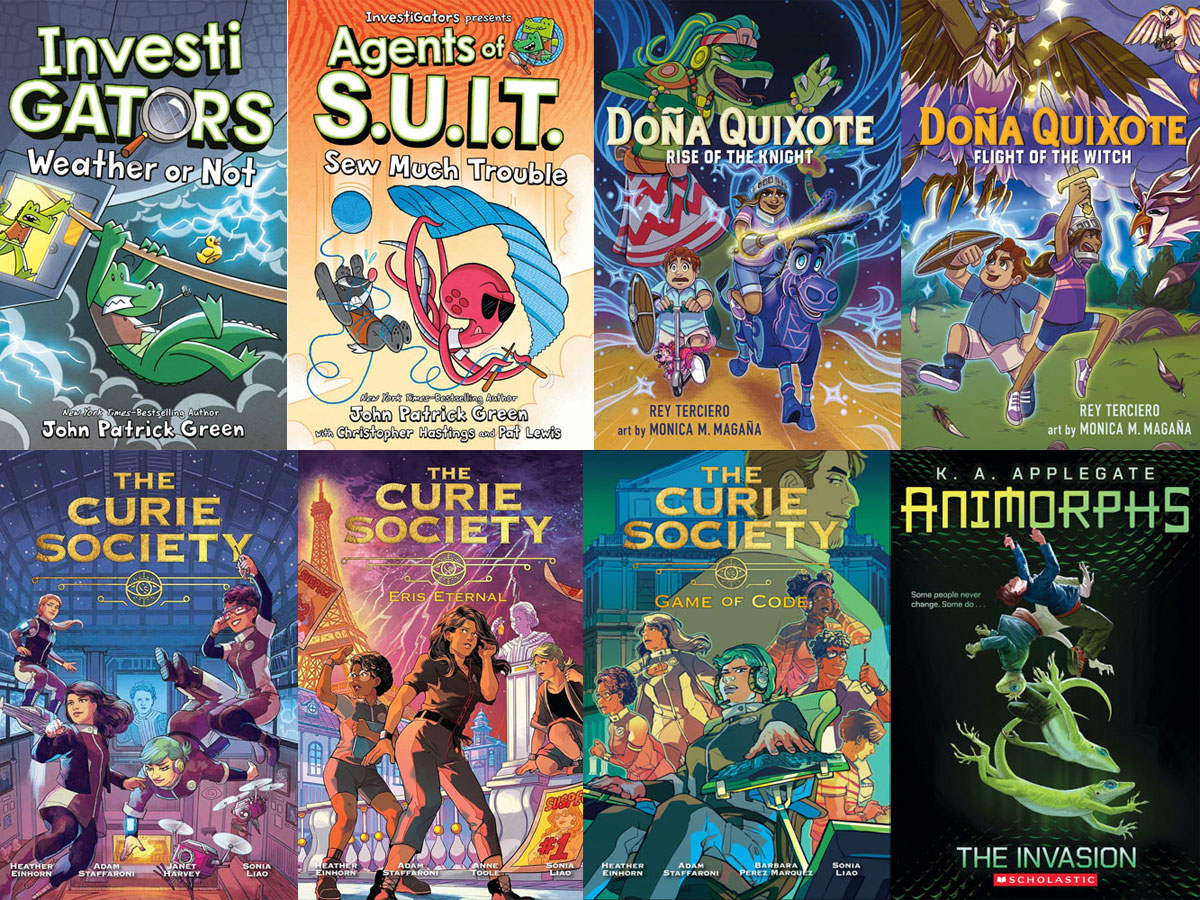
Today’s stack: a couple kids’ series about saving the world!
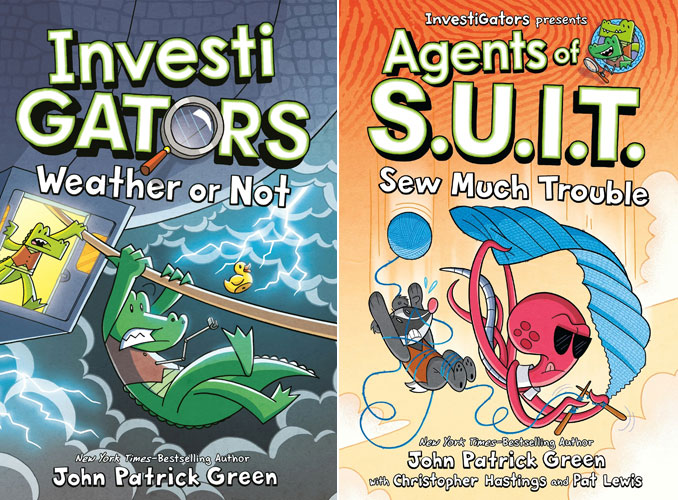
InvestiGators: Weather or Not by John Patrick Green
Agents of S.U.I.T.: Sew Much Trouble by John Patrick Green with Christopher Hastings and Pat Lewis
The world of S.U.I.T. (that’s Special Undercover Investigation Teams) continues to delight with these two books. InvestiGators is the original series, with alligator partners Mango and Brash chasing down ridiculous villains. Agents of S.U.I.T. is the spin-off series, giving some of the secondary characters from InvestiGators their time to shine.
In Weather or Not (due out in June), the city is experiencing two unusual phenomena: an unseasonably warm winter, and all the water in the taps has been replaced with … milk? Oh, and Brash has a toothache, which is a roundabout way of bringing up his former crocodile partner Daryl, who has appeared in previous books as a crackerdile, a waffledile, a rockodile, and more. Hmm, why would the reader need to be reminded about Daryl, I wonder? As usual, Mango and Brash manage to save the day with a mix of high tech gadgets and low-tech gags.
Sew Much Trouble puts the spotlight on Sven Septapus (an octopus with only 7 arms), who is usually behind the scenes at S.U.I.T. He’s the Q of the organization, putting all that nifty tech into the vests (and other clothing) for the field agents. But there’s been a mysterious theft, and Sven gets sent to investigate his favorite reality TV show, Sew You Think You Can Sew. A subplot involves a falling out between the badger agents Bongo and Marsha, who each get paired up with other agents (and of course learn an important lesson about appreciating each other).
My daughter and I have read all of these books so far; they’re incredibly silly and just jam-packed with puns, wordplay, and visual gags, many of which are probably there for the adult readers. There’s a throwaway gag about a comic strip called “Carfield” drawn by Dave Jimbus. One of the sewing contestants is a duck named Jason Waterfowls … to set up a joke 40 pages later: “Don’t go, Jason Waterfowls!” Oh, and Sew Much Trouble also throws in some references to The Emperor’s New Clothes, a classic tale that I’m partial to myself, so that was a little bonus.
If you like secret agents and absurd humor, these are definitely worth investigating for yourself!
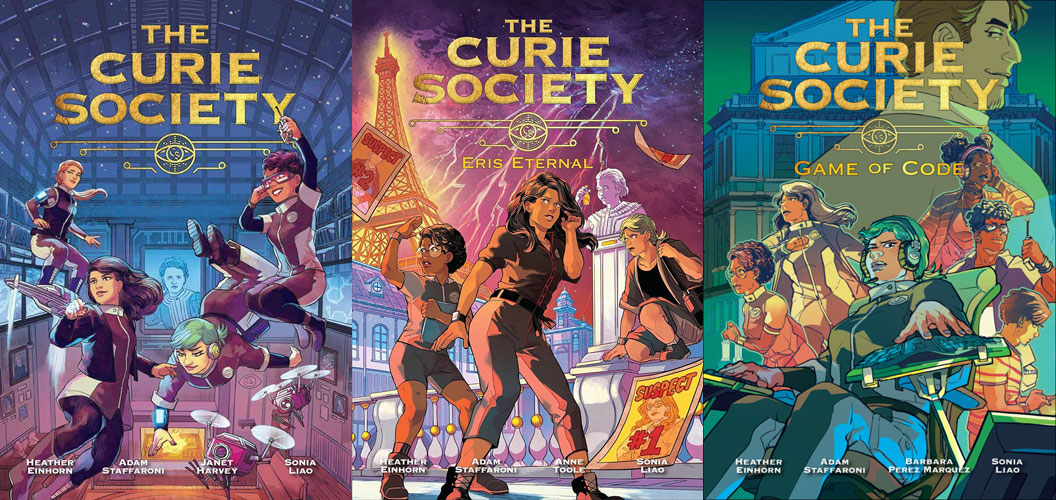
The Curie Society series, created by Heather Einhorn and Adam Staffaroni
I wrote about the first book in this series back in 2023; it’s about a secret society started by Marie Curie to advance women in science, and the series centers on three first-year college students who have been recruited for their talents. In the first book (written by Janet Harvey and illustrated by Sonia Liao), they learn about an organization called Eris that includes women who were formerly part of the Curie Society but felt it did not go far enough to achieve its aims.
Eris Eternal is the second book (written by Anne Toole and illustrated by Sonia Liao) and takes the trio to Paris for Fashion Week. A prominent tech incubator has been threatened leading up to her launch: was it one of the women that she has been sponsoring, or is there somebody else behind the sabotage? The plot weaves together material science, fashion, and biotech, and the team has to figure out what Eris is up to. They’ve mostly been apart for the summer and are learning to work together again. Simone, the youngest, bristles at feeling like she can’t be trusted to work independently, while Maya has been feeling alone and struggles to reconnect.
The third book, Game of Code (written by Barbara Perez Marquez and illustrated by Sonia Liao), centers on a big tech conference in Madrid; the trio has been recruited to help the local team with their presentation. But Taj has her mind on other things: she plays an online combat game with her friends back home, and the big tournament just happens to be in Madrid at the same time. She feels torn between two worlds—but then it turns out there are some unusual links between the two events.
Aside from featuring a lot of female characters involved in various scientific fields, each book also has a section at the back that dives a little more into the real-world science and scientist. The first book includes a section with brief biographies of many contemporary women in science. The second has two mini-comics, a biography of Marie Curie and a look at biofabrication with Dr. Ritu Raman from MIT. The third also has two mini-comics, one that highlights three different women (Ada Lovelace, Fei-Fei Li, and Katherine Johnson), and then a chat about AI with MIT’s Lalana Kagal. (I wasn’t fully on board with that last one, though—Kagal does mention the need for fact-checking and safeguards, but otherwise mostly avoids talking about the harms that AI and those selling it are currently doing.)
I enjoyed this series and its focus; there’s a good mix of action and science (though some of it is not real … yet). The interpersonal drama is expected, but also feels a little contrived. Will they need to learn to work together and trust each other every time? It felt like they’d figured some things out by Book Two, but then in Book Three the tension ratcheted up again. Overall, though, this is a cool series that could spark an interest in science for young readers.
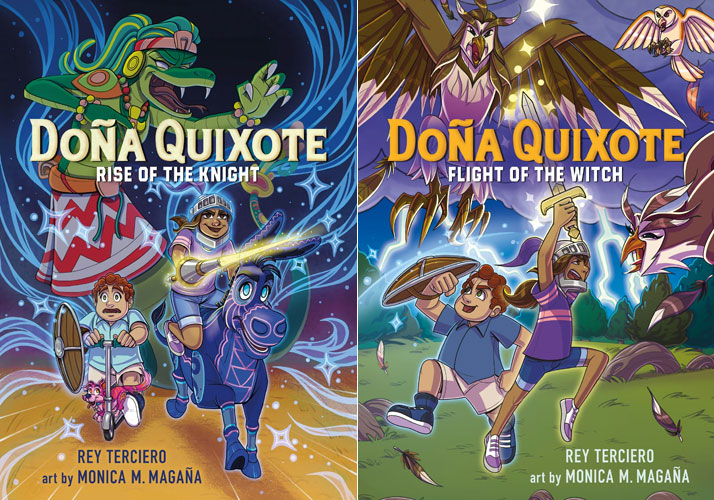
Doña Quixote written by Rey Terciero, illustrated by Monica M. Magaña
Lucia Castillo grew up hearing stories from her grandfather about fighting monsters, but the rest of the town called him Abuelo Loco and just thought he was a crazy old man wearing a knight helmet. Years later, Lucia finds her grandfather’s helmet and discovers that when she wears it, she can see the world of magical beings, including a shape-shifting mayor who seems to be up to something. With her best friend Sandro, Lucia charges into battle—but soon learns that being a hero isn’t always easy to figure out. The first book, Rise of the Knight, is about Lucia’s discovery of the magical world (and the trouble she gets into while trying to be a knight).
By the second book, Flight of the Witch, Lucia is the hero of the town, and the townspeople are constantly asking her for help. Nobody seems to appreciate the role that Sandro plays—not even Lucia herself. She thinks that being a hero is solely her responsibility, but it’s hard to save the world and keep up with your homework. In this book, the townsfolk are losing their prized possessions to thieving owls, and Lucia tracks them down to discover a coven of witches. But she can’t face them alone.
The stories are, of course, based on Don Quixote; Sandro is unable to see any of the monsters that Lucia faces, but he’s smart and is able to strategize. Meanwhile, Lucia is impulsive and leaps to attack without thinking through things first, which often gets her into trouble. The second book in particular is where she really starts to learn her lesson about relying on others, especially Sandro. (Appreciating your teammates seems to be a big theme in today’s books!) In the story, Lucia is even descended from Don Quixote himself, which is why the helmet works for her. In addition to the ties to Don Quixote, these books also include a wide variety of monsters and creatures from Latin American cultures.
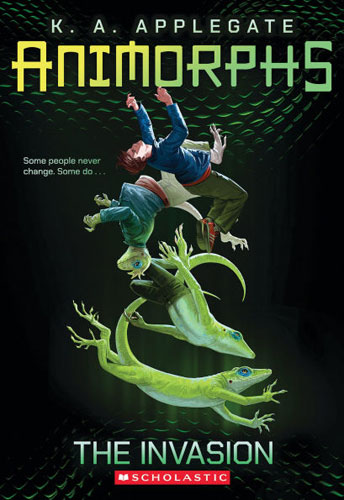
Animorphs: The Invasion by K. A. Applegate
I was in college when the first Animorphs book was published, so I didn’t read them at the time, and my own kids just never got into them. Since then, I’ve read a little about what Katherine Applegate said about the ending of the series—that it’s not the typical happy ending you’d get from a kids’ book series because she didn’t want to glorify war—and that made me a little curious about it. Well, this year is the 30th anniversary of the start of the series, so Scholastic is re-issuing the books (with new cover art that looks a bit less creepy than the ones I remember seeing at the bookstore three decades ago), and I read the first book.
Here’s the premise, in case you didn’t know already: a couple of kids encounter a dying alien, who tells them that another alien species (the Yeerks) have invaded Earth. They’re slug-like beings that get into your brain and control you, which means that anyone could actually be a Yeerk. Before dying, the alien gives them the ability to morph: they can acquire the DNA of any animal they encounter and then turn into it. But these are teenagers. How are they supposed to stop an alien invasion? Who can they tell, if authority figures might actually be the enemy? And how do they use these morphing powers to fight the invasion?
The book is pretty short and is a fast read, and things happen fast. I was a bit surprised by how intense it gets, both in terms of physical violence as well as the emotional aspects: one character soon discovers that a loved one is a Yeerk. Another spends too long in animal form—and is now permanently stuck. In the first book! Presumably there are going to be some more kids who can transform (since I can’t imagine only four teenagers are going to stop an alien army) but I guess we’ll find out.
Disclosure: I received review copies of these titles. Affiliate links to Bookshop.org help support my writing and independent booksellers.