Serve up delicious dishes at the food cart festival!
What Is Chicken Fried Dice?
Chicken Fried Dice is a roll-and-write game for 1 to 5 players, ages 10 and up, and takes about 30–45 minutes to play. It’s currently seeking funding on Kickstarter, with a pledge level of $49 for a copy of the game, or $89 for the all-in edition that includes fancier dice, a custom playmat, a wooden dice coop, and a mini-expansion with more customers..
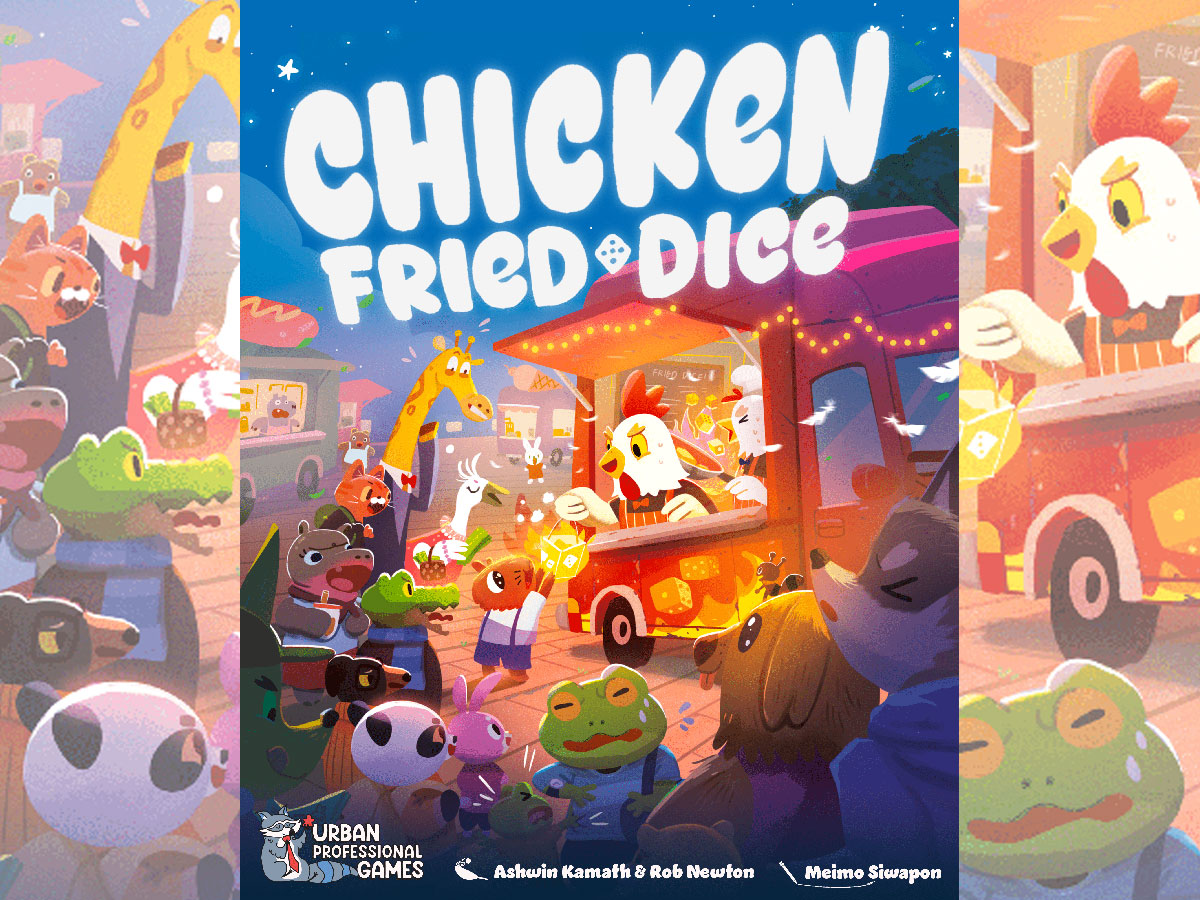
Chicken Fried Dice was designed by Ashwin Kamath and Rob Newton and published by Urban Professional Games, with illustrations by Meimo Siwapon.
New to Kickstarter? Check out our crowdfunding primer.

Chicken Fried Dice Components
Note: My review is based on a prototype copy, so it is subject to change and may not reflect final component quality.
Here’s what comes in the game:
- 5 Food Truck boards
- 5 Bonus Boards
- 20 Food Station tiles (4 per player)
- 5 Coop Wall segments
- 25 Ingredient dice (5 each of 5 colors, plus 3 Head Chef dice)
- 15 Starter Customer cards
- 81 Customer cards
- Scoreboard tile
- 5 Dry-Erase markers
- 5 Compost tiles (for solo game)

The artwork in this game is really delightful, particularly the wide variety of animal customers. The photo above is just a very small selection but you can see everything from snails to birds to a certain breakdancing koala. (There are a few other references hidden throughout, and I’m guessing probably more than I missed.)
The cards and food truck boards use little icons to denote the different dice colors—a lemon for yellow, broccoli for green, and so on. The icons are a little small (particularly in the food stations on the food truck) but can help distinguish those spaces. The dice themselves are only distinguished by color, though, so I’m not sure if this is a complete solution for color blind players.

The food truck boards are dual-layered so that they’re able to hold the food station tiles, which are used to upgrade the four sections of the food truck. The bonus boards fit underneath the food trucks and have cutouts for the wheels so everything fits flush together. The backs of the food trucks are used for the solo game—each truck has its own special rules—but it’s a shame that these fun chefs and distinct food trucks aren’t visible in the regular game.
The bonus boards are also double-sided: one side is the menu side (recommended for learning games), and the other is the picnic side offering a new way to use the flavor bonuses.
The truck boards, bonus boards, scoreboard, and customer cards are all glossy so that you can write directly on them with the dry-erase markers. One fun touch is that the backs of the customer cards look like order tickets—and they actually have different order numbers on them!
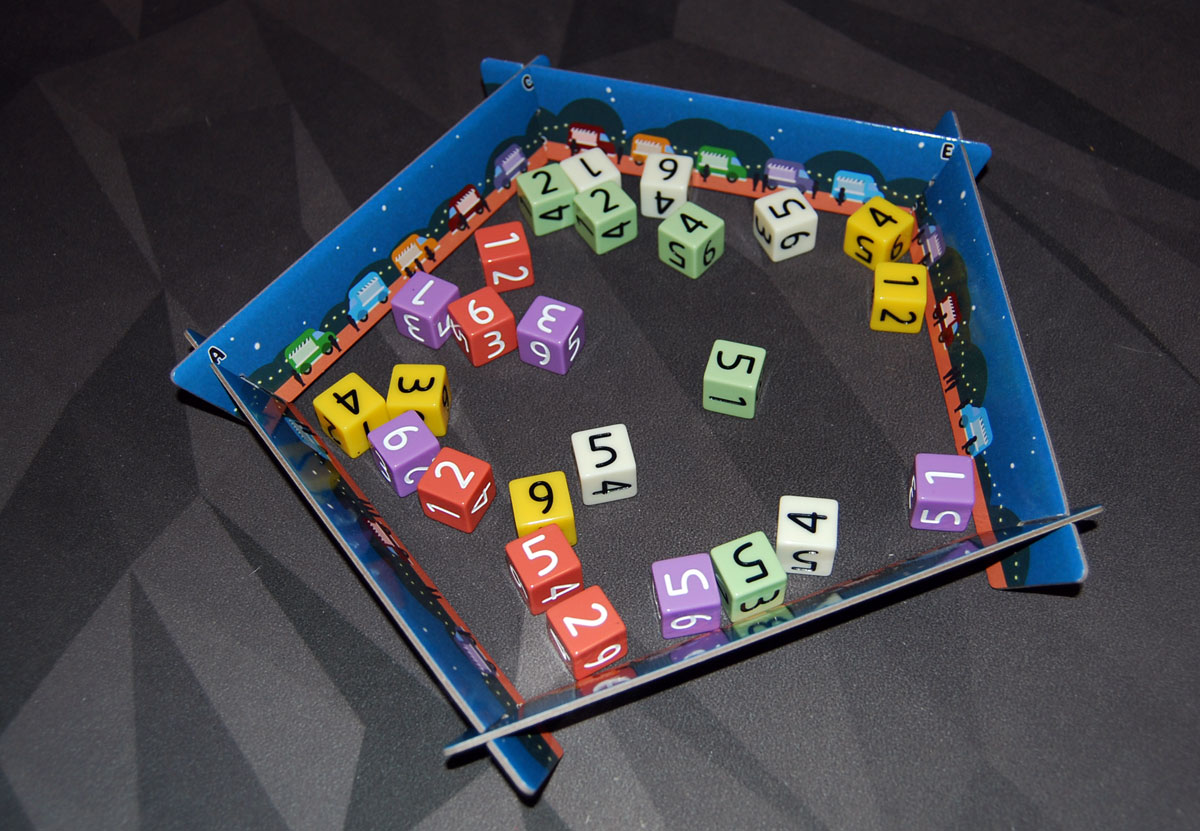
Since most of the dice are all rolled into a shared pool, the dice coop is a nice way to provide a dice tray without too much expense: it’s five pieces of cardboard that slot together to make a pentagonal enclosure. The walls are angled outward, giving it a bit of a bowl shape. You can’t pick it up, but you shouldn’t have to because players are only allowed to take one die at a time from it anyway. (In some of my photos I had the tray assembled with the illustration on the outside so it looks blank—I believe it might be printed double-sided in the finished game.)
How to Play Chicken Fried Dice
You can download a draft of the rulebook here.
The Goal
The goal of the game is to score the most points by serving customers, upgrading your food truck, and earning tips!

Setup
Assemble the coop and place it where everyone can reach it. Make a pool of dice: one of each color per player, plus the three head chef dice. Shuffle the customer decks and place them nearby.
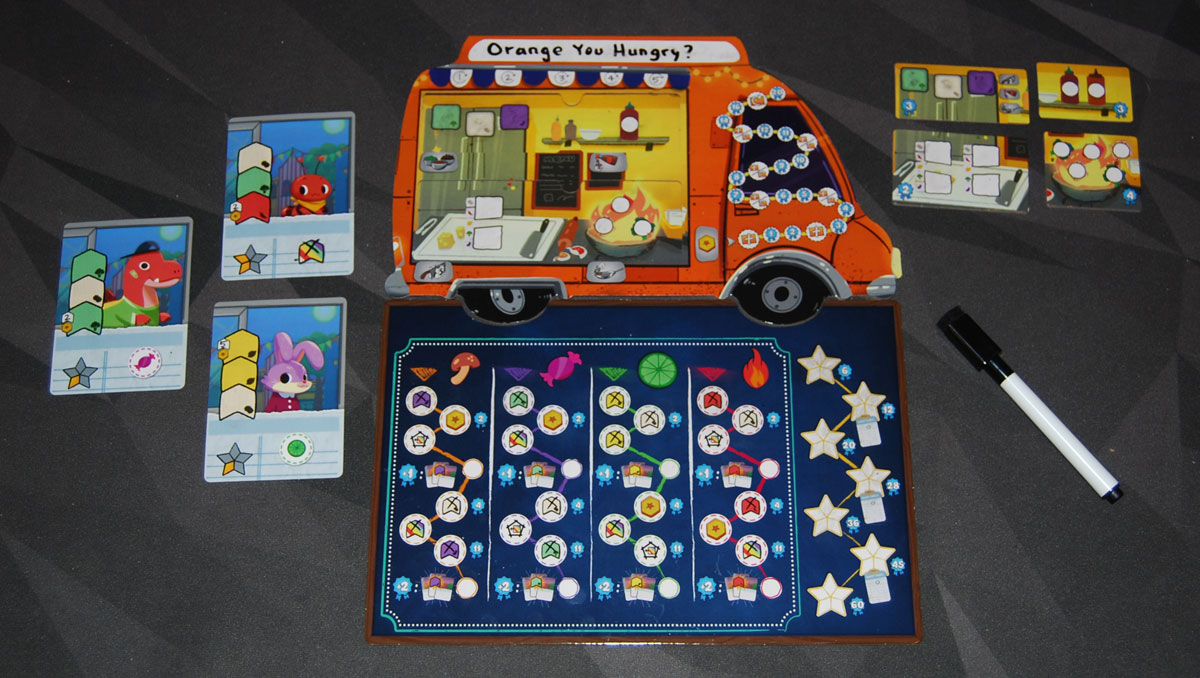
Give each player a food truck and bonus board, a dry-erase marker, and the 4 food station tiles matching their truck color. Also deal three starting customers to each player, which are placed face-up. Everyone should name their food truck.
The player who cooked for a group most recently becomes first player and takes the head chef dice.
Gameplay
The game takes 5 rounds. Each round has three phases: Prep, Chuck and Pluck, and Cleanup.

Prep: The head chef rolls the three head chef dice and decides the order they will go into the prep station in the upper left corner of their food truck. Everyone else writes them in the same order. (Everyone will get at least one turn as head chef, and depending on player count there may be rounds where everyone can choose for themselves.)
Chuck and Pluck: This phase is the meat (or the tofu?) of the game. First, everyone takes 5 ingredient dice and chucks them into the coop simultaneously. Then, everyone simultaneously gets to pluck dice from the coop to use to create dishes for their customers. There is no turn order—everyone just plays at their own pace.
A few rules:
- You may only take one die at a time, and you must use it before you take another die.
- You may only take 4 dice total per round (unless you use a special effect that gives you additional dice).
- No roughhousing!
- Don’t change the die’s value after plucking!
- Once you’ve set the die down in front of you, you can’t put it back.
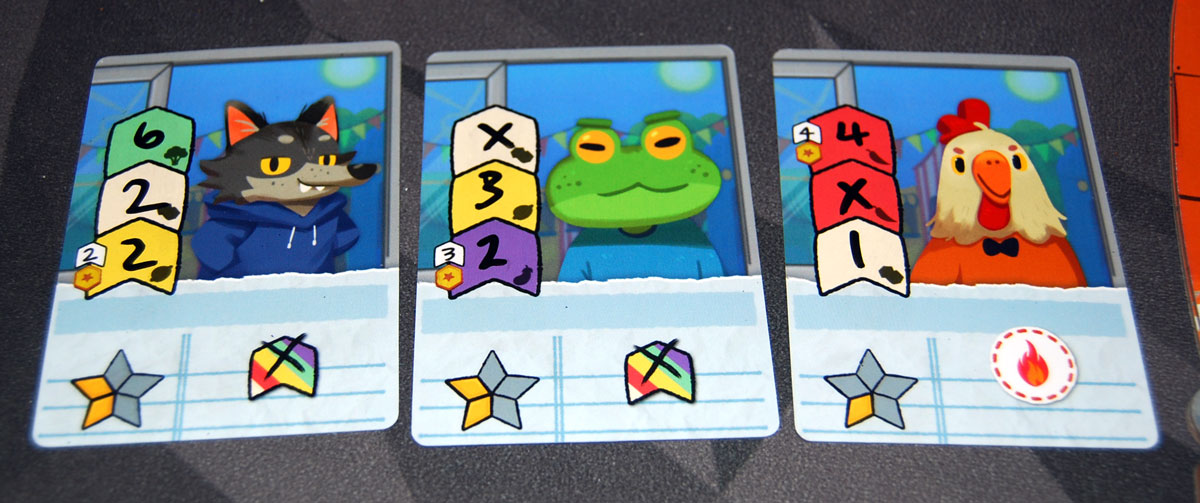
When you pluck a die, set it near your food cart, and then you may use its value and color on one of your recipe cards. Each recipe card has a number of colored spaces to fill out—these are the ingredients needed to create that dish. The values of the dice must stay the same or increase as you go up the card, though you can fill out the spaces in any order. (For instance, for the wolf customer seen above, I could write the white 2 in the center space, then write the green 6 at the top and then complete it with the yellow 2 at the bottom.)
When you complete a card, you immediately get the bonus effect at the bottom of the card—either a free cross-off or a flavor bonus. The free cross-off can be used to write an “x” in a matching ingredient space on a customer—it does not count as a number but is considered to be in the correct sequence.

Another possible bonus effect is a flavor bonus—these are marked on your bonus board below your food truck. On the menu side of the bonus board, there are four flavor profiles—savory, sweet, sour, and spicy—and each one has its own track. You circle the bonuses from top to bottom, and then you can cross them out at any time to use them. These effects can let you fill in an ingredient space, grab another die from the coop, or earn extra tips. You’ll also score bonus points at the end of the game based on hitting spaces on the tracks.
On the picnic side of the bonus board, you fill in the flavor icons in the seats at various picnic tables, following the rules on each one for matching or non-matching icons. You’ll get bonus actions for filling in spaces, and bonus points at the end of the game for filling tables.
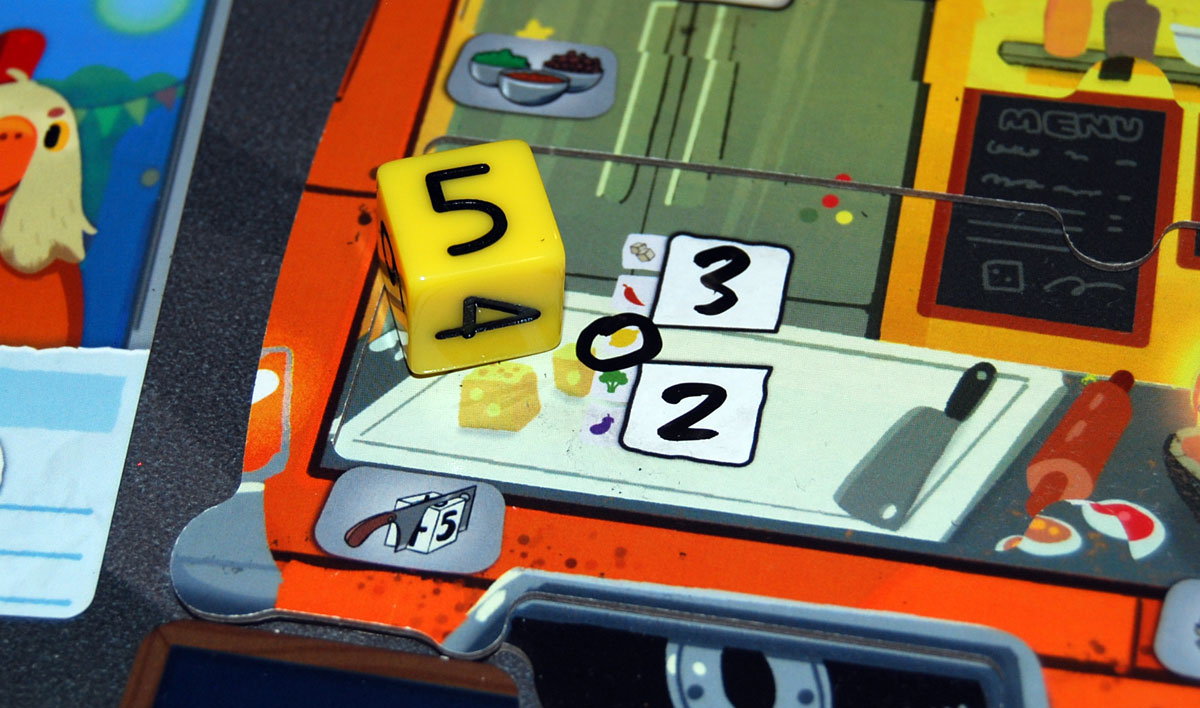
Your food truck has some food stations that can be used to manipulate dice as well. The prep station (where you wrote the three head chef values) has three dice that can be used during this round as the ingredients shown; at the starting level, you cannot modify these prep dice in any way. Just cross them out when you’ve used them on a customer card.
The chop station lets you take a die and cut it into two smaller values—it retains the same color, but now you have two separate values to use. The sauce station lets you change the color of a die, and the toss station lets you re-roll a die.
Once everyone is done grabbing dice (don’t forget to use your prep station numbers!), then the Cluck and Pluck phase is over.

Cleanup: First, erase all the marks on your food stations and reset them for the next round.
For each customer that you completed this round, count the number of highlighted review star segments on the cards, and mark them in the star segments on your bonus board. Each completed star will earn bonus points, and every other completed star will give you more customers. Then move completed customers to a scoring pile.
For each customer that was not completed, color in one highlighted star segment on the customer card—these will no longer earn you star segments when you serve them. If a customer did not have any left to color in, then that customer leaves in a huff. (Fortunately they don’t leave negative reviews!)
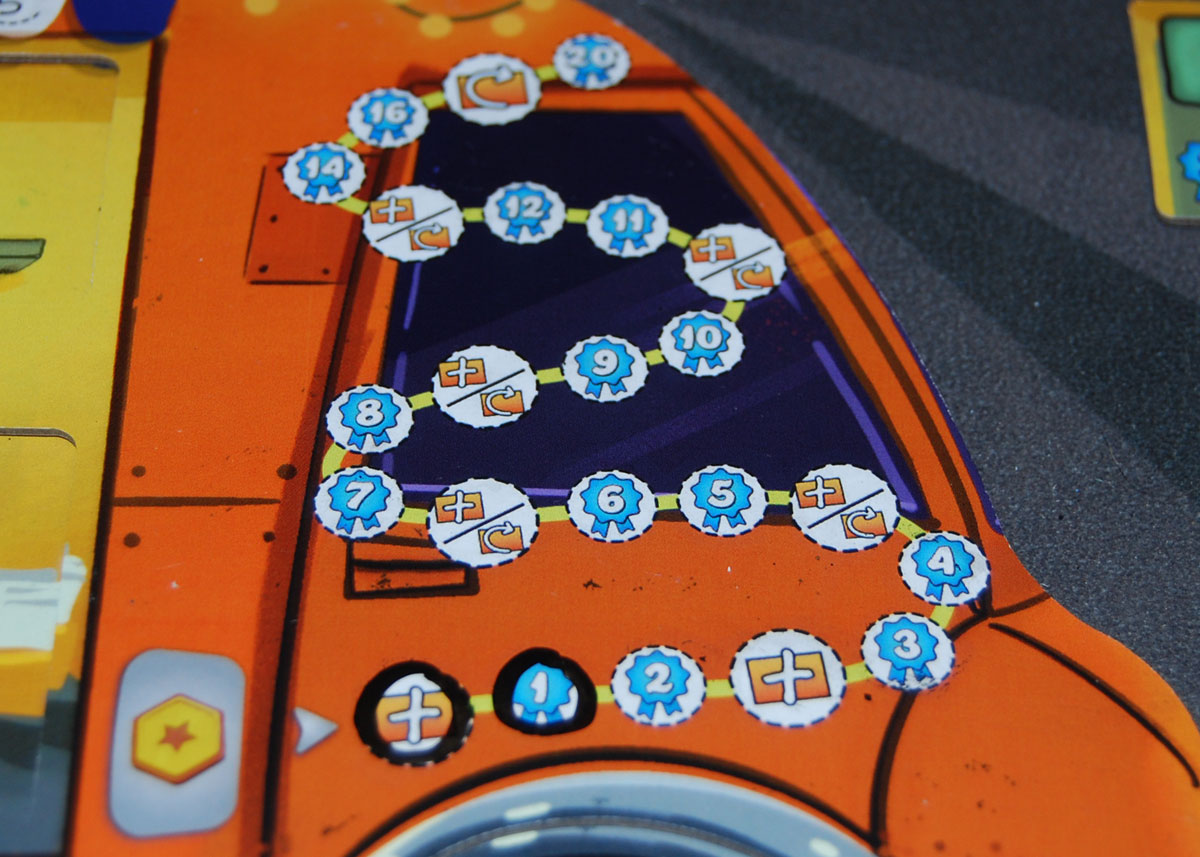
Finally, check your cards for tips: some ingredient spaces on the customer cards have a little tip icon and a number. If you filled in the space with the matching value, then you earn one tip. Mark off the tips on your tip chart—blue ribbons are for scoring, and the rectangle icons are for upgrading your food stations.

Each food station can be upgraded twice—you add the tile to your board for the first upgrade, and then flip it over to the “fire” side for the second upgrade. Upgrades are also worth points, shown on the blue ribbons on the tile. Upgrading the prep station will add the ability to chop, sauce, and toss your prep dice; the second upgrade makes two of the dice wild colors. Upgrading the chop, sauce, and toss stations lets you do those actions more times per round.
Attract new customers: draw 3 new customers from the deck, plus one for each bonus star that you’ve completed that shows a customer card icon. You may discard any number and draw back up once per round, and you must keep at least 3 new customers. (But, just like a real food cart, you reserve the right to refuse service to anyone and eventually they’ll just go away.)
Pass the head chef clockwise to the next player.
Game End
The game ends after the end of five rounds.
You score points for:
- The highest blue ribbon you reached on the tip track
- Blue ribbons on your food station upgrades
- Points earned on your bonus board
- Points for the highest completed review star
Highest score wins, with ties going to the player who served the most customers.
Solo Variant
There is a solo variant where you choose one other food truck to be your competitor, which means there are five different automated chefs to play against. You get to be head chef every round, but the order that you use for the prep dice will affect what dice your rival tries to take from the coop, how many bonus points they earn for the round, and what unique rule is triggered for that round.

Why You Should Play Chicken Fried Dice
“Are you expecting me to believe a chicken fried these dice?”
Yes, absolutely. Just look closely at that cover illustration!
Aside from having a punny title, Chicken Fried Dice is a great blend of sweet and spicy. It’s adorable and cute, and it has a bite. It requires a nice balance between playing fast and careful planning, as you try to serve all your customers from a rapidly dwindling supply of ingredients. There are lots of ways that roll-and-write games use dice: in some instances, everyone can use the values rolled and they aren’t consumed; in others, players take turns drafting dice so they are consumed but in an orderly fashion. Chicken Fried Dice throws in some real-time shenanigans, which means you need to think ahead about what color-and-value combinations you’re looking for and prioritize plucking those dice first!
(As with any real-time game, one of the potential difficulties is making sure that everyone is actually playing correctly, so it’s a good idea to check in with all the players after each round to make sure everyone is only taking 4 dice per round, that they’re filling out their customer cards correctly, and so on.)
If you love combos, there’s plenty of that to be found. Serve this customer, which lets you check off an ingredient on this customer, which completes them, giving me a flavor bonus that gets me another die that I can use on this third customer. You have terrible luck with dice? In this game you can chop, sauce, and toss them to manipulate values and colors. (My favorite by far is chopping—making my ingredients go a long way!)
You’ll have to make choices about how to spend your dice. Do you try to match all the right numbers for tips (so you can upgrade stations more quickly) or do you make it easier to fill in the customer cards? Depending on which values you write on the cards, you can make the remaining spaces a lot more restrictive. Serving customers quickly can be worth a lot of points—and good reviews will bring in even more customers—but making sure each dish is perfect earns you tips, and those upgraded stations make it easier to get all your customers served.
I’ve really enjoyed playing the prototype of Chicken Fried Dice and I’m excited that it’s finally launching. I saw designer Ashwin Kamath running demos of this last year at some local cons, so I know it’s spent a long time in the prep stage—but now it’s time to get cooking!
For more information or to make a pledge, visit the Chicken Fried Dice Kickstarter page!
Click here to see all our tabletop game reviews.
 To subscribe to GeekDad’s tabletop gaming coverage, please copy this link and add it to your RSS reader.
Disclosure: GeekDad was loaned a prototype of this game for review purposes.