Greek Mythology is filled with gods, heroes, monsters, quests, and much more. Now you can create your own pantheon and realm out of a hand of cards in order to score the most points. The award winning card game Fantasy Realms has been given a new theme and some new mechanics to adapt the original to the stories of myths of ancient Greece in Fantasy Realms: Greek Legends.
What Is Fantasy Realms: Greek Legends?
Fantasy Realms: Greek Legends is a hand-building card game for 2-6 players, ages 12 and up, and takes about 20 minutes to play. The game consists of players drawing cards from a deck or discard pile in order to form the best combos and score the highest points. Fantasy Realms: Greek Legends was designed by Bruce Glassco and published by Wizkids, with illustrations by Darren Calvert. It’s currently available for preorder from WizKids as well as online retailers such as Amazon and has a suggested retail price of $19.99 for a copy of the game.
Fantasy Realms: Greek Legends Components
Here is what you get in the box:
- 79 Cards
- 6 Reference Cards
- 1 Rulebook
- 1 Score Pad
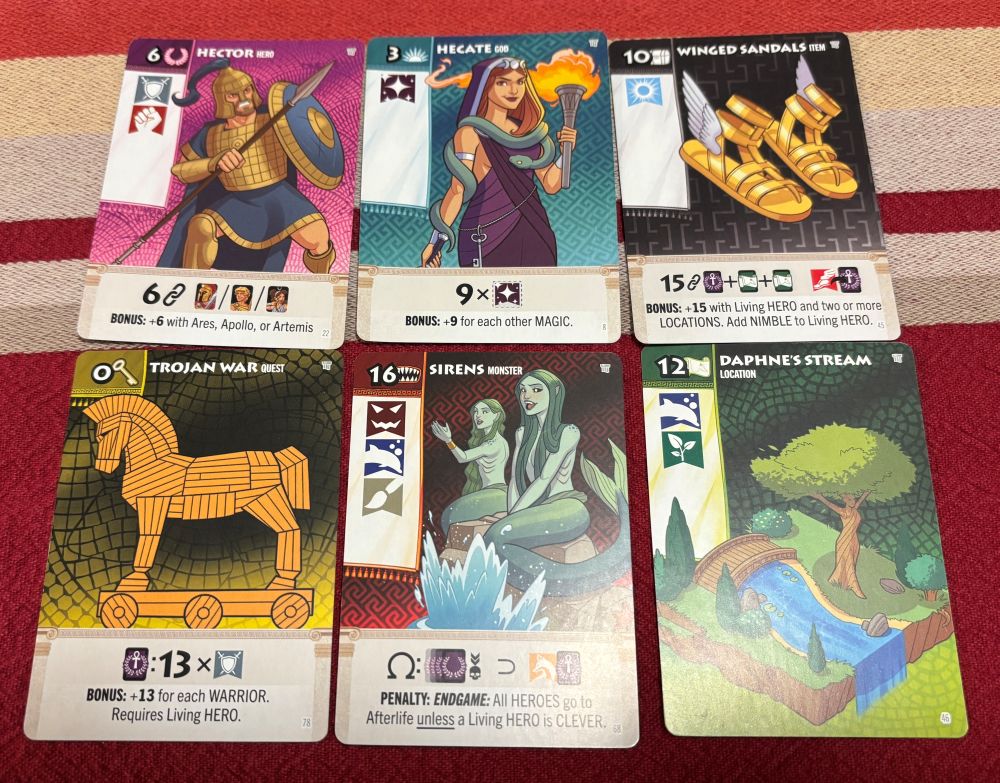
There are 79 cards in the game. They are divided into six suits of 11-19 cards each. Each card has a unique name at the top, a suit listed along with a base value in the top left corner which can be from 0 to 25, tag icons along the left side, and bonus or penalty text that explain how the card interacts with other cards.
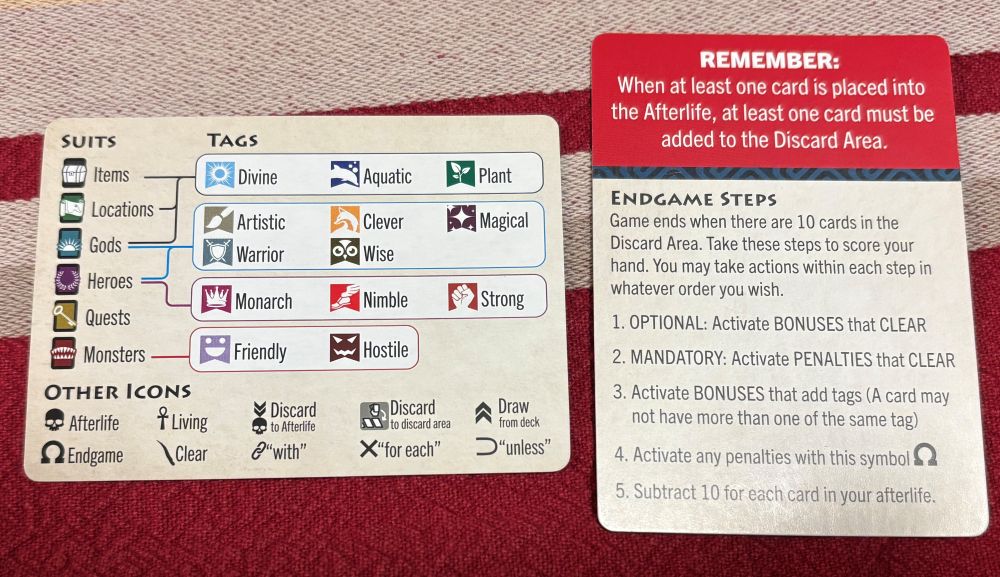
The game also includes six reference cards that list the end game steps as well as a key to all of the icons for suites and tags. These are great for new players when learning the game.
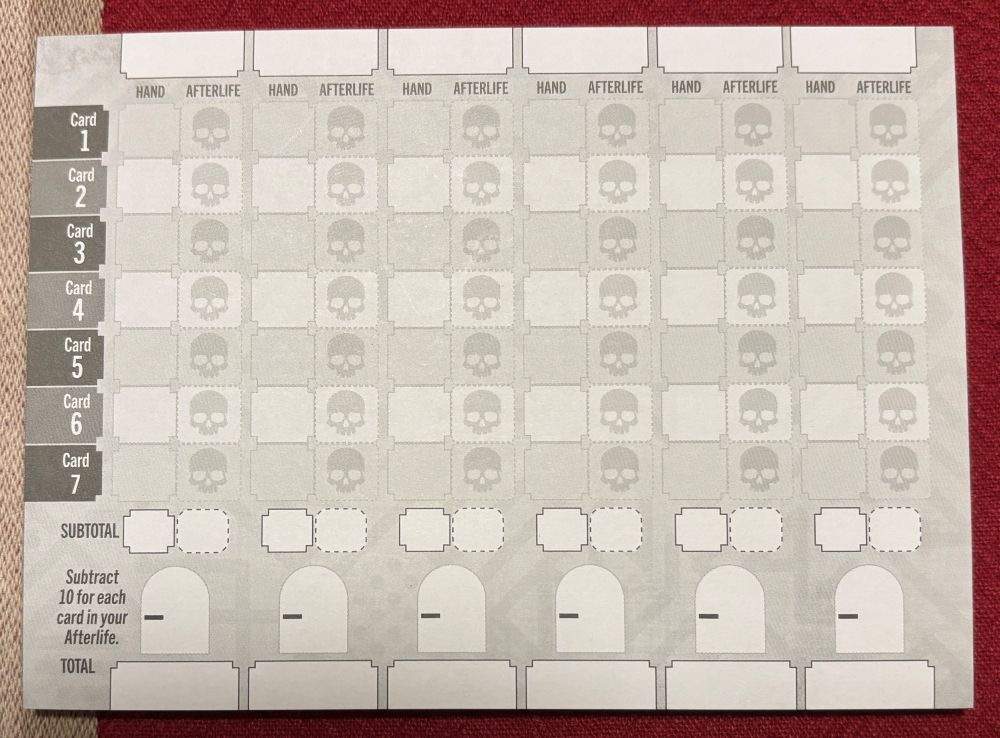
At the end of the game, the score pad is used to calculate each player’s score. There are spaces on each double-sided sheet for six players and their scores for their hand as well as the cards in their afterlife.
How to Play Fantasy Realms: Greek Legends
The Goal
The goal of the game is to earn the most points with the combination of cards in your hand at the end of the game.
Setup
Fantasy Realms: Greek Legends is extremely easy to setup and start playing. Shuffle the deck of 79 cards and deal seven cards to each player. Then take the remaining cards and place the deck in the center of the play area along with open space to place discarded cards next to it. Randomly choose a starting player and then begin play.
Gameplay
During a player’s turn, they can either draw a facedown card from the deck or select one of the faceup discarded cards. The first player must draw from the deck since there are no discards yet. After drawing a card, the player then discards one of the cards from their hand and places it faceup in the discard area or into their Afterlife. Be sure to spread out the discarded cards so that all players can see these cards. Players can discard any card, including the one they just drew. If a player discards into their Afterlife, they also must draw the top card from the deck and add it to the discard area. The player to the left then takes their turn and play continues in a clockwise direction with each player taking a card and discarding a card during their turn.
As players are drawing and discarding, they are trying to create combos to maximize their points. Therefore, it is important to understand how they bonus and penalty text works. There are five main terms used in these texts on the cards. ‘With’ refers to a bonus you get when this card is with a card of the designated type. The bonus is only applied once. On the other hand, ‘For Each’ would provide that bonus or penalty multiple times if there are more than one card of the type listed. ‘Clear’ can be a tough concept at first. If a card says it clears other cards, those cleared cards have their bonuses, tags, and penalties. Essentially it wipes out everything for those cards. ‘Blanked Unless With’ applies the blanking unless one of the named cards is also in your hand. Finally, ‘Clears’ can get rid of a penalty or part of a penalty on a card. That card still keeps its suit and base value. There are only a few cards that have Clear on them.
Game End
The game ends as soon as there are 10 cards in the discard area. Players then calculate their scores using the score pad. On the score pad, players list the value of each of their 7 cards in their hand along with any bonuses or penalties. They then list the values for the cards in their afterlife. Add these totals together for cards in your hand and your afterlife and then subtract 10 points for each card in the afterlife.. The player with the highest total score is the winner. In case of a tie, the hand with the lowest total base value, including cards in the aferlife, is the winner.
Let’s look at a couple examples of combinations of cards in players’ hands at the end of the game.
Theseus is worth 10, Artemis is worth 21 since there are two hostile monsters, the Golden Apples are worth 17 sine there is a quest, the Minotaur and Antaeus are worth 15 and 18 respectively, the Labyrinth is worth 13 because there is at least one hostile monster, and the Epic Quest is worth 30 since all of its bonus requirements are met. This hand is worth 124.

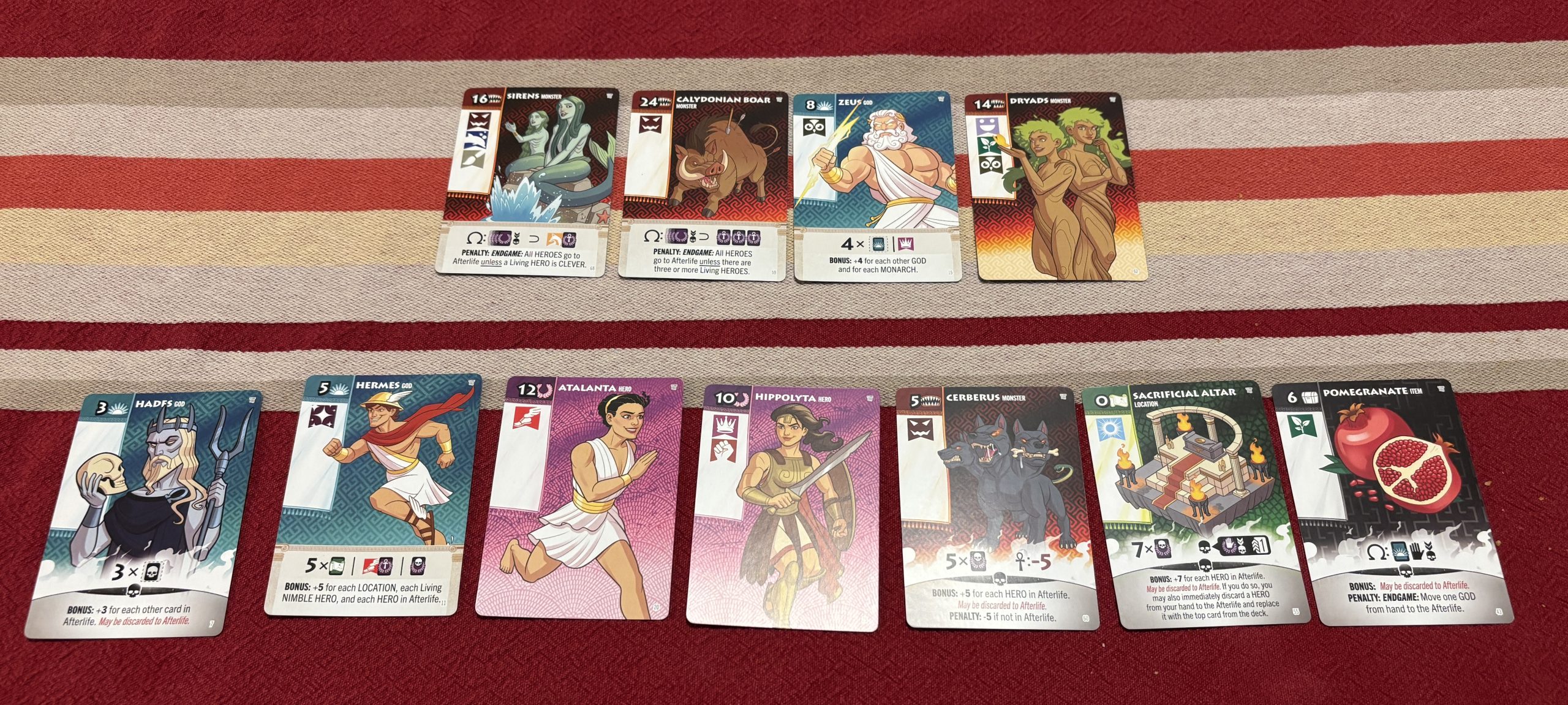
This hand has four cards that the player discarded to the afterlife. Then the monsters and the Pomegranate send the two heroes and Hermes to the afterlife at the end of the game. Let’s score this hand. The Sirens are worth 16, the Calydonian Boat is 24 and the Dryads are 14. Zeus is worth 20 because of two other gods and the monarch hero. Hades is worth 21 since there are six other cards in the afterlife. Hermes is 20 with 2 heroes and an location. Atalanta and Hippolyta are worth 12 and 10 respectively. Cerebus is worth 15 since there are two dead heroes and the Sacrificial Altar is worth 14 for the same reason. Finally, the Pomegranate is worth 6. Then you lose 70 points for 7 cards in the afterlife. So the final total for this hand is 82. While the player was able to score 11 cards instead of 7, the penalties cost the player more than the bonuses for sending heroes and a god to the afterlife.
Why You Should Play Fantasy Realms: Greek Legends
Let me start off by saying I absolutely love the original Fantasy Realms. It is one of my favorite games. I first played in when it was originally released in 2017 and have been playing it ever since. A new version of the game was released in 2021 and it was one of the three finalist nominees for the 2021 Kennerspiel de Jahres, which recognizes the expert or connoisseur tabletop game of the year which are usually aimed at more experienced players. While the suggested age range is 12 years and up, some younger children might be able to play this. Scoring and understanding bonuses and penalties are what make this game difficult for younger children. WizKids released Marvel Remix and Star Trek: Missions in 2022. Both of these are card games based on the Fantasy Realms rules that use their own themes with some additions and changes to the rules to make them better fit the theme. I enjoyed both of these games as well as the Cursed Hoard expansion to the original Fantasy Realms.
There are several reasons I like Fantasy Realms: Greek Legends. First, it is fast to setup and easy to teach to new players. Another reason to enjoy this game is because it is different every time. Everyone gets seven random cards at the start. Therefore, it is hard to have a pre-arranged strategy. Players have to see what they get and then change their strategy on the fly depending on what cards they draw and what cards other players discard. In many games, I will come up with a plan at the start only to change it when something better is revealed during play. There is also an element of push-your-luck as you might hold onto a high value card that is only valuable if you can find other cards that benefit it. As a result, when the number of cards discarded begins to approach 10, you have to decide whether to ditch those cards or push on. The interaction between cards is amazing. While some cards have a bonus with just one or two other cards, others can benefit, or penalize, several cards. You really have to pay attention to both names as well as suits. Finally, a game of Fantasy Realms: Greek Legends goes rather quickly. This makes it great for a quick game to start a game night, for playing during a lunch break. Since the box is not that big, you can also take it easily with you while travelling or camping, though I would suggest putting sleeves on the cards. Plus the artwork on the cards looks great. It has almost a cartoonish look.

One of the new unique features of Fantasy Realms: Greek Legends is the addition of the afterlife. This is essentially a personal discard that can provide more cards for scoring at the end of the game. The downside is that each card in the afterlife subtracts 10 points from your final score. Therefore, players need to make sure that each card in their afterlife provides more than 10 points of bonus to make up for the penalty. While I still continue to enjoy the original Fantasy Realms, one of the downsides is all of the interactions between cards. This can make the game difficult for new players. Fantasy Realms: Greek Legends is a bit easier for new players. The cards have suits based on the type of card: items, locations, gods, heroes, quests, and monsters. There are symbols that show bonuses and penalties. I really like that below the symbols, there is a written explanation of the symbols that helps players know what to do while they learn the symbology. This combination is great for teaching the game. The toughest part for beginners is understanding what ‘clears’ means and I explain that it essentially erases certain values and information on that card.
Everyone with whom I have played Fantasy Realms: Greek Legends has enjoyed it. I highly recommend Fantasy Realms: Greek Legends for fans of the original as well as those who enjoy a quick, thinking card game with a fun theme.
For more information, visit the Fantasy Realms Greek Legends webpage!
Click here to see all our tabletop game reviews.
 To subscribe to GeekDad’s tabletop gaming coverage, please copy this link and add it to your RSS reader.
Disclosure: GeekDad received a copy of this game for review purposes.