
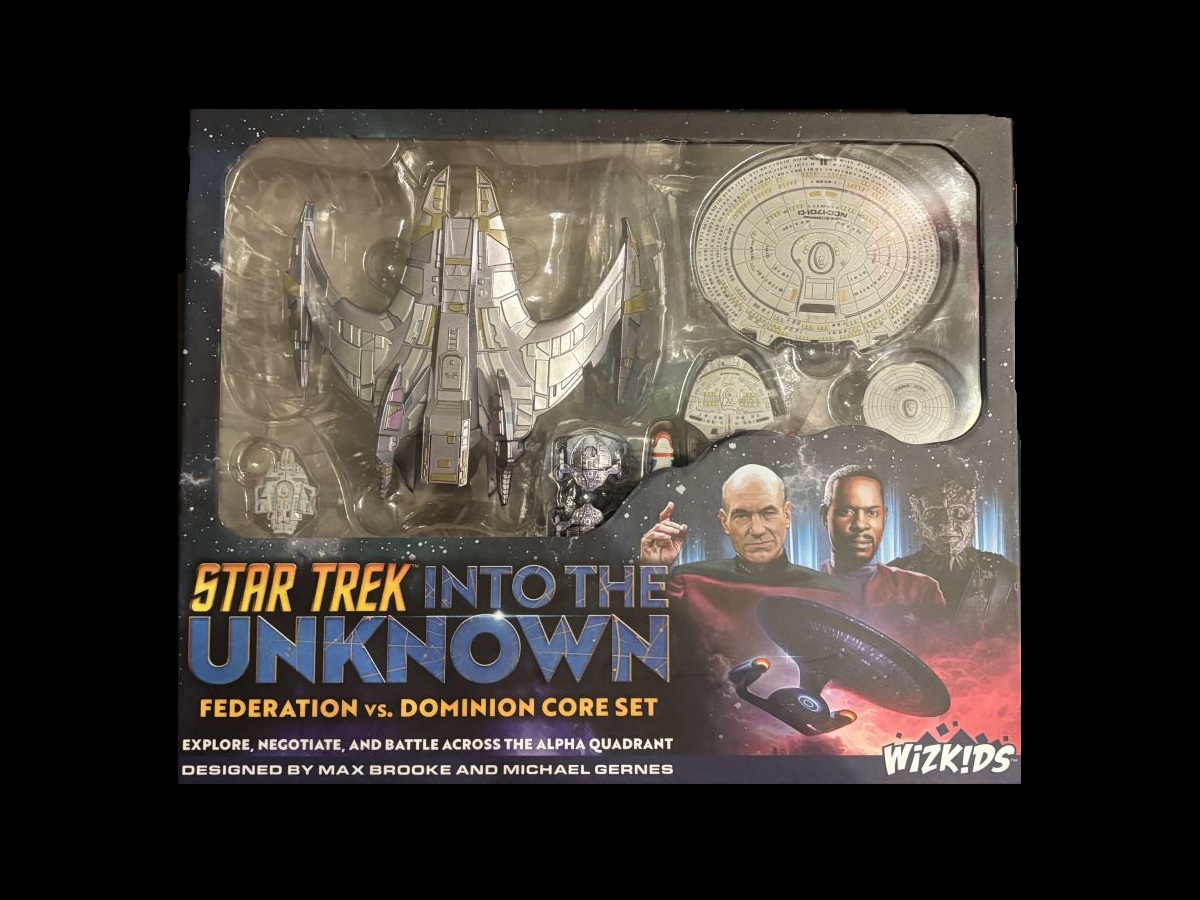
For 60 years, Star Trek has been a franchise that includes television shows, movies, books, comics, animated series, tabletop games, video games, and every type of merchandise you can imagine. The number of stories and characters have increased astronomically since the beginning. Now players have the opportunity take take command of starships from Star Trek as they play through story-driven campaigns or tactical duels in Star Trek: Into the Unknown. This game is set during the Dominion Wars which take place during the latter seasons of Star Trek: Deep Space Nine.
What Is Star Trek: Into the Unknown?
Star Trek: Into the Unknown is a tactical miniatures game for 2 players, ages 14 and up, and takes about 30-180 minutes to play. Each player commands a fleet of starships from the galaxy’s major civilizations to compete in evolving, multi-part missions. Fleets maneuver, explore, and negotiate, but when conflict erupts, they must leverage every advantage to defeat their opponents in thrilling space combat. The game is currently available at local game stores as well as through online retailers such as Amazon. The Federation vs. Dominion Core Set sells for a suggested retail price of $149.99 for a copy of the game. A miniature of the USS Enterprise-D with metallic paint is also available for $29.99. Other expansions will be available soon.
Star Trek: Into the Unknown was designed by Max Brooke and Michael Gernes and published by WizKids, with art by Kurt Komoda, Daniel Solis, Joshua Gilardi, and Rickey Riddey.
Star Trek: Into the Unknown Components
Here is what you get in the the Federation vs. Dominion Core Set.
- 6 painted ship miniatures
- 6 ship display cards
- 7 base and peg sets
- 30 officer cards
- 24 mission cards
- 30 damage effect cards
- 30 equipment, directive, and other unit cards
- 2 saucer separation cards
- 12 dice
- 2 turning tools
- 3 transparent range rulers
- 2 system marker sets
- assorted gameplay tokens
- 1 Learn to Play guide
- 1 Campaign guide
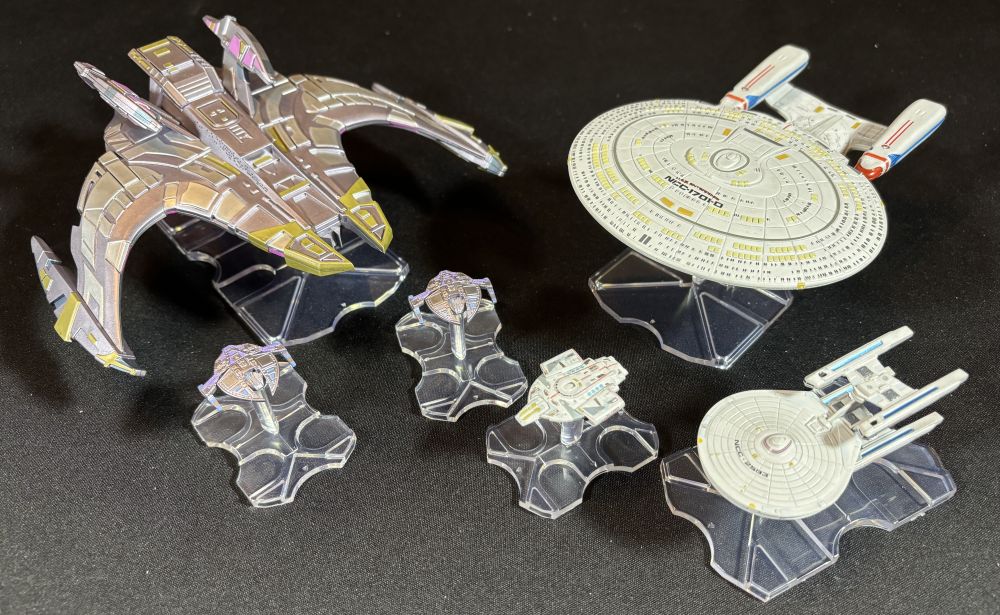
Star Trek: Into the Unknown-Federation vs. Dominion Core Set comes with six fully-painted starships. These include a Galaxy class capital ship, a Constellation class support ship, a Defiant class scout ship, a Jem’Hadar battle cruiser, and two Jem’Hadar fighters. These ships are mounted to bases using pegs and the bases have slots to hold informational tokens.

Each of the six starships have their own ship display. These displays include information on all of the actions that ship might take divided into different stations to which officers can be assigned. The displays also have four dials to keep track of the current conditions of the ships. The tip dial records reserve power, the dial on the right side displays alert status, recharge rate, engine power, weapons power, instruments power, shields, and launcher status. The dial on the top left shows hull status while the dial below it represents the current stats for the ship’s crew.

Officers are the main characters of the story. While they are not units themselves, they can be placed aboard ships and give orders to take actions. Officers are represented by officer cards. Each card has two sides–Ready and Committed. The ready side lists all the information about the officer including their skills and abilities. This side shows that the officer is ready to give orders. Once an officer has been chosen to give an order, the card is flipped over to the committed side. This side has a large image of the officer as well as abbreviated information that is used during the game for committed officers.

Mission cards are used to assemble the three parts of non-story missions called incident missions. There are overture cards which instruct players how to setup an incident mission, situation cards which contain special rules that run throughout the mission, and complication cards which provide a twist midway through the mission. There are also directive cards provide additional rules for each player depending which of three directives are being used: combat, exploration, or diplomacy. If hostilities erupt, players flip over their directive card to the hostile side which provides rules for the new situation.

Each type of ship has their own unique deck of damage cards. When a ship takes a certain amount of damage and is required to draw a damage card, that card is then used to show the effects of the damage and how it can be repaired.

In addition to the other cards, there are also title and equipment cards which can be attached to starships to provide additional actions or reactions to a starship. These can be provided during the setup of a story mission or purchased when creating your own missions.
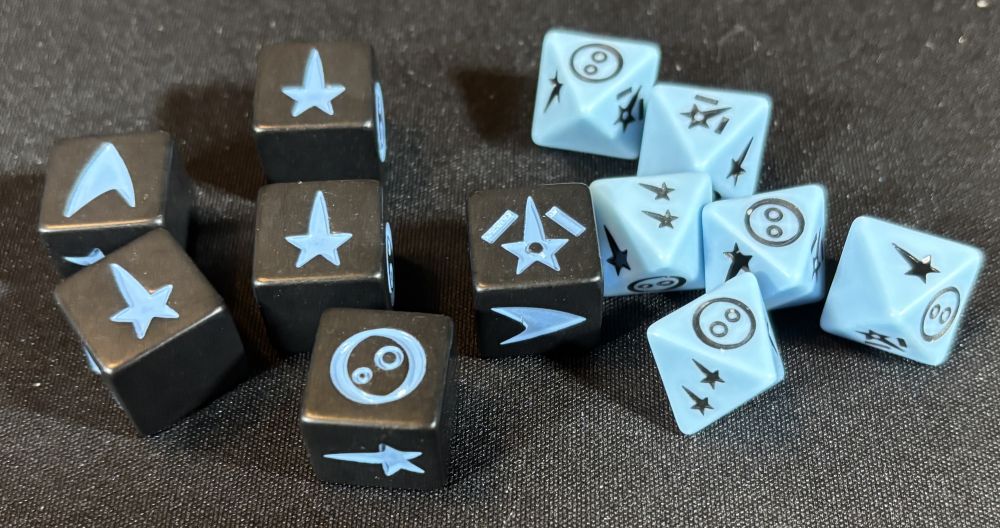
Star Trek: Into the Unknown includes two types of dice. The blue eight-sided dice are intuition dice and are used for various tests that must be made during a game. The black six-sided dice are expertise dice and used during a test when a committed officer leading a test has the relevant skill for that test and are rolled in addition to the intuition dice called for during a test.

When moving starships, players use the turning tools and rulers. The turning tool as marks to designate the amount of rotation a ships is making. The rulers are used to measure the distance the ships move. The turning tool actually fits over the ruler so a player can slide the tool and ship along the ruler to its new position. System markers are used to show the four corners of the play area which is always 36 inches by 36 inches as well as the center of systems and their circular boundaries. A mission may have 1-3 systems in the play area.

The game includes many assorted tokens that are used to record the status of units, objectives, projectiles, shuttles, and more. The punch sheets holding the tokens actually include labels telling players each type of token.
How to Play Star Trek: Into the Unknown
The Goal
The goal of the game is to score more victory points than your opponent. These victory points are earned, or lost, in a variety of ways depending on the scenario or game being played.
Setup
The setup of a mission is contained in either the story missions or by using the missions cards. They include making the play area and using the boundary markers to created systems. Any objectives or other things are placed on the player area. Players choose which side they will be playing as, then take their directive cards and assemble their fleet of ships and ship display cards. The ships are placed in the play area as instructed by the mission. Next they collect the officer cards they will use. One player is given the priority token as determined by the mission. The influence tracker is placed just outside of the play area along with the influence token. Finally, the dice and tokens needed for the mission are placed within reach of all players. Before beginning the mission, both players should be familiar with the Overture for the mission as well as the Situation. These can be found on mission cards or in the story missions. They provide information on scoring victory points as well as additional actions which players can take related to the mission.

Gameplay
Star Trek: Into the Unknown is played in rounds with each round consisting of five phases. Let’s take a look at each phase in turn.
The Priority phase starts with the player who has priority for the round and can give a priority order. The players take turns giving one priority order until both players have passed or neither player has any ready officers. A player can pass at any time, but once they pass, they are done giving priority orders for the round. In order to give a priority order, a player first choses a unit to activate and a specific action for that unit. Actions can be found at the stations for a ship’s display card. If at a station, the player must choose a ready officer at that station or choose a ready officer in the same section as that station and assign them to an open station. Next, the officer is committed by flipping the officer card to its committed side. Finally resolve the action as described.

After the Priority phase is complete, the players progress to the Standby phase. This has two steps: ships activate and then projectiles activate. This time the standby player (the one who does not have priority) goes first. Each player takes turns giving each of their ships one standby order. Standby orders do not require a ready officer to be at a station and a ready officer does not have to be committed to perform a standby order unless you want to use the officer’s abilities to pay the cost of the action. With the exceptions of firing weapons, a unit can perform the same action twice with both a priority order and then a standby order. Once players have chosen to give a standby order to as many ships as they wish, second part of the phase occurs where projectiles activate. Each torpedo must be given a standby order while all other projectiles may be given a standby order.

The Hazard phase comes next. Here players resolve hazard effects starting with the priority player. First they resolve effects from damage cards followed by effects from features such as anomalies. Finally, hazard effects from special mission rules or hazard units are resolved. The priority player resolves all of their hazards and then the standby player does the same.
During the Ready phase, the priority player completes all four steps of this phase then the standby player does the same. During the first step, each ship must cancel a number of peril tokens by spending an equal number of advantage tokens. Next, the player readies up to 3 committed officers. That is a total number of officers, not 3 per ship. Now the player can relocate to any station or section of the ship no matter their status. Finally, the player resolves all unit or officer abilities that have a Ready ability. For example, ships can regain reserve power during the Ready phase from their engineering station.
Finally, the Hail phase allows fleets to negotiate with each other. Starting with the priority player, a player can choose to hail another player or pass. Hails are available on the diplomacy directive card, through mission rules, or another component. Then after both players have completed all phases, the player with the priority token this round flips it over and gives it to the other player to end the round and begin the next round.
During the mission, once something occurs that starts the complication as listed in the overture, the players refer to the influence tracker, which can be adjusted per mission rules, and then select the complication based on which player has more influence. The complication is a twist in the game and may require some setup and changes in the mission rules.
Game End
Once a complication begins, the complication directions provide the events which trigger the end of the game. Players then tally the victory points they have earned and the player with the most victory points is the winner.
Why You Should Play Star Trek: Into the Unknown
First off, when I first received a copy of Star Trek: Into the Unknown–Federation vs. Dominion Core Set, I was a bit overwhelmed. It comes with a 40-page Learn to Play guide as well as a 40-page Campaign Guide. Plus there are links to a living document called Additional Rules which provides another 60 pages. However, by just focusing on the Learn to Play guide first, it found that the rules can be learned as you play the game. In fact, the Learn to Play guide walks players through the learning mission called ‘At Perdition’s Gate’. In fact it walks players through setting up the mission before it even gets into the rules. After covering the basics of how the game is played, it continues in more detail as providing instructions to actually play the learning mission. For example, the Federation ship uses the engage warp action to move into the system with a priority order. Then the Dominion player, whose ship is already in the system, uses impulse maneuvers to approach an objective. I like how it uses examples from the game to illustrate the rules. While the game does offer some complexity, it is added a bit at a time. After playing the learning mission, the campaign guide explains the structure of the campaign and then offers four linked missions, each introducing new rules along the way. The online additional rules are a good reference when playing the game. So don’t be overwhelmed at the start and try to read everything all at once. Just follow the plan of the game designers to learn the game over the course of five missions.

While the rules of the game are robust and cover many of the actions from the franchise, the game components are also detailed and impressive. As a person who does not care to paint miniatures, I appreciate when the miniatures come painted and these starships look incredible. There is quite a bit of detail on each one. The stands are well designed to be used with the movement tools as well as to hold tokens. The artwork on the cards is beautiful and features art from the television series. The movement tools are also well-designed and easy to use. However, I am very impressed with the display cards for each starship. They use the card with dial design that WizKids use for their Dungeons & Dragons: Onslaught series of games. All of the actions the ship can take are on that card and the dials let you adjust information as damage is taken, power used, and various levels of alerts are ordered. Plus with slots for assigning officers, it really feels like you are commanding a starship as you give orders to the various officers.
The design and production of Star Trek: Into the Unknown are both excellent. However, the real question as to the value of the game is the playing of it. I really enjoyed playing this game. The learning mission was just that–a learning experience. Therefore, I played the same mission again now that I better understood the rules, switching sides with my opponent. I discovered that the key is to focus on the objectives so you can score the most victory points since that is what wins the game. While some miniatures games have you move and then attack or perform actions, Star Trek: Into the Unknown offers the players the choice to perform the actions they want in the order they want. Each faction also plays a bit differently I learned. The Federation is more focused on preserving the peace while the Dominion is more focused on attacking. During the two playthroughs of the learning mission, we experienced both complications and they were quite a bit different. One mission felt more like a race while the other resulted in a battle. The other four missions are part of a campaign. However, the campaign guide suggests players may want to play these missions individually outside of a campaign to learn the additional rules that each of these missions introduce. For example, the first mission adds advanced maneuvers, probes, and the ability to ram other ships. By the time you have played all four missions, you will have learned all of the rules. In addition to the campaign missions, players call also play incident missions using the mission cards. Since you randomly select an overture, a situation, and two complications, you can create a great variety of different missions.

While the Star Trek: Into the Unknown–Federation vs. Dominion Core Set provides a lot of game play, WizKids is already adding more to the game. The first campaign expansion, Rising Tensions, will be released shortly and adds the Klingon Empire with a Klingon Attack Cruiser and a Bird of Prey as well as a Federation Miranda-class cruiser and another Defiant-class escort along with a 3 mission campaign, more officer cards, more mission cards, and new rules for Cloaking. Another ship pack will also be released soon featuring two Klingon Birds of Prey–one painted and one with a cloaked effect along with a ship display card. Then in the second half of 2026, the Glory and Zeal campaign expansion will be released featuring two more Klingon ships and two Cardassian ships, adding yet another faction to the game. So if you are concerned about devoting some time to learning to play just the core set, don’t worry. there is more coming and it looks pretty impressive.
There have been a lot of tabletop games set in the Star Trek universe. Each has different ways of bringing the characters from the series and movies into a game. With Star Trek: Into the Unknown, WizKids has done a great job creating a robust miniatures game that really has the feel of commanding starships. The painted miniatures are fun to move around the play area and deciding how to assign your officers to various stations so you can complete the actions you need to win the game adds a great command level to such a game. Plus there is so much more to this game than most other miniatures games which focus primarily on combat. Star Trek: Into the Unknown has exploration and diplomacy as well as you scan anomalies, send out probes to gather information, and hail your opponents. Each mission has the feel of playing out a Star Trek episode. As I mentioned earlier, I really had fun playing this game. I am impressed with the presentation, design, and gameplay. If you are a fan of Star Trek, then I highly recommend getting Star Trek: Into the Unknown–Federation vs. Dominion Core Set. It is the beginning of hours and hours of great gaming experiences. Even if you are not such a big fan, but looking for a great miniatures game with some unique features, you will probably also enjoy this game. I acknowledge that playing Star Trek: Into the Unknown is a commitment. But it is worth it. I can’t wait to see what else is in the works for this great game in the future.
For more information, visit the Star Trek: Into the Unknown webpage!
Click here to see all our tabletop game reviews.
 To subscribe to GeekDad’s tabletop gaming coverage, please copy this link and add it to your RSS reader.
Disclosure: GeekDad received a copy of this game for review purposes.


