Whodunnit? Match the alibis to the suspects—the odd one out is the true villain!
What Is Alibis?
Alibis is a cooperative word game for 2 to 6 players, ages 10 and up, and takes about 20 minutes to play. It retails for $19 and is available in stores or directly from the publisher.
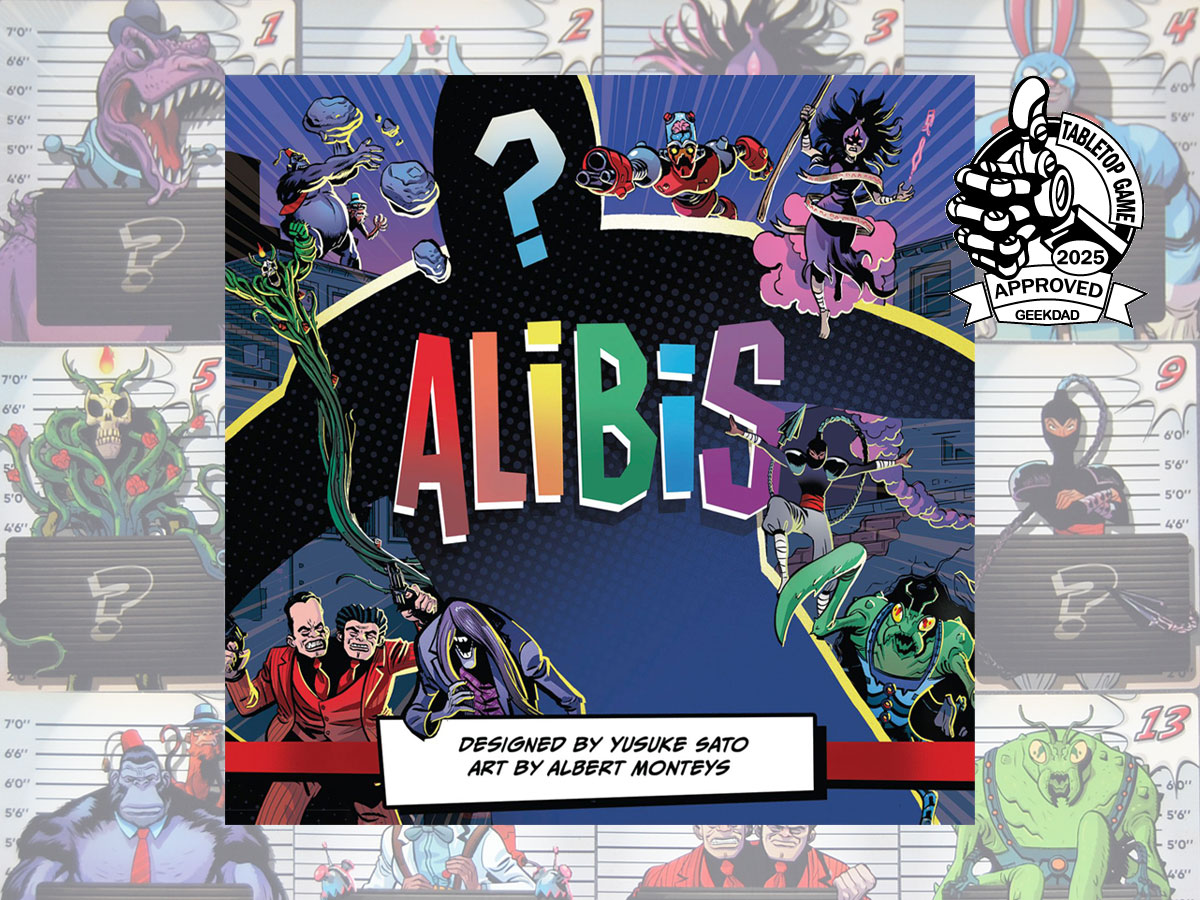
Alibis was designed by Yusuke Sato and published by Allplay, with illustrations by Albert Monteys.
Alibis Components
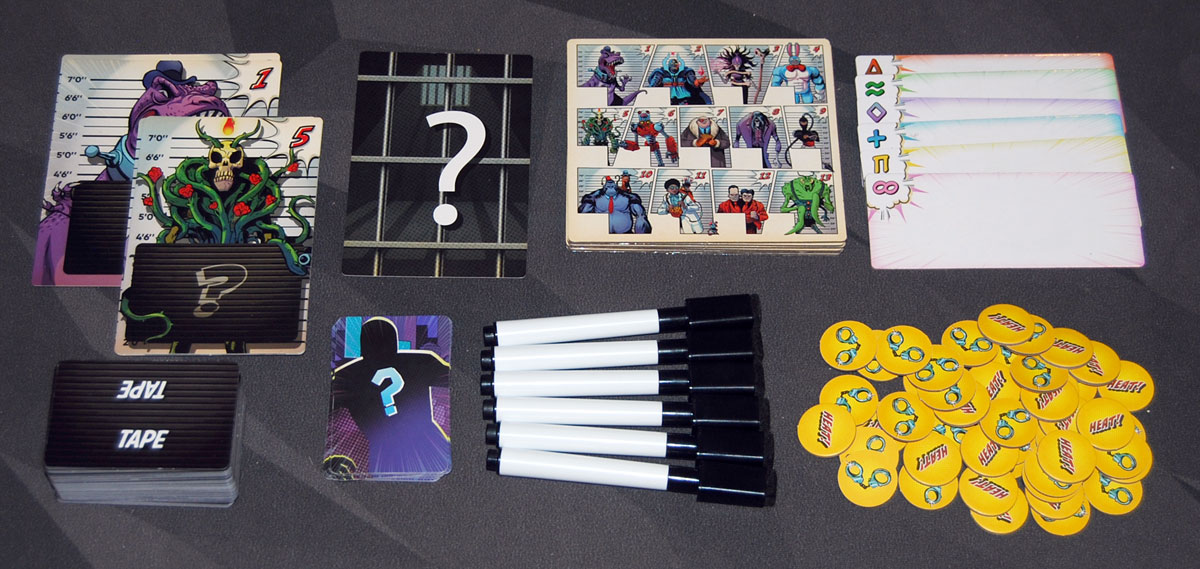
Here’s what comes in the box:
- 13 Suspect boards
- Perpetrator board
- 91 Word cards
- 13 Suspect cards
- 6 Deduction boards
- 6 Alibi tiles
- 6 Dry Erase markers
- 48 Heat tokens
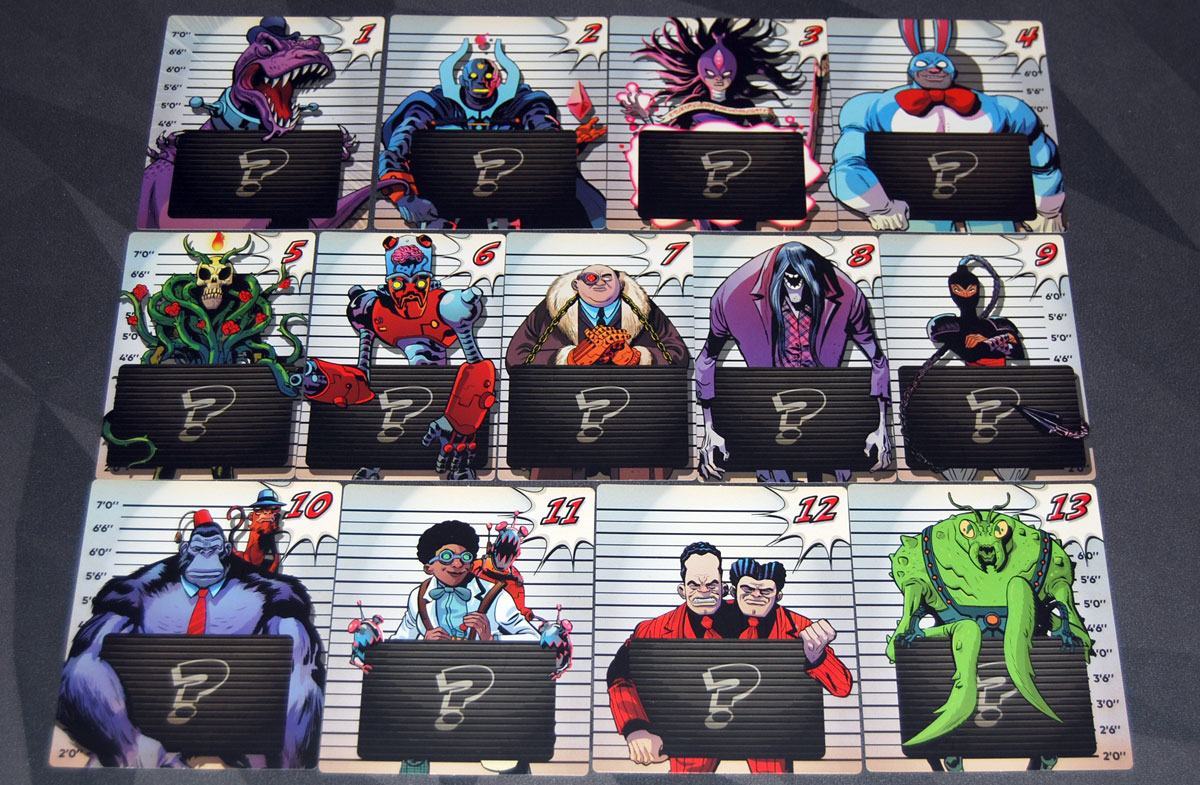
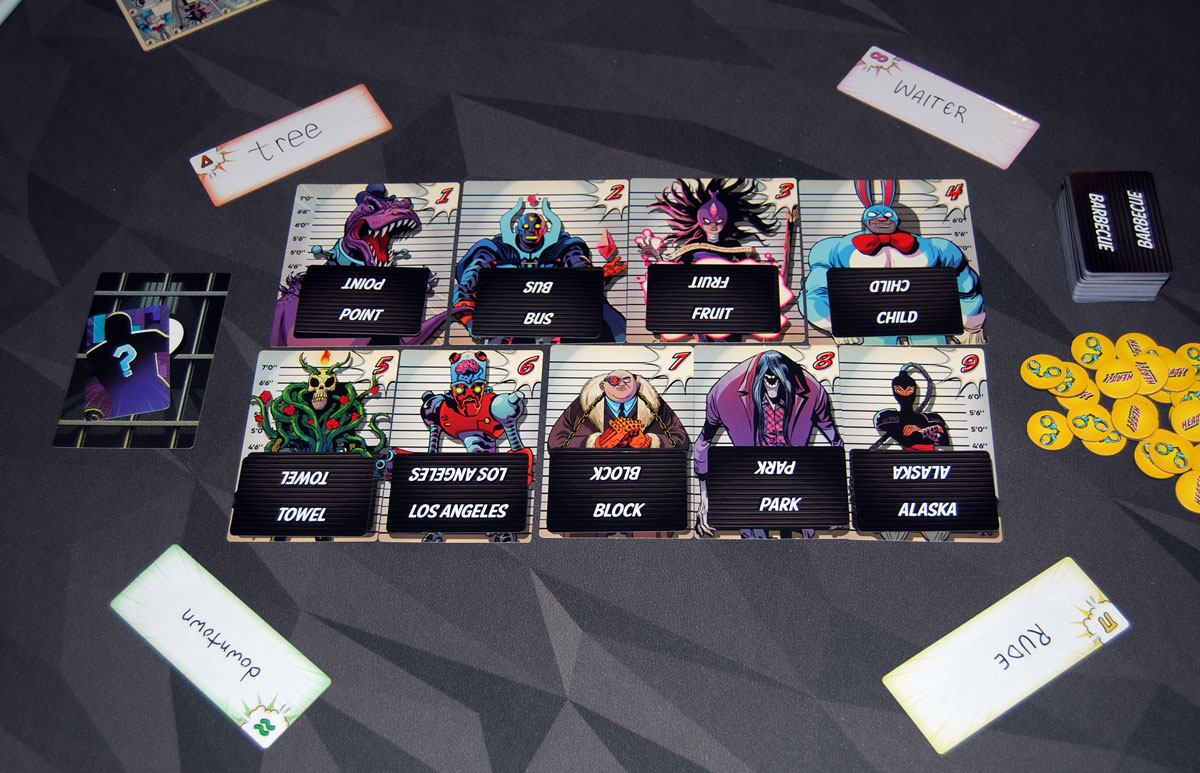
The suspect “boards” are just large cards that show various cartoony supervillains, standing in front of a mugshot background and holding up a sign. The artwork on these is fantastic and they’re all original characters, all the more impressive because they’re not really necessary for the gameplay. They’re just to help establish the theme, but in the actual gameplay you don’t refer to the character designs at all, just their numbers. Some of the cards are larger and some are smaller, mostly so that the center row (when using all the cards) has an odd number. Each suspect has a matching small card, and there’s also a large card (the perpetrator “board”) that has a question mark on it.
The word cards are pretty similar to Codenames: small cards with the word printed both right-side-up and upside-down so that they can easily be read by everyone around the table. The cards are sized to fit on the mugshot illustrations.
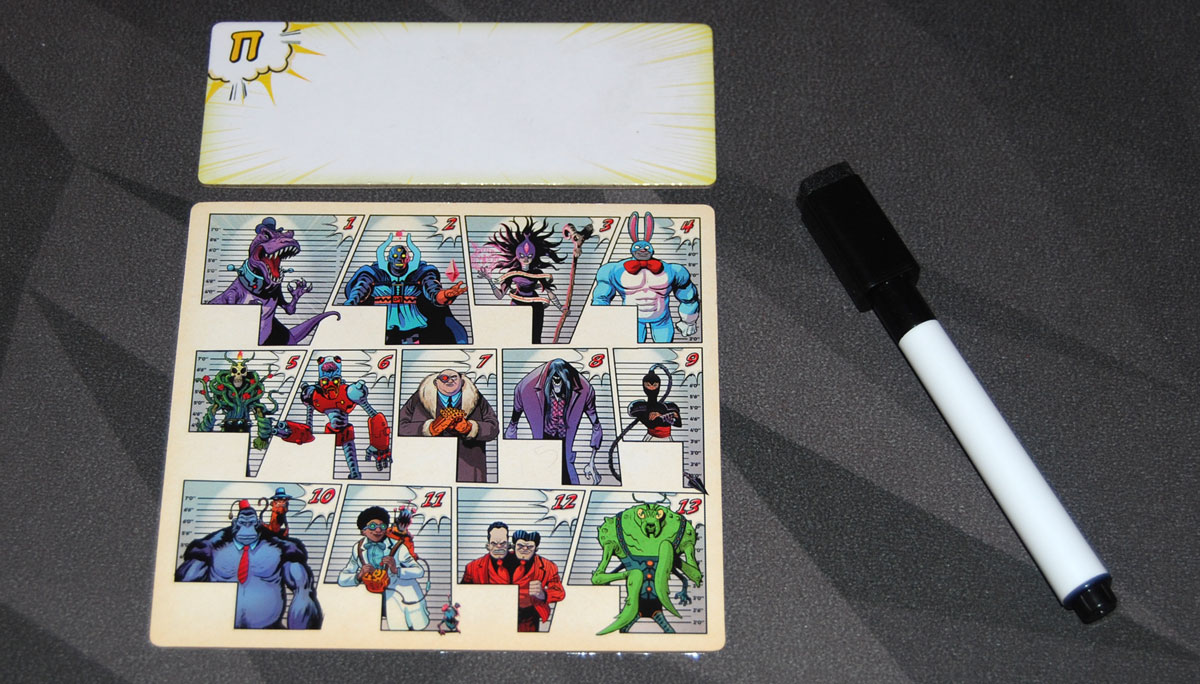
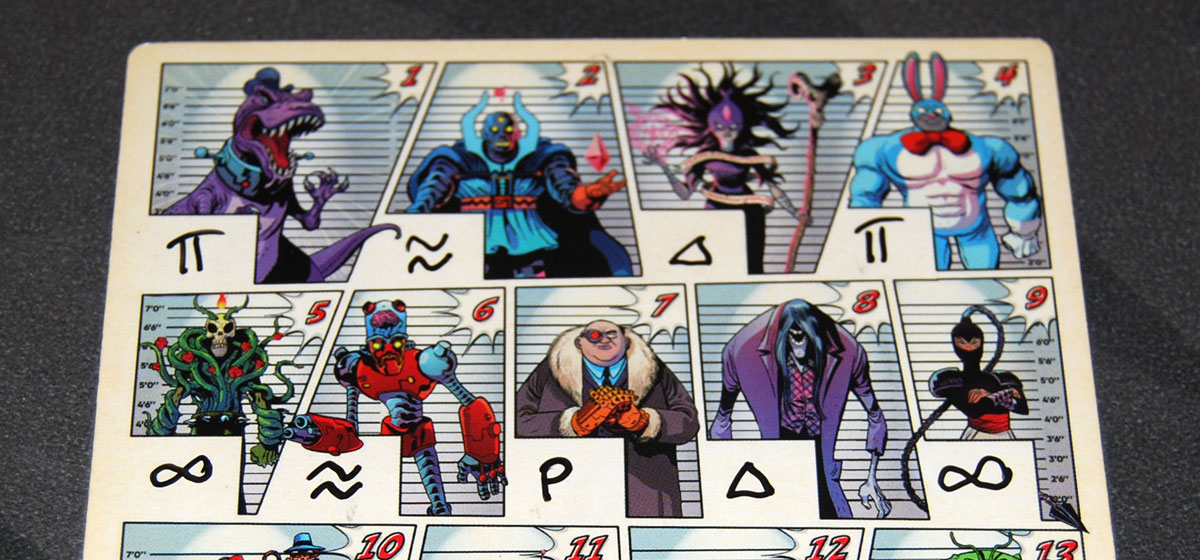
The alibi tiles are small rectangular tiles, mostly blank with a small mathematical symbol in the top corner. The deduction boards are square tiles that have all 13 suspects in a grid, with a small space to write a symbol next to each one. These tiles are glossy so you can write on them with the included dry erase markers.
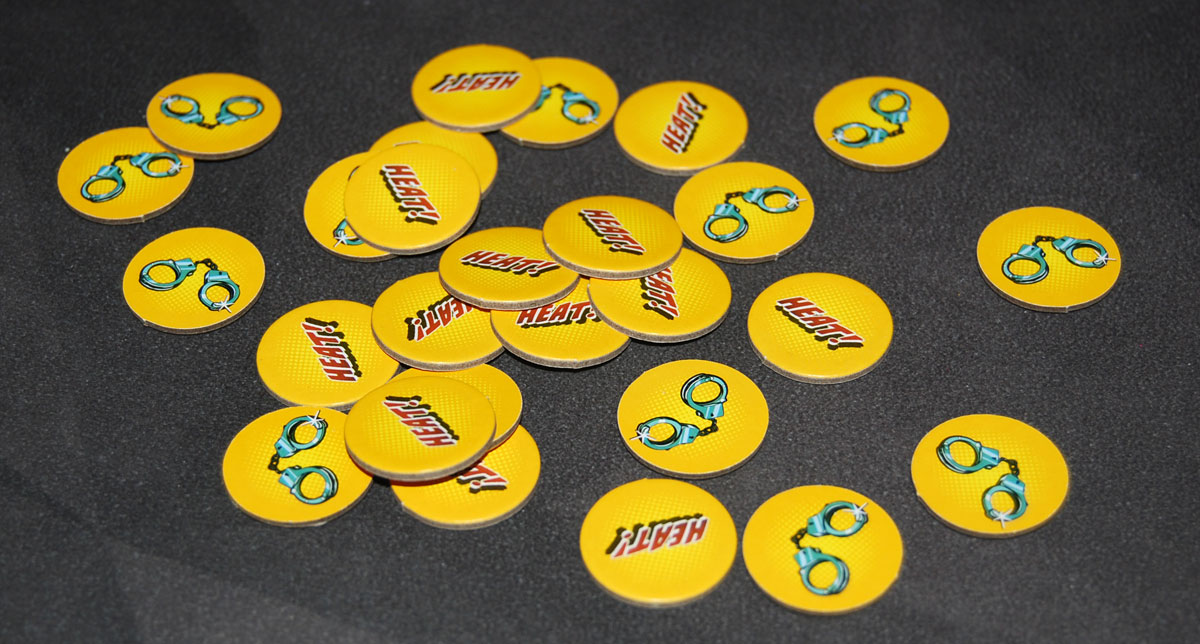
The heat tokens are simple cardboard tokens.
The whole thing comes in Allplay’s standard small box size, a little big for a pocket but still quite compact. Fitting everything into the box nicely can be a little bit of a challenge but it is possible.
How to Play Alibis
You can download a copy of the rulebook here.
The Goal
The goal of the game is to remove as much heat as possible within 3 rounds.
Setup
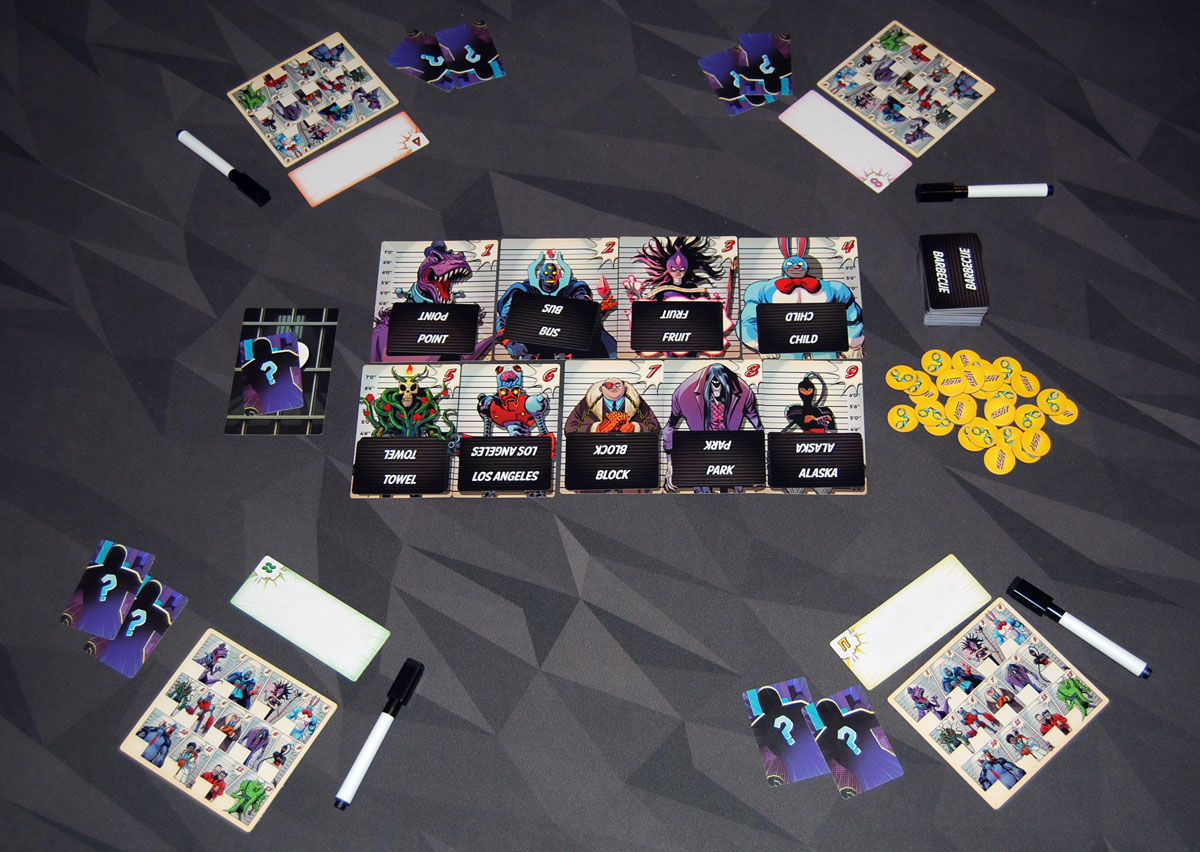
Lay out the suspect tiles based on the player count, and place the perpetrator board nearby. Make a pile of heat tokens based on the player count. Return the rest of the suspect tiles and heat tokens to the box, as well as the small suspect cards that aren’t in play.
Give every player an alibi tile, a deduction tile, and a marker.
Gameplay
At the start of each round, place a word card on each suspect board. Shuffle the suspect cards and deal two to each player, and place the last suspect card on the perpetrator board face-down. (Suspect cards should be kept secret from other players.)

First, each player will create an alibi: look at the two words on your suspects, and think of a one-word alibi that ties those two words together. Ideally, you want an alibi that does not relate to any of the other suspects in the grid. Your alibi must relate to the meaning of the words and not their position in the grid, the illustration of the villain, or the spelling of the word. (For instance, you can’t use the alibi “six” if both of your words have six letters.) You may not use any words or parts of words that are present in the grid.
Once everyone has written an alibi, you share the alibis with the other players. (The rules say to do this one at a time, though we often just reveal them all at once.) For each alibi, you secretly mark on your deduction board the two suspects you think best match that alibi, using the little mathematical symbols. Don’t forget to mark your own as well! The one leftover suspect is the one you think is the perpetrator—mark that with a P.
Finally, you reveal and score all the alibis. Each player reveals their two suspects, and checks if anyone got both suspects correctly. If any other player got both suspects, the team removes 1 heat. (Maximum 1 heat per alibi, no matter how many players got it right.)
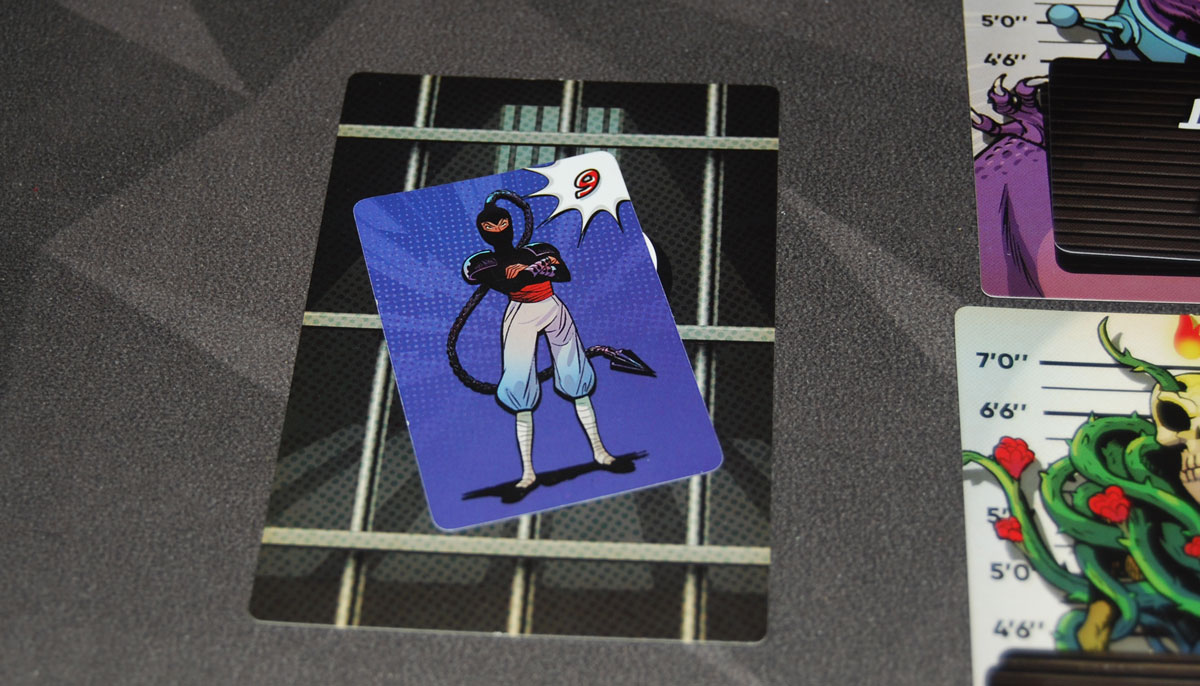
Then, reveal the perpetrator. For every player who caught the perpetrator, remove 3 heat.
Game End
The game ends when there is no more heat, or at the end of the third round. Otherwise, reshuffle the suspect cards, lay out new word cards, and start another round.
At the end of 3 rounds, check how much heat is remaining in the pile, and check the chart in the rulebook to find out your ranking, from Unimpressive Underlings to Marvelous Masterminds.

Alibis is GeekDad Approved!
Why You Should Play Alibis
[This portion contributed by Rob Huddleston]
Codenames was our GeekDad Game of the Year in 2015, and it’s become one of those games that serves as a sort-of template for so many other games. In fact, I’d bet big publishers now hear pitches like “it’s Codenames but…” all the time.
And there’s no question that Alibis was inspired by Codenames. But it’s much more than a simple reskin. It takes the template and does so much more with it.
First, there’s the cooperative element. Rather than teams working against each other, in Alibis you’re all working together. Of course that’s hardly unique, either, but with word games like this there’s so often an element of trying to come up with a clue that will simultaneously help some players and hinder others. But here, you have to come up with a word that will always help, and in many ways, that’s so much harder. In one game we played, my two words were “vault” and “glasses,” which would have been hard enough on its own, but “rob” was also out on the grid, so I couldn’t use anything that might relate to a bank vault because every one would naturally lead to “rob.” In a non-cooperative game, that becomes easy–I would want my competitors to be lead astray. But I lost count of the number of times someone at the table would reveal their word by saying, “I apologize in advance…”
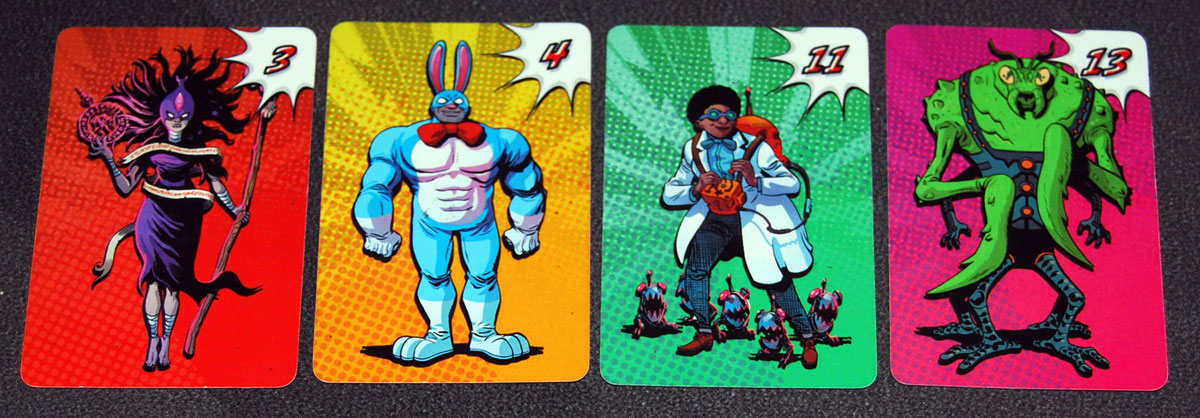
While the theme of Alibis isn’t clearly spelled out, I don’t see that as a real hindrance. We know that we have a lineup of what appear to be cartoon super villains, and we know that we’re trying to find the one who did … something, I guess. Are we the good guys hoping to arrest the bad guy? Are we the bad guys hoping to point the figure at someone else so we get away with it? Who knows? But also, who cares? The art gives the game a nice table presence (we don’t just have a grid of cards with a words on them) and it makes it a bit easier to figure out which words you are supposed to have if you can associate it with a picture and not just a number. If the theme is a bit loose but its implementation makes the game easier to play and even a bit more fun, then I’m good with it.
I recently saw a series of posts from someone I follow on Instagram about a new cooperative game that they were looking at and their big complaint, right off the bat, was that the game was too easy. There’s a fine balance designers have to find with cooperative games between making the game so easy that it isn’t worth playing, but not impossibly hard so that it isn’t fun to play. I’m not sure Alibis has that completely figured out–we didn’t come close to winning any of the times we played–but I am convinced that the game makes it so that it doesn’t matter. If I’m going to invest hours playing something, I want to know that I can win. But if I’m going to spend 15 or 20 minutes playing a game where I’m having so much fun that it doesn’t really matter, then I don’t care so much about the goal.
And that leads to the real charm of this game. Of course all of us play boardgames for a lot of different reasons, but social interaction has to be way up there on the list. And games like this, where you’re all working together but will naturally be spending a lot of your time laughing, a lot of your time teasing your friends for their horrible clues, and all of your times genuinely having fun.
[And now back to Jonathan H. Liu]
As Rob mentioned above, Alibis really couldn’t exist without Codenames. But just as various games have expanded upon the deck-building foundation of Dominion and (in my opinion) improved the gameplay, I think Alibis is a fantastic twist on the word-association genre. One of our family favorites is So Clover!, another title that has some similarities to Codenames; like Alibis, it also involves coming up with one-word clues that link two keywords at a time. Each player is creating their own puzzle (4 clues for 8 keywords), and then once they’re done, everyone else tries to fit together the puzzle. But there, each player’s puzzle is entirely independent from everyone else’s.
The genius of Alibis is that we’re all building a puzzle together. The best way to identify the perpetrator is if you also manage to solve every player’s hint. It is possible, of course, to get the perpetrator because you just swapped two suspects between two players, but quite often one mistake can mess up your whole board. Unlike Codenames, where the clue-givers know ahead of time who the assassin is and can work to avoid that word, nobody knows who the perpetrator is until the end, so you don’t know which words are more important to set apart.
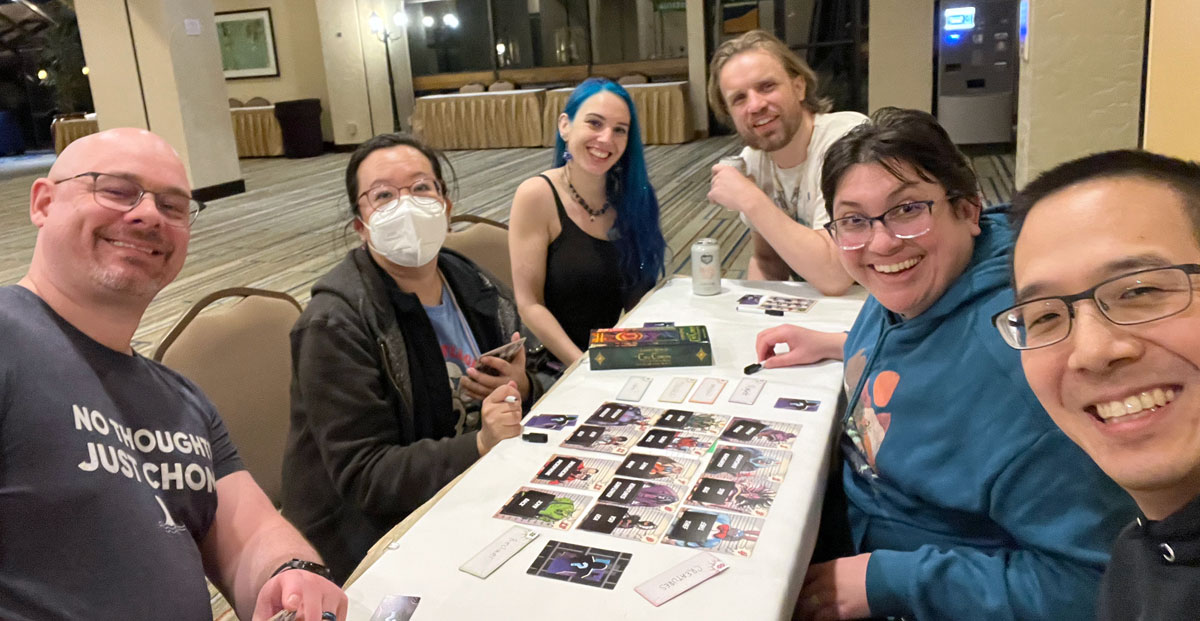
I first heard of Alibis when fellow GeekDad Alex brought it over for a game night—it was a brand-new copy, and I enjoyed it so much that I asked to borrow it for OrcaCon, a small game convention in Seattle. Over the course of the weekend, Alibis got played so many times that by Sunday evening two of the pens had run out! (That’s not a knock on the pen quality, by the way—it’s to show how many repeat plays there were.) So I owe Alex a new copy, but that’s okay because now it means I have my own—which I’ll be getting some new pens for shortly.
If you like wordplay and you’re looking for a great cooperative games, put Alibis on your wanted list.
To pick up a copy, visit the Allplay website!
Click here to see all our tabletop game reviews.
 To subscribe to GeekDad’s tabletop gaming coverage, please copy this link and add it to your RSS reader.
Disclosure: GeekDad received a copy of this game for review purposes.