Usually when I gather my thoughts at the end of the week to write my Stack Overflow, I check in a box that I keep next to my desk, where I keep books that I’ve finished reading but have not yet written about. I’ve usually got a few there—books that were waiting on some others in the same category, things that I ran out of time to cover in one column so I saved them for later, and so on. Generally speaking, I’m reading more quickly than I’m writing about books, so there’s some backlog to work through (to say nothing of the fact that I get books more quickly than I can read them, which is a whole other type of backlog!). But occasionally, like today, I actually reach the bottom of the box: there are just two finished books here, and one more current read that I’m just about finished with. So despite the fact that these three novels don’t really have much in common, that’s today’s stack.

Strange Houses by Uketsu, translated by Jim Rion
Most of the books I share have been sent to me for review, but that doesn’t stop me from picking up interesting-looking books at the store. This one—originally published in Japanese in 2021 and translated into English this year—caught my eye because of the floor plan on the cover. Flipping through it, I saw that there were several more floor plans throughout the book (this time labeled in English).
The story starts with a house for sale in Tokyo that has a strange layout, including a weird empty space in the walls. The writer shares the floor plan with his architect friend, who points out even more unusual details. Eventually this leads to some theories about how this house is linked to news about a murder, which then leads to some other strange houses.
The book is described as a “mystery-horror” and that’s a pretty good fit: it’s a murder mystery but most of the clues and hints are all taken from the house layouts themselves, with the architect reasoning his way through why a house might be built the way it is. The story is disturbing and a little far-fetched in places, but I was fascinated with the way that the houses were laid out, and the gradual discovery of what’s going on inside them and why.
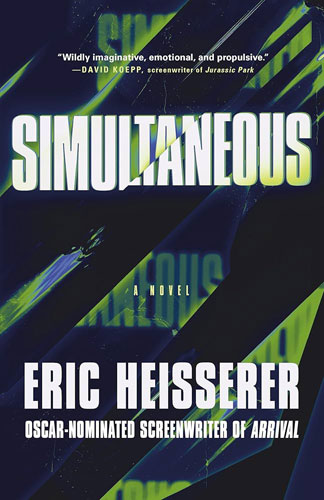
Simultaneous by Eric Heisserer
The day before a pipeline explodes and kills seven people, a woman called 911 and gave a warning. Grant Lukather, an agent in the Predictive Analytics department of Homeland Security, knows that there’s no such thing as psychics or magic, and that if somebody knows about a disaster ahead of time, usually it’s because they’re somehow involved.
Sarah Newcomb is the woman who called; she’s a past-life hypnosis therapist, and she claims that her information came from a session she had with a client. Despite Grant’s skepticism, he can’t prove that Sarah—or her client—is lying, but pulling on the threads eventually leads him to a copycat serial killer in Colorado that defies logic.
I don’t want to give away the surprises, but I will say that when we finally get an explanation of what’s happening, of how Sarah’s client is linked to the serial killer, it is extremely weird but also made sense. While it’s not how I believe the world actually works, it’s plausible enough for story-logic to set up for an exciting mystery case. Heisserer was the screenwriter of Arrival, which played around with concepts of how we perceive time, and in Simultaneous he creates another mind-bending proposal for how our minds work. It’s not exactly time travel, but it’s definitely time-travel-adjacent, so if you like that sort of thing, it’s worth a read!

The Everlasting by Alix E. Harrow
Owen Mallory is a historian, a scholar who went to war and came back scarred, and he’s obsessed with the legend of Una Everlasting. She lived a thousand years ago and her story is the foundational myth that his country, Dominion, is built upon. She was the ultimate warrior, knighted by the queen and sent off on heroic quests that eventually united the various disparate kingdoms under one flag, one faith. Her stories have been passed down and translated and adapted over the centuries, and now Owen has the opportunity of a lifetime, translating one of the original recorded documents upon which most of the others were based. But what he soon finds is that he isn’t just translating the book—he is living it and writing it, somehow transported to the past to journey with Una herself.
This book is the one I’m almost done with, but I’m also dragging my feet a little because I’m not sure I want it to end. It’s a story about disillusionment: Owen has to come to terms about what it really means that Dominion was “united,” about the reality of Una’s quests. As for Una, she seems like an unstoppable force, but she is also trapped in her role, unable not to play her part in Dominion’s tale. It’s also a love story (which comes as no surprise, really), but one that takes ages for them to admit. It’s a story about belief, about the power of stories, and about making legends.
The book is narrated by Owen and Una, alternating as if they’re telling each other the story, with the occasional break where we get to read portions of the story as they were passed down, kind of like a fairy tale. This one is time travel for sure, though it’s more about the consequences of it than the precise mechanics and rules of it. I’m really enjoying it, and recommend to readers who want some high fantasy mixed with time travel.
Coming Up
As we’re drawing close to the end of the year, we are starting to work on our various traditional group posts, reflecting on our reading resolutions and setting new ones for 2026, and sharing our favorite reads from this year. Watch for those starting near the end of the month! In the meantime, looks like I’ll need to refill my box of finished books.
Disclosure: Except where noted, I received review copies of the books covered in today’s column. Affiliate links to Bookshop.org help support my writing and independent booksellers.