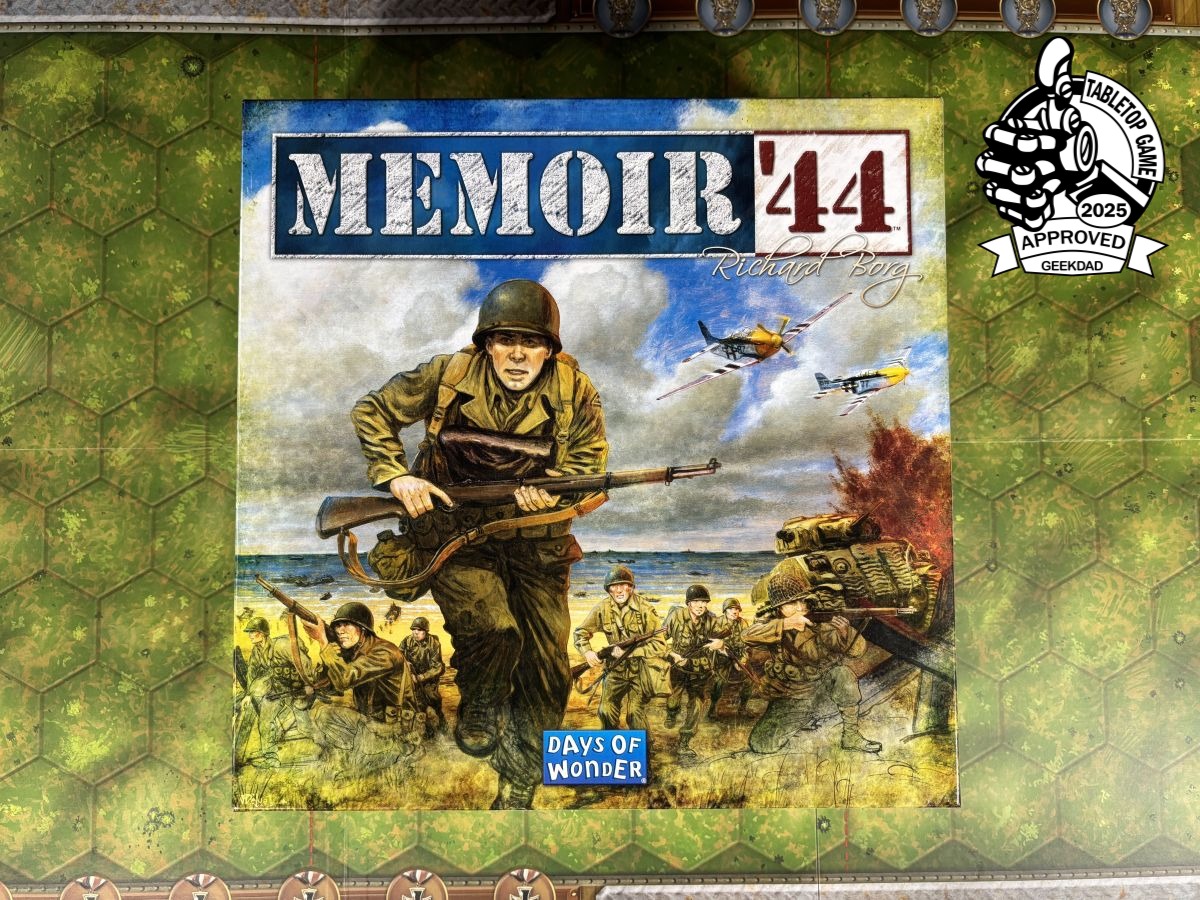
Almost 20 years ago, I came across a WWII wargame that was unlike any other I had seen. It had been released for the 60 anniversary of D-Day, had nice miniatures and had some great rules that were easy to learn but not too simplistic for a veteran wargamer like myself. The real bonus was that it was perfect for playing with my 8-year-old son. We spent many hours playing various battles and even purchased some of the expansions to add more scenarios, units, and more advanced rules. Over the years as my children grew up and we began playing different games, Memoir ’44 was played less. However, a new edition of the original game with new miniatures, new art, and some updates to the rules has brought this game back to the game table and my son who is now an adult has once again enjoyed our time together playing the new Memoir ’44 Refresh.
What Is Memoir ’44 Refresh?
Memoir ’44 Refresh is a light, miniatures wargame for 2-4 players, ages 8 and up, and takes about 30-45 minutes to play. It is set during WWII on the Western Front and players take on the role of either the Axis forces or the Allies. It’s currently available from your friendly local game store as well as online retailers with a suggested retail price of $69.99 for a copy of the game. Memoir ’44 Refresh was designed by Richard Borg and published by Days of Wonder, with illustrations by Julien Delval.
Memoir ’44 Refresh Components
Here is what you get in the box:
- 144 Army miniatures
- 36 Obstacle miniatures
- 1 Double-sided map board
- 60 command cards
- 22 Summary cards
- 8 Attack dice
- 44 Double-sided terrain hexes
- 6 Activation tokens
- 4 Double-sided bunker and bridge tiles
- 10 double-sided victory medal tokens
- 14 Special forces badge tokens
- 4 cardholder sections
- 1 rules booklet
- 1 scenario booklet

Memoir ’44 Refresh comes with 144 detailed army miniatures. The Allied forces are in green while the Axis/German forces are in blue. Each army contains 42 infantry, 24 armored vehicles, and 6 artillery. These miniatures are new sculpts and made of a harder plastic than those in the original version of Memoir ’44. In addition to the army miniatures, there are also 36 gray man-made obstacles used during scenarios. These include 12 hedgehogs, 12 wire, and 12 sandbags.

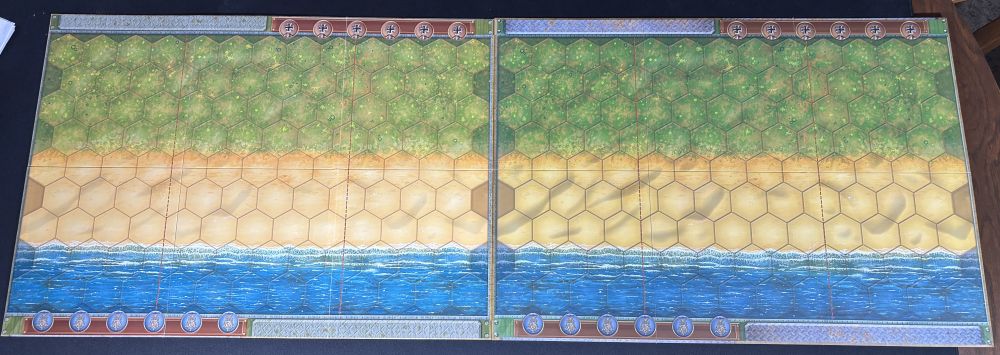
The map board is double-sided and consists of one side with a coast for beach landing scenarios while the other side consists of clear countryside terrain.

Players use command cards to order their units. Some cards list a number of units and one or more of the three sectors on that map where units can be given orders. Unlike some games where players can move every unit every turn, the command cards in Memoir ’44 Refresh represent the limits on a commander to give orders during a battle. There are 60 command cards, which are used by both sides.
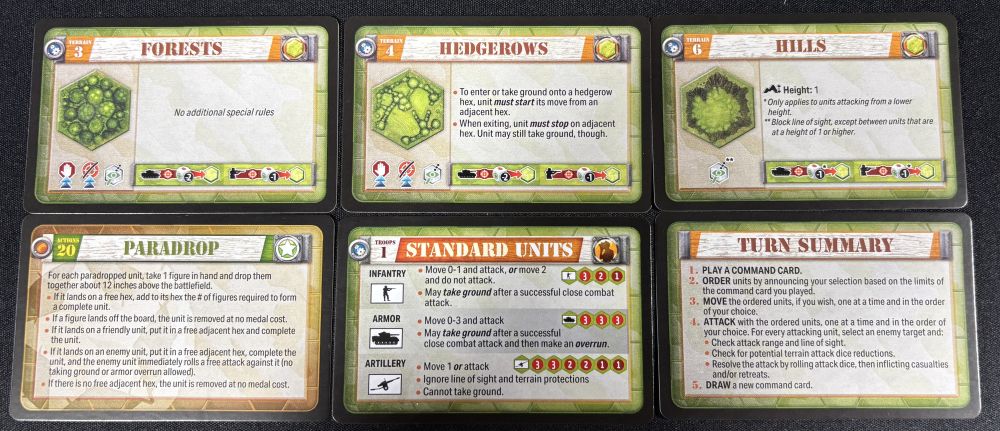
In addition to the command cards, Memoir ’44 Refresh also comes with 22 summary cards that provide information on the various types of units, terrain, as well as a turn summary. These are a great way to provide quick information during the game without constantly having to refer to the rulebook. Players just place out those cards that are relevant to the current scenario.

The attack dice in Memoir ’44 Refresh do not have pips or numbers on them. Instead they have symbols and are used to determine damage inflicted during an attack. Different symbols represent damage to different types of units. For example, infantry receive one damage for each infantry or grenade symbol rolled. Players roll a certain number of dice during an attack based on the type of unit used to attack as well as the range from that unit to the enemy target.
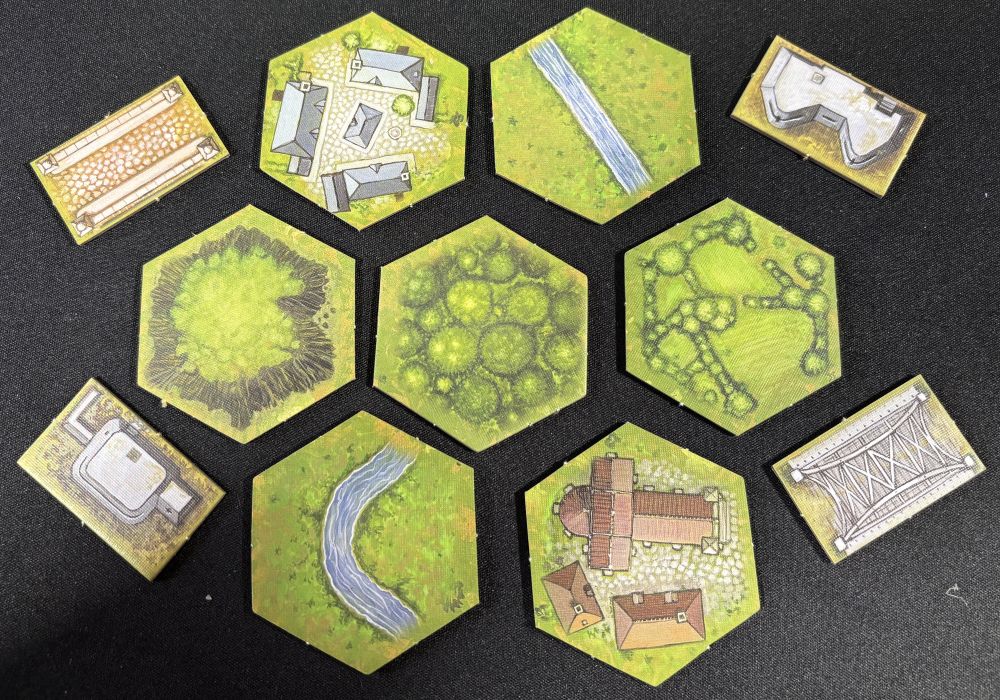
Since the map board contains only clear terrain, terrain tiles are used to represent landforms that can hinder movement or block line of sight. Some can also provide defensive bonuses to units on them. There are also structure tiles to represent bridges and bunkers.
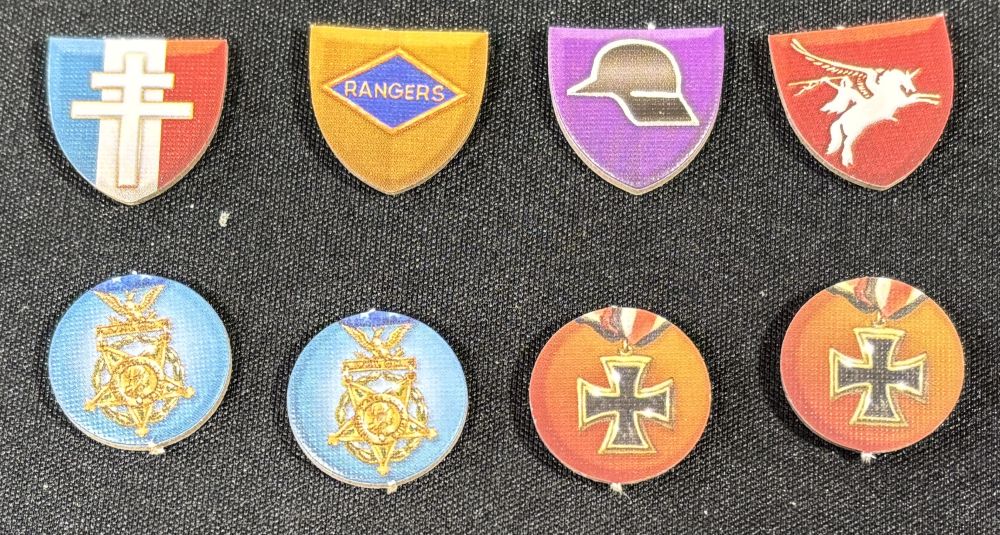
The 24 tokens included in the game include 10 medals used to represent completing objectives as well as 14 badges that are placed next to units on the map to show that they are a specialized unit with additional abilities.
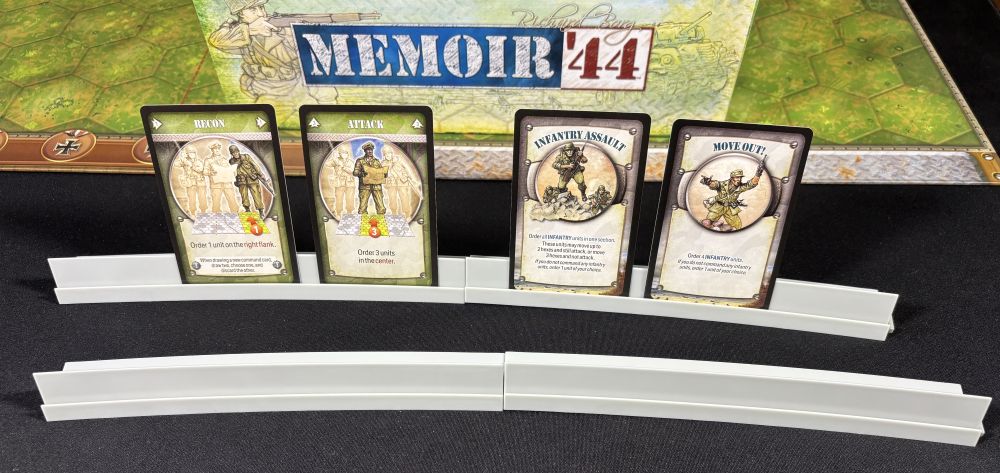
The cardholder pieces can be assembled into two cardholders that allow players to keep all of their command cards visible to themselves but not visible to their opponent. While players do not need to use them, they can be useful in team games so that both players on the same team can see what cards their teammate have. The original Memoir ’44 featured straight cardholder pieces that were somewhat easy to knock over. However, the new cardholders in Memoir ’44 Refresh are curved so they don’t tip over.
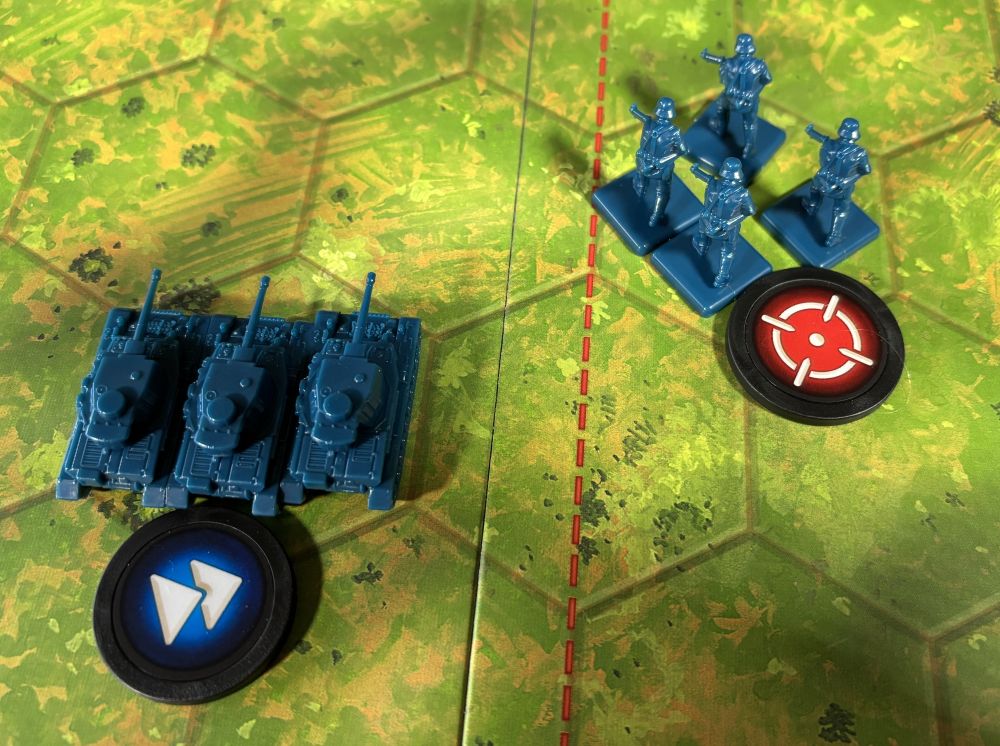
One of the new features in Memoir ’44 Refresh are the six activation tokens. These can be used to keep track of which units have been activated. One side has a movement symbol while the other has an attack symbol. To use these, place one of these tokens with the movement side up next to each unit you want to activate with the command card you just played. Then after moving a unit, flip the token to the attack side to show that it has completed its movement. Finally, after you attack with that unit, remove the token to represent that this unit is no longer activated. These activation tokens are great when you play a command card that activates several units in different sectors of the battlefield.
How to Play Memoir ’44 Refresh
The Goal
The goal of the game is to achieve your victory conditions for a scenario.
Setup
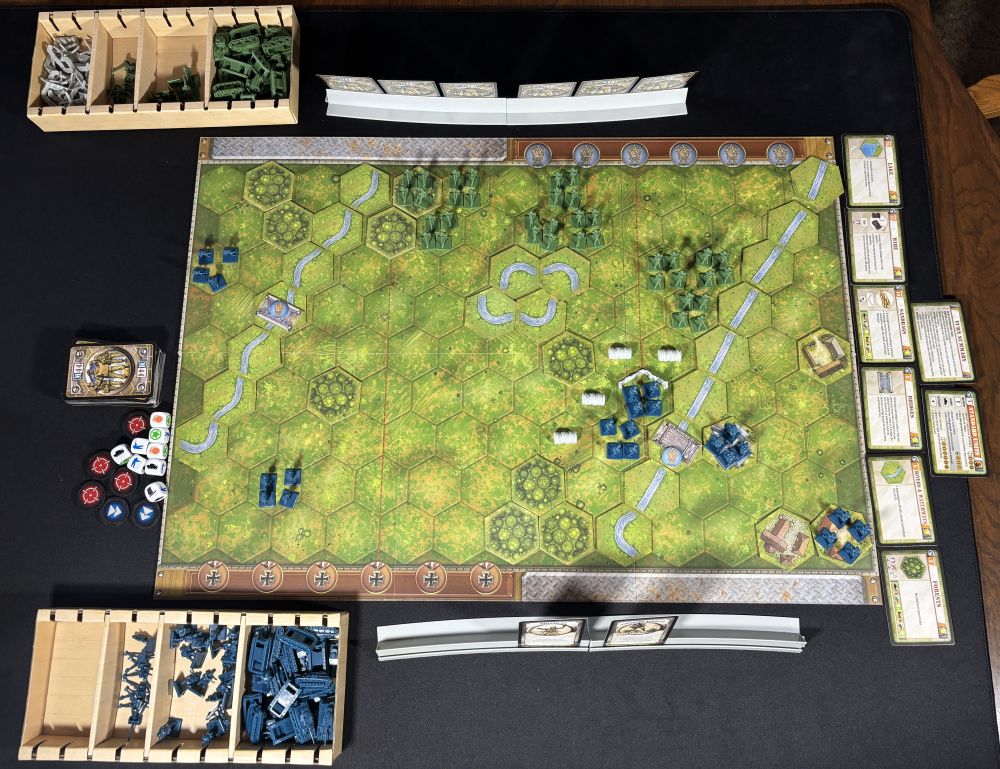
Start off by selecting a battle from the scenario book. After placing the map board in the center of the table with the indicated side face up, place any terrain tiles as indicated by the scenario. They are listed along the side and include an order for their placement. Next place the miniatures on the board on the positions shown in the scenario booklet. The number of miniatures in each hex depends on the type of the unit. Once this has been done, place any special unit badges next to the units as shown in the scenario to designate that those units have unique abilities. Place the summary cards used for that scenario where the players can easily access them and assemble the cardholders if the players choose to use them.

Decide which side each player will control and sit so they are either on the Allied or Axis side of the mapboard. Shuffle the command deck and deal the number of cards to each player as indicated in the scenario book. Place the remainder of the cards face down next to the board. Each player then takes four dice. The scenario booklet also indicates which player goes first. You are now ready for the first player to begin their turn.
Gameplay
Memoir ’44 Refresh is played in turns with each player completing their turn before the next player takes their turn. A turn consists of five steps: play a command card, order units, move units, attack, and draw a card. Let’s take a look at each step in greater detail.
At the start of a turn, the active player selects a command card to play from their hand. There are two main types of command cards. A section card designates which of the three sections of the map units may be given orders. Tactics cards, on the other hand, allow the player to make special moves or attacks or take specific actions. After a command card has been played, the player then choose which units will receive orders this turn. Only ordered units can move and attack during the turn.
After all ordered units have been chosen, then the player can move those ordered units up to their movement range. This is listed on the unit summary sheets. Units can move one space for each of their movement allowance. Some terrain may affect movement or prohibit certain types of units from entering them. Only one unit can occupy a space and units cannot move through other units, whether friend or enemy. Infantry have a unique movement rule. They can move two spaces, but they cannot attack that turn. However, if they only move one space, they can still attack.
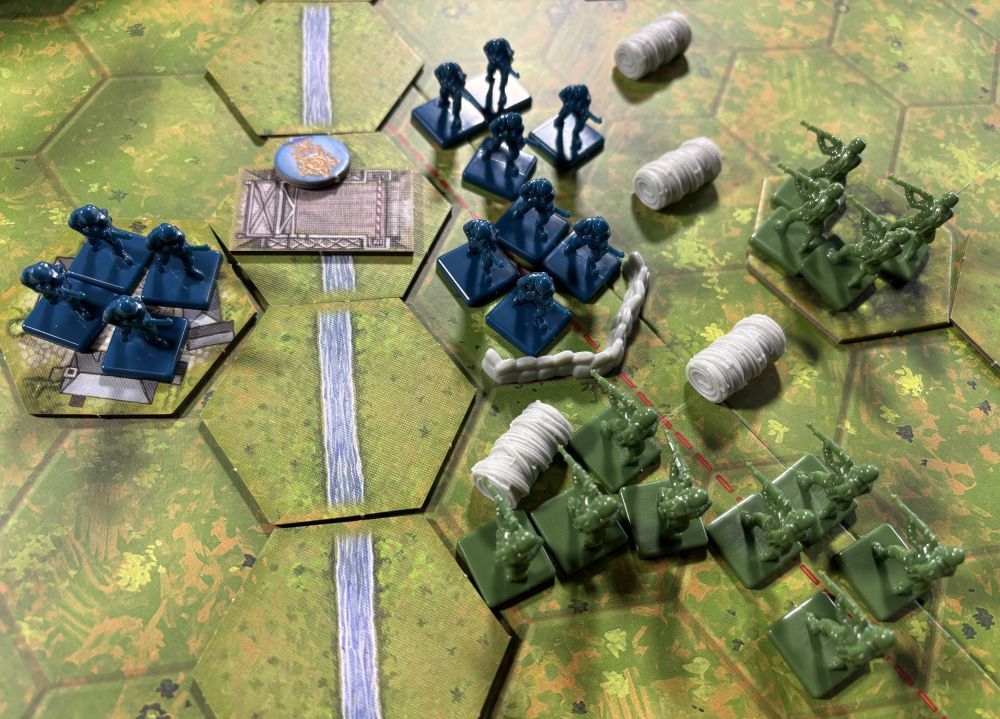
Once the player has moved all of the ordered units they wish to move, they can then attack with those units. To perform an attack, they first select a target that is within their attack range. This is listed on the unit summary card. They also check to see if the enemy is in their line of sight. Terrain and other units can block line of sight. If the target is both in range and in line of sight, then the attacking player rolls the number of dice listed on the summary sheet for the appropriate range. After the dice have been rolled, the attack is resolved by determining the number of hits based on the symbols on the dice and the type of unit being attacked. The infantry icon scores hits on all infantry. The tank icon scores hits on armored vehicles. The grenade icon scores a hit on all types of units. A star icon usually counts as a miss, though some tactic command cards treat this as a hit. The retreat icon with the flag symbol forces the owner of the defending unit to move the unit one space towards their baseline (the edge of the map board where the player is sitting) for each retreat icon rolled. If they are not able to retreat due to terrain or units blocking their way, they must take one hit for each space they could not move. After the number of hits have been determined, that number of miniatures are removed from the unit. If the last miniature is removed, it is given to the attacking player to place in one of their medal spaces along their baseline as a victory objective.
After all attacks have been resolved, the player then draws a command card to complete their turn. Now the next player takes their turn.
Game End
The game ends when one player has earned the number of medals listed in the scenario booklet. Medals can be earned by defeating enemy units as well as special instructions in the scenario such as occupying key hexes on the map. Once a player reaches the victory conditions, the game ends immediately and that player is the winner.

Memoir ’44 Refresh is GeekDad Approved!
Why You Should Play Memoir ’44 Refresh
Memoir ’44 Refresh is based on the Command and Colors systems created by Richard Borg for Battle Cry! back in 2000 and then used for Memoir ’44 in 2004 and several other games since then. While I never had a chance to play the first game, I enjoyed playing the original release of Memoir ’44 with my children. It offered a great introduction to wargames that could be easily taught and played quickly. When I learned that Day of Wonders was releasing Memoir ’44 Refresh, I was excited to give it a try. Fortunately, my oldest son who I originally played Memoir ’44 with and is now an adult, was around to play with me. The first scenario, Pegasus Bridge, is not only one of the first battles that took place during the night in the early hours of D-Day, it also features only infantry and is a great way to learn the game while only using one type of unit. If you get a chance, watch the scene from the classic movie, The Longest Day, before or after you play this scenario to see Major John Howard and his “Ox and Bucks” land silently in gliders and capture the bridge.
The second scenario, Sainte-Mère-Église, adds armored vehicles to the game,while the third scenario, Sword Beach, not only has an amphibious landing by the British troops but also adds artillery. While the original game came with 16 scenarios, Memoir ’44 Refresh includes those original 16 as well as 5 additional scenarios that can be played together in sequence as a mini-campaign. As a military history major and history teacher, I also appreciate the historical background provided for each scenario as well as how the designer has simplified both small and large battles so players get a feel for the challenges of those individual engagements without being drowned in details.
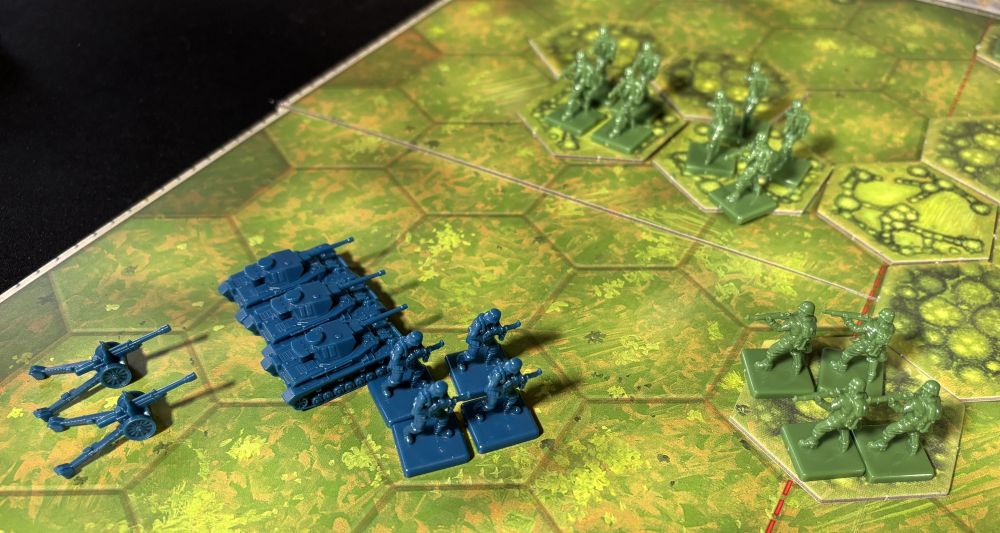
While the map board features only clear or beach terrain and the sector lines, the terrain tiles allow players to create a vast number of unique battlefields. Not only does the terrain look great, it also has important effects on the battlefield by blocking line-of-sight as well as restricting movement and giving advantages to units in that terrain. The key to winning most battle is using the terrain to your benefit and denying it to your enemy. The other important aspect is to use your units abilities effectively. Infantry are more effective when they are closer to their targets, so it is usually advantageous to have them advance towards the enemy–unless they can occupy terrain that make it harder to hit them. Armor can move quickly so they can move across the battlefield quickly and attack at ranges 1–3 with three dice. Artillery, on the other hand, can only move one space or attack–not both. However, they can attack units up to six hexes away. Both infantry and armor can take ground becuse if the adjacent defending unit is either destroyed or forced to retreat, the attacking unit can move into the vacated hex. Armor can also then perform an overrun where they get to make a second attack. They can also take ground again if permissible, but can only do one overrun per turn. Once again, the game system in Memoir ’44 Refresh allows players to use tactics to win the game without requiring complicated rules. The focus is on gameplay and not looking up specifics every time you attack.
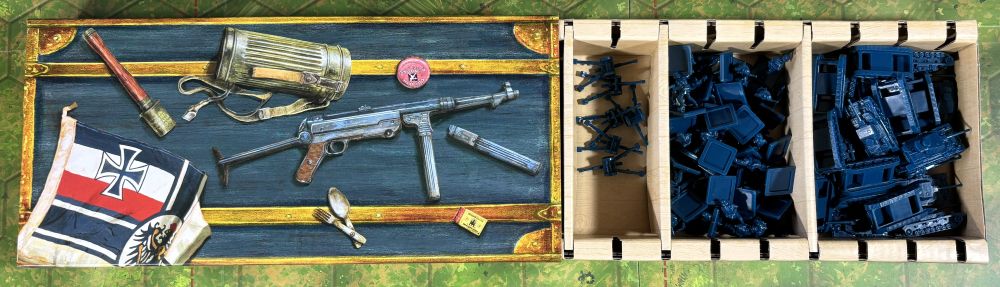
Memoir ’44 Refresh includes a useful plastic organizer in the box to keep the cards, tiles, dice, and tokens each in their own spots. There are also two cardboard containers for all of the miniatures–one for the Allies and one for the Axis. These boxes can be removed from the game box so players can have easy access to them during the game. Because each type of component has its own spot in the organizer, it makes it quick and easy to set up a game and then to put it away. This is a bonus for a game that is already quick to play and another great feature that adds to the overall value of the game. Personally, I love organizers for my games and the inclusion of these just adds to the overall value of the game.

I have not played Memoir ’44 in over a decade. I had purchased and played a few of the expansions and enjoyed them, but eventually moved on to deeper, more complex wargames as my children grew up. As I opened up the box of Memoir ’44 Refresh, I felt a bit of nostalgia and remembered the many games I had played in the past. Unpacking the components felt both new and familiar. I really like the organizer and the quality of the new miniatures. The rulebook has been rewritten to make the rules more clear and the summary cards have been improved with useful symbols as well as text. The artwork on the box and the cards has also been improved. Overall, the game just looks better and is better organized.
However, looks are not everything. Memoir ’44 Refresh still plays well. The system is well-refined and focuses on strategy and tactics rather than complex rules. This allows players to consider how to best use the terrain and their units to defeat the enemy instead of having to look up rules and specifics for many different units. While there are elite units, their abilities are simple. For example special forces infantry can move up to two spaces and attack while elite armor gets four miniatures per unit rather than only three. Plus all of that information can be found on unit summary cards so there is no need to flip through the rulebook. The scenarios are short to play, so you can play several in one sitting since it does not take long to reconfigure the map with terrain tiles and return the miniatures to the board between scenarios. The rulebook suggests players play a scenario twice, with each player playing as both sides then determining a winner by totaling the medals they earned in both games. I am very impressed with Memoir ’44 Refresh and hope Days of Wonder comes out with refreshed versions of the many expansions since some are no longer available or difficult to get.
For those who already own Memoir ’44, do you need to purchase Memoir ’44 Refresh? The answer is probably not. However, if you are a big fan of the game, you may want to get it anyway. I know that it has refreshed my love and appreciation for this game and I look forward to using it for my high school Game Design class as well as for my history classes and tabletop game club. Plus, now that I have two copies of the game, I can play the larger Overlord scenarios which I have not done before.
I thoroughly enjoy playing Memoir ’44 Refresh and highly recommend this game to players who want a quick historically based wargame that is easy to learn and teach to others so you can focus on the battle rather than on the rules and setup. It is also great for families and can serve as a first wargame for parents to introduce to their children and help them gain a love for history. Yet even though the game can be played by children, don’t think of this as a children’s game. Most of the audience for the game are adults. Think of it as a game that is quick to learn, but can take some time to master.
In the twenty years since I first played Memoir ’44, I have purchased and played many other wargames, some of which cover the same battles. However, I did not play any of them as much with my family and friends as I did Memoir ’44. There is a reason this game has endured for so long and has such a large fan base. Memoir ’44 Refresh has reminded me why I loved the game from the beginning and wonder why I stopped playing it. For all of the many reasons I have stated above, Memoir ’44 Refresh has truly earned the coveted designation GeekDad Approved!
For more information visit the Memoir ’44 Refresh page!
Click here to see all our tabletop game reviews.
 To subscribe to GeekDad’s tabletop gaming coverage, please copy this link and add it to your RSS reader.
Disclosure: GeekDad received a copy of this game for review purposes.