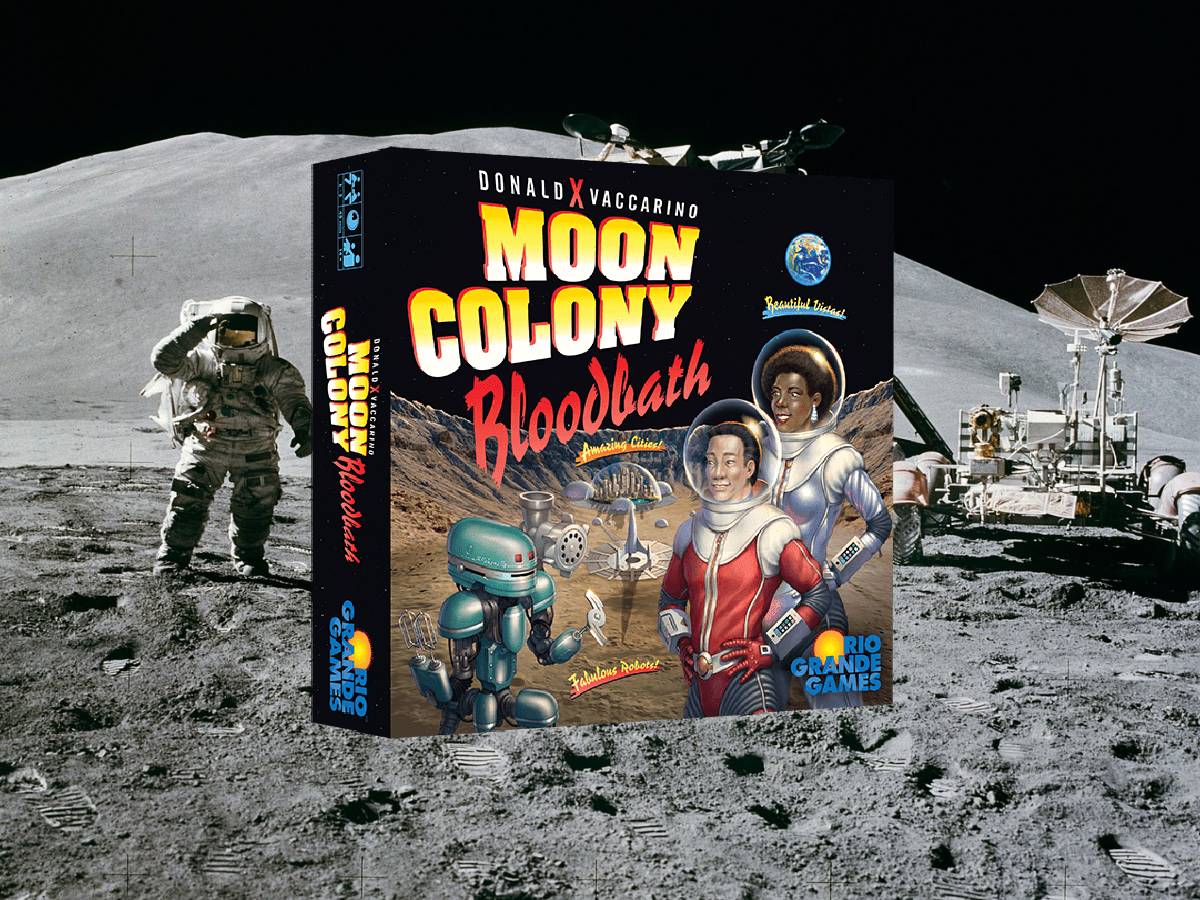
It’s a shiny retro future, and mankind is putting colonies on the moon. I’m sure it will all run smoothly, without any accidents or glitchy robots to contend with…
What Is Moon Colony Bloodbath?
Moon Colony Bloodbath is an engine-building tableau game for 1-5 players, ages 12 and up, and takes about 45 minutes to play. Even though there’s the word “bloodbath” in the title, all of the violence is blood-free and humorous, making this a game that is still suitable for the family. It retails for $49.99 and is currently available to purchase on Amazon or at local games stores.
Moon Colony Bloodbath was designed by Donald X. Vaccarino and published by Rio Grande Games, with illustrations by Franz Vohwinkel.
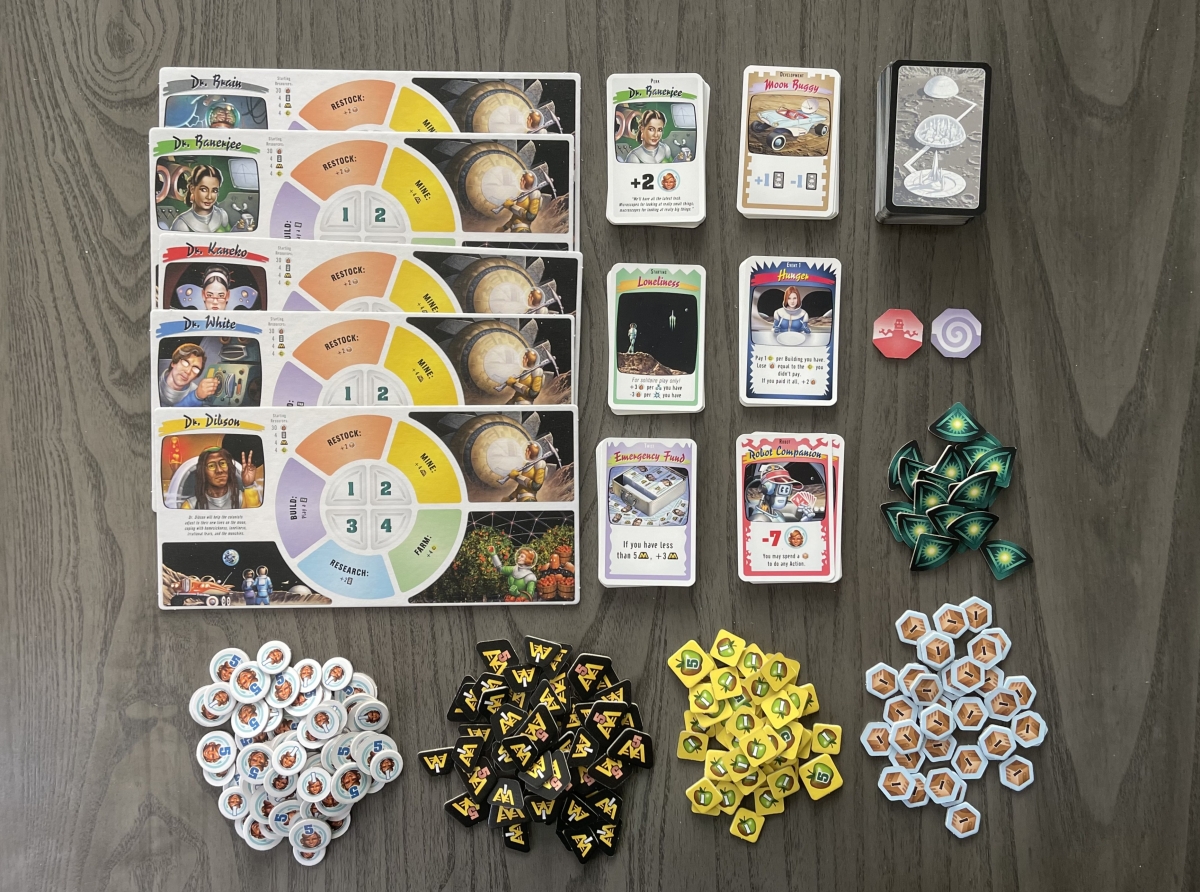
Moon Colony Bloodbath Components
Here’s what comes in the box:
- 90 Building cards
- 25 Perk cards
- 25 Twist cards
- 20 Development cards
- 20 Robot cards
- 13 Event cards
- 7 Starting cards
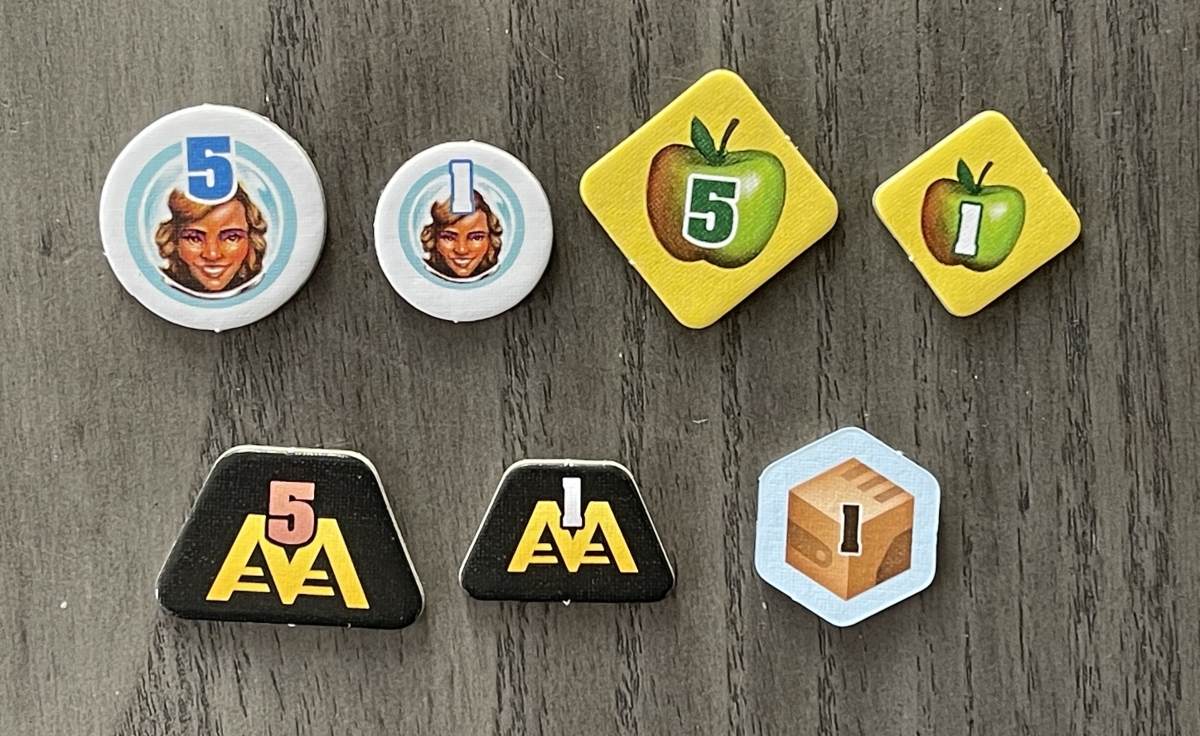
- 75 Population tokens (1 and 5 value)
- 60 Money tokens (1 and 5 value)
- 50 Food tokens (1 and 5 value)
- 40 Restock tokens
- 20 Action chits
- 1 Robot Deck chit
- 1 Twist Deck chit
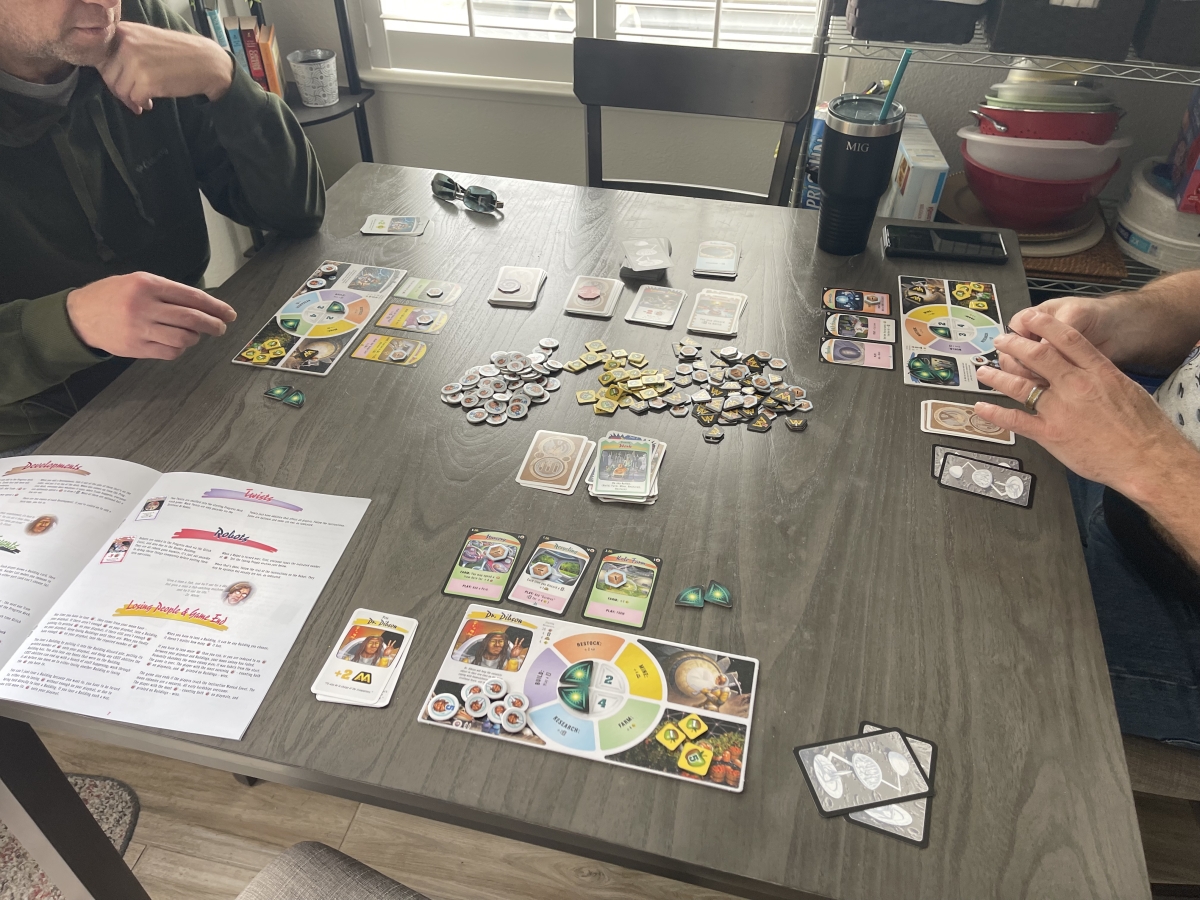
There are 5 different cardboard Moon Base player boards. Each of the boards is identical, except for the name and picture of the scientist on the board. So pick your favorite!
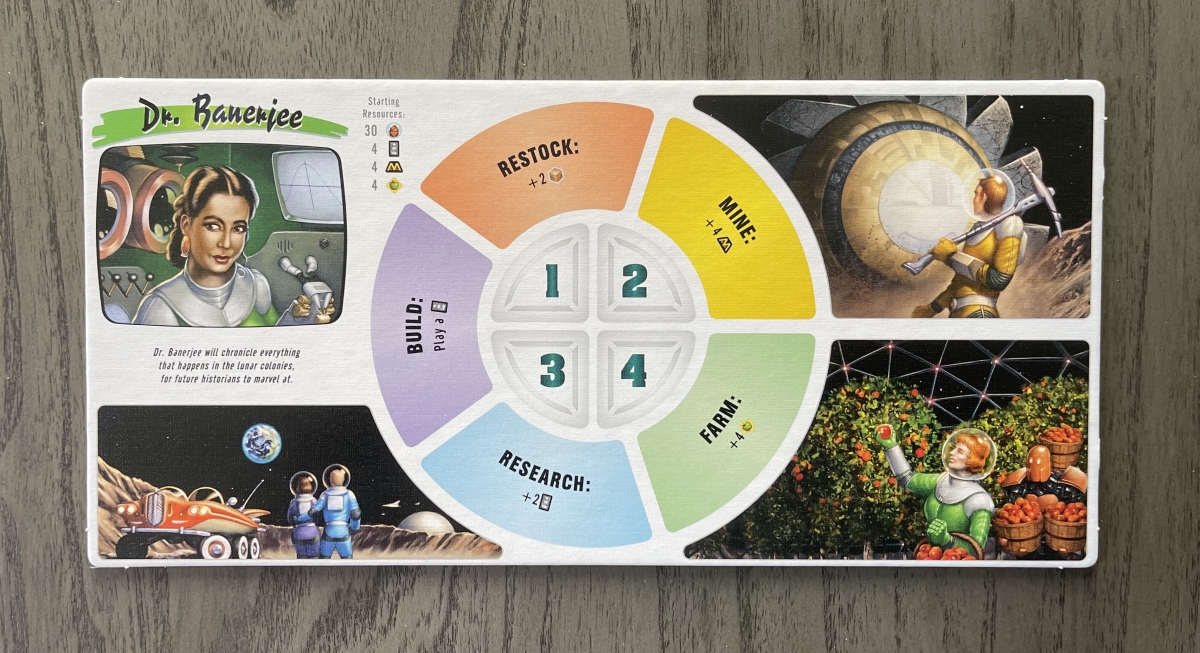
Each player board also has a corresponding set of 5 Perk cards. These may get added to the game deck when a card goes into play that says, “Add a perk.” Like the boards, the Perk cards are identical from character to character, other than the image and character name on the cards.

The boards have spaces to hold tokens representing population, money, and food. In the center of the board are the different actions a player can take when a “work” card comes into play.
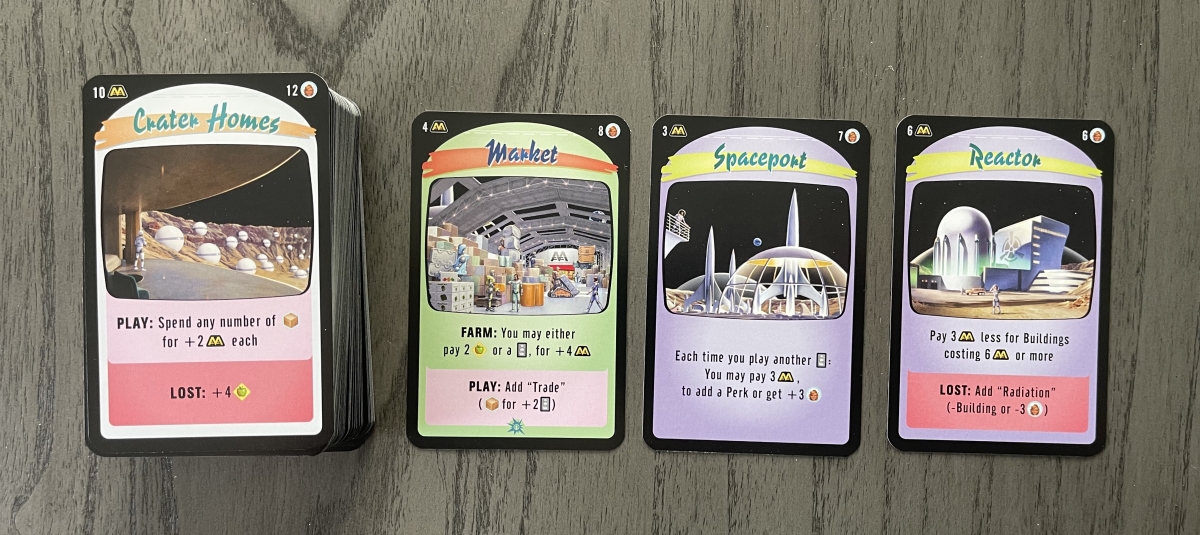
Throughout the game, you will have opportunities to acquire, pay for, and build a variety of buildings, which can aid you in various ways throughout the game. These buildings also add to your population.
The artwork on the player boards and cards have an old-fashioned feel to them, which works thematically as the setting is an alternate history where mankind is putting colonies on the moon in what possibly is the 1950’s (the actual timeframe is non-specific).
How to Play Moon Colony Bloodbath
You can download a copy of the rulebook here.
The Goal
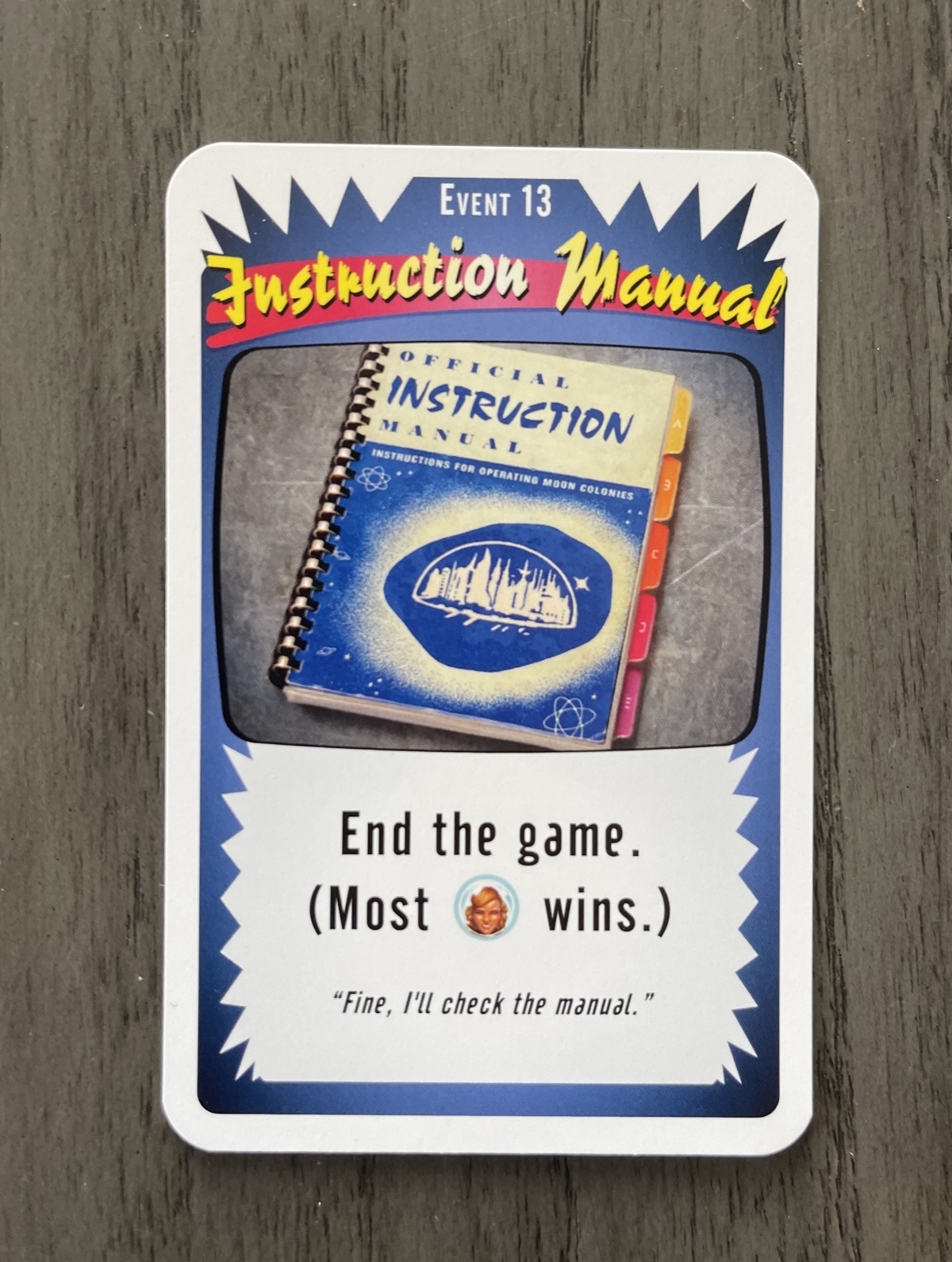
The goal of the game is to reach the bottom of the Event deck with the most survivors.

Setup
Shuffle the deck of Building cards and deal a hand of 4 to each player. Each player then chooses one of the scientists and takes the matching Moon Base player board and 5 Perk cards. Each player then takes 4 Action chits, 30 Population, 4 Money, and 4 Food, and places them on their board.
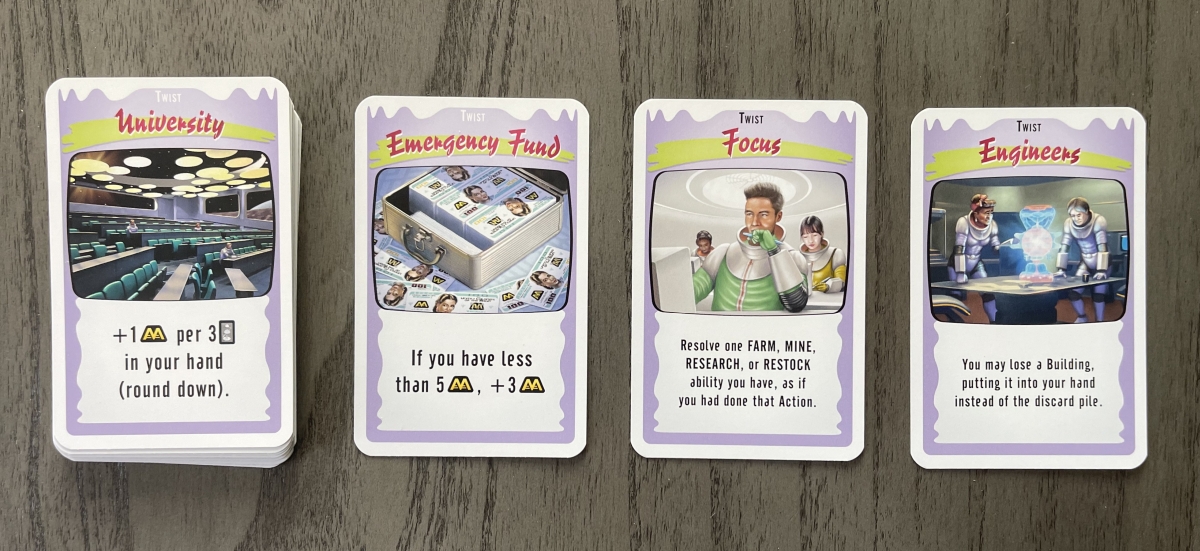
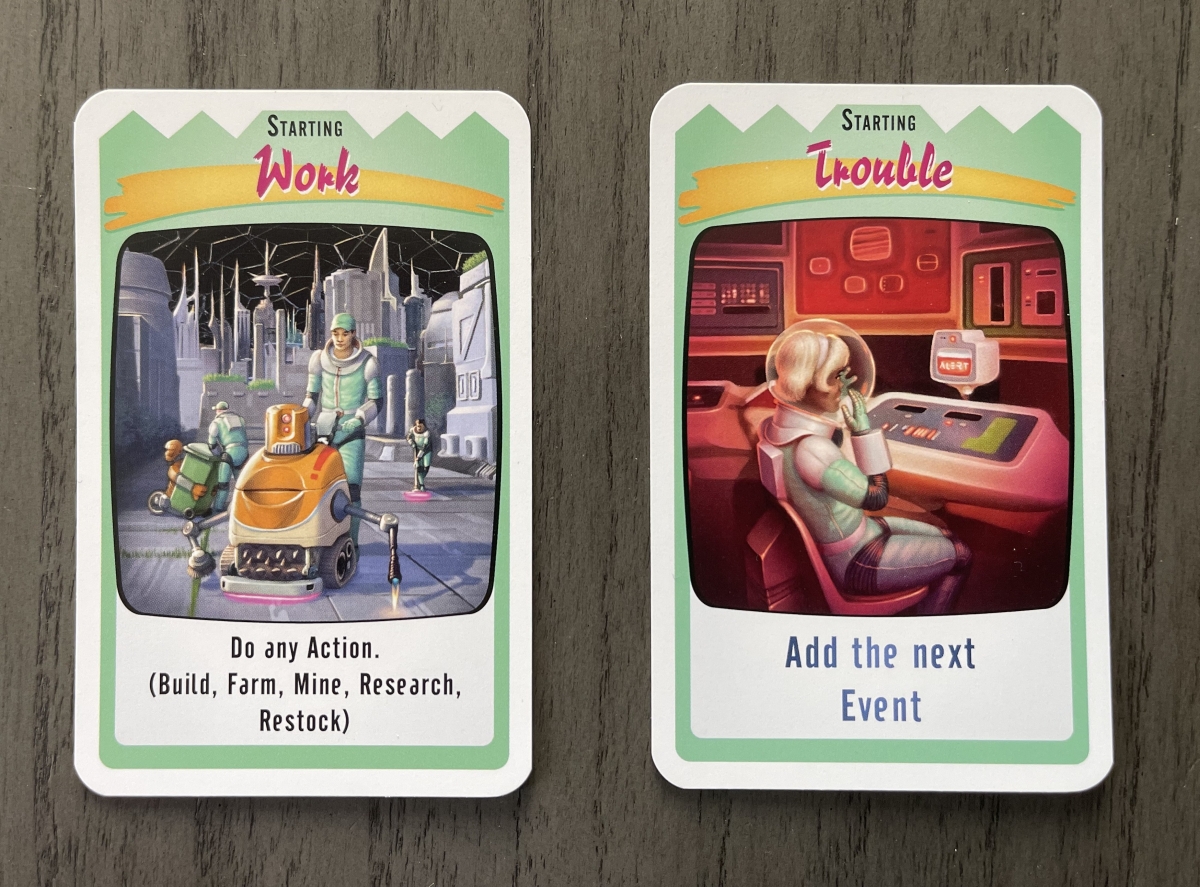
Shuffle the Twists and deal out 2 face up for all players to see and familiarize themselves with. Then shuffle them into the Starting cards (2 copies of Trouble and 4 copies of Work). This will be the initial Progress Deck.
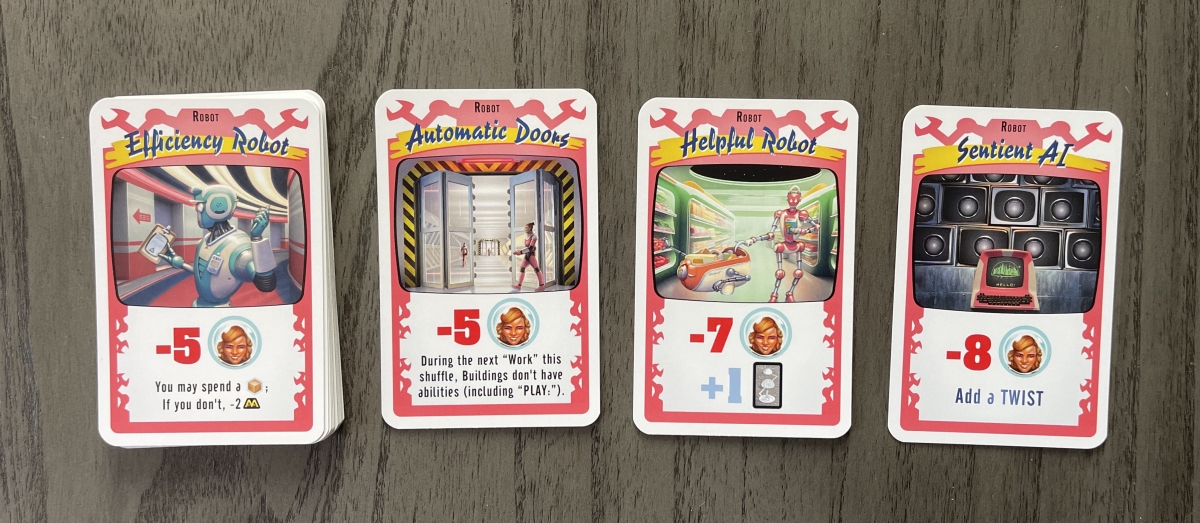
Take the rest of the Twists and place the deck facedown, with the Twist deck token on top. Shuffle the Robots, and create a facedown deck with the Robot deck token on top.
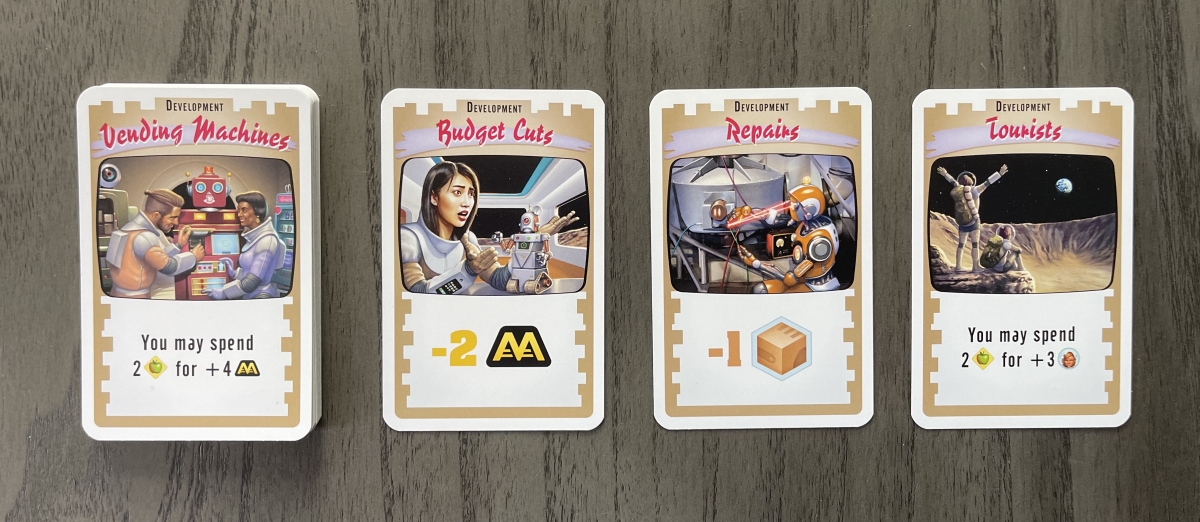
Put the Developments into a faceup deck. Keep the Events, sorted by number with the 1st event on top, in another faceup deck.
Finally, create piles of all the resource tokens on the tabletop.
Gameplay
There is no starting player. Each turn, one of the players turns over the next card from the Progress Deck, putting it faceup on the discard pile. Everyone simultaneously follows the instructions on the card, and then once everyone is done, the next card is flipped over.
If, after resolving a card, the Progress Deck is empty, shuffle the Progress Deck discard pile to create a new deck, and everyone then resets their Action chits.
When a Trouble card is revealed, you will take the next event from the Event Deck and put it facedown on top of the Progress Deck. This will then become the next card played.
Note: whenever a card tells you to add another card, draw it from the appropriate deck and place it facedown on top of the Progress Deck. It will then be the next card played.
When a Work card is revealed, you can choose any of the four actions to do. Put one of your Action chits onto the action you wish to take, and then after completing the action, move the chit onto the next available number on your Moon Base Player Board. The actions are:
- Restock. Take two Restock crates from the supply, and add them to any one or two buildings.
- Build. Pay the cost for a Building in your hand, and then place the card facedown. All players building then reveal their cards and put them into their tableau, carrying out any one-time Play instructions on the bottom of the card.
- Mine. Take 4 Money from the supply.
- Farm. Take 4 Food from the supply.
- Research. Draw 2 Building cards into your hand from the Building deck.
Putting certain Buildings into play will have a player add a Development into the Progress Deck.

Other buildings may have a player add a Perk into the deck. When that happens, choose one of your five Perk cards and place it facedown on top of the Progress Deck. When it is drawn, only the player whose character matches the Perk card will get the benefit.
Robots are added to the progress deck via the Glitch Event card. Additional Twists might get added during a game, but only if you’ve already added the Sentient AI Robot.

If you would ever need to discard Population and you don’t have enough on your board, you would discard one of your Buildings, taking an amount of Population tokens equal to the amount shown on the card in the upper right corner. Then, pay the Population cost from those tokens. SomeBuildings also have Lost actions that are taken when you have to discard the Building.
Game End
The game ends one of two ways: Either when the Instruction Manual event (the final event) is reached, or when one player loses all of their Population and Buildings. At that point, players count up their surviving Population on both Building cards and Population tokens, and whoever has the most, wins.
Solo Play
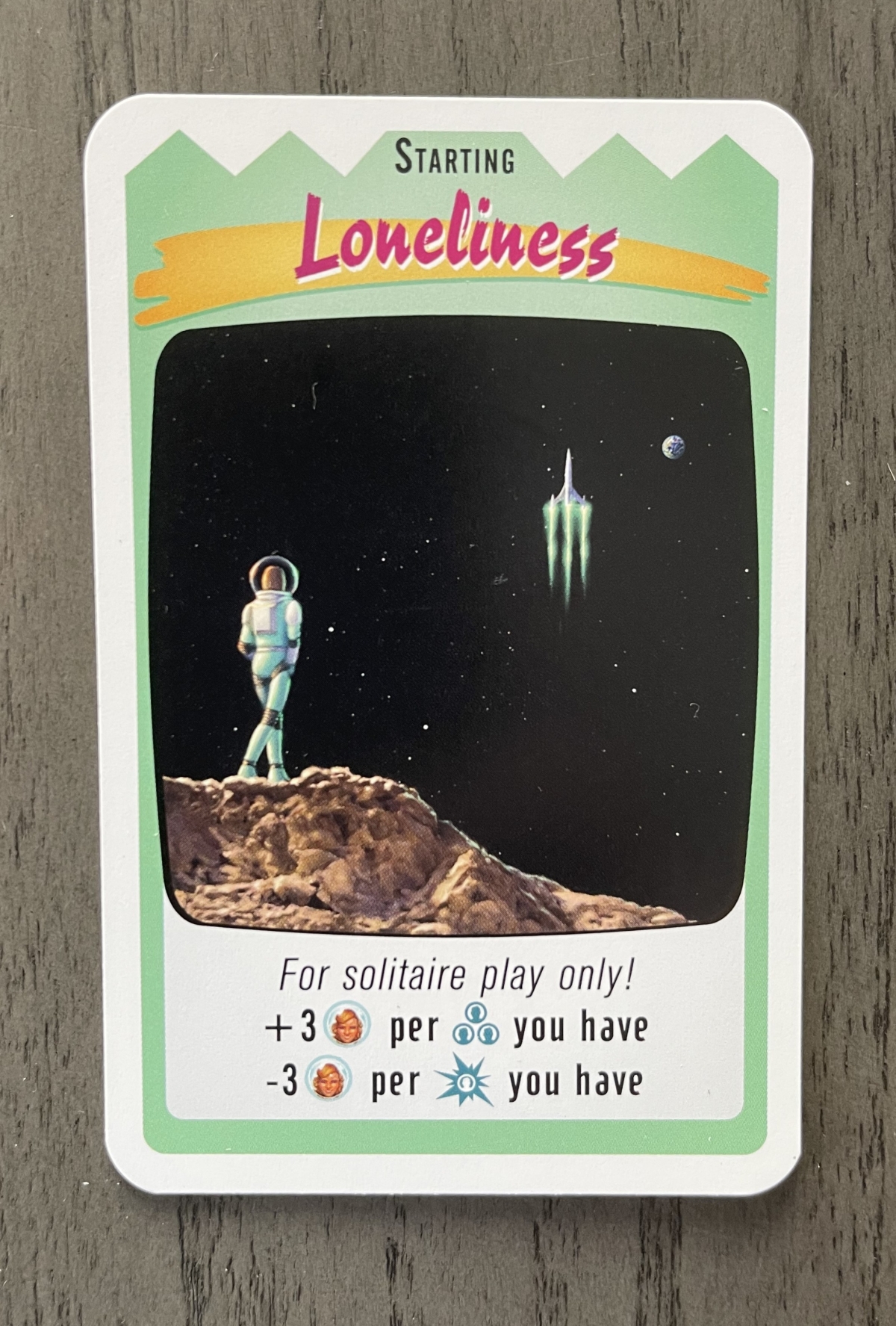
Solo play couldn’t be easier. During setup, simply add the Loneliness card to the Progress Deck at the start of the game. That’s it! Otherwise play is identical to a multiplayer game.
Why You Should Play Moon Colony Bloodbath
The designer, Donald X. Vaccarino, calls Moon Colony Bloodbath “an engine-building engine-losing tableau game.” As opposed to most engine-building games, in this one you will inevitably see your engine disappear, piece by piece, as your moon colony falls prey to accidents, starvation, and malfunctioning robots. It’s one of the things that gives the game a unique twist on a familiar mechanic.
But before your engine is torn apart, you will begin the game slowly building it up. I like that you start Moon Colony Bloodbath with a very tight little Progress deck. There’s a very satisfying arc to a game, as you and the other players continually add cards to the Progress deck based on the actions you all take.
Because of the randomness of the shuffle, you won’t know the order cards will appear each round. But everyone at the table knows exactly what cards are in the deck, and can try to plan their actions accordingly. There’s a nice bit of strategy involved in figuring out what Buildings to play to help get the resources you need to keep adding the population you’ll inevitably lose.
And there’s no way to avoid losing your colonists! This is a game about crisis management. It starts off fairly slow and relaxed, but the disasters start snowballing, until you’re desperately trying to keep just a few of your Population alive. People playing Moon Colony Bloodbath are often surprised at just how brutal the game can be, but that brutality is in the sheer number of colonists that will meet an untimely end, not in the difficulty of playing the game itself.

In fact, Moon Colony Bloodbath is both easy to teach and to play. Most of the instructions are printed right on the cards, so once you know the basic progression of the game, all you have to do is turn over the next card, follow its instructions, rinse and repeat. Which means you can focus on your meaningful choices when it comes to building your engine and managing your resources.
It’s worth noting that, if you enjoy playing solo, then Moon Colony Bloodbath has one of the easiest solo modes to play. By inserting just one card into the starting Progress deck, the gameplay is changed up for a single player. No complicated automa decks or variant rules here; you just shuffle in that one card and get to playing.
As I mentioned at the top of the review, despite the theme and title, Moon Colony Bloodbath is still a light-hearted game. However, it’s certainly understandable that families with younger kids may not feel it’s appropriate to play a game predicated on the mass deaths of your colonists. And while I enjoyed the exponentially cascading disasters that occur during the course of the game, others may find that kind of progression off-putting.
Some people may think that the artwork is a bit bland and old-fashioned, but it certainly fits that retro futuristic theme. It would be a shame to pass the game up based off of the art, because there’s a very enjoyable tableau building game in Moon Colony Bloodbath. It may come as no surprise to those playing the game that Donald X. Vaccarino was the designer of one of the greatest deckbuilding games of all time, Dominion. Moon Colony Bloodbath’s gameplay is simple yet engaging, and individual games are quick enough that you’ll often want to reset and try another, in the hopes of getting just a little bit farther into the Event deck…and maybe even to that “Instruction Manual” card.
For more information visit the Rio Grande Games Website!
Click here to see all our tabletop game reviews.
 To subscribe to GeekDad’s tabletop gaming coverage, please copy this link and add it to your RSS reader.
Disclosure: GeekDad received a copy of this game for review purposes.