Time to knit some cozy garments to keep you warm for the winter!
What Is Knitting Circle?
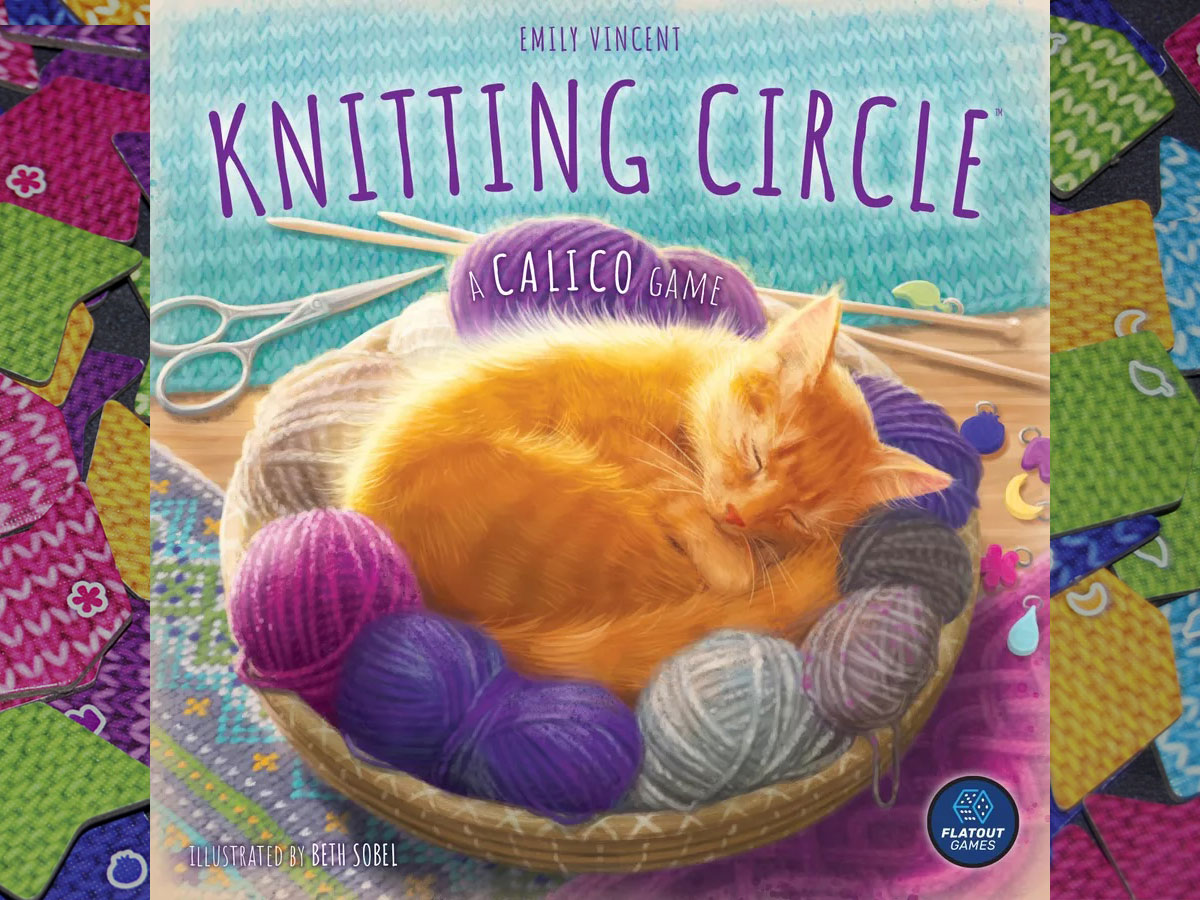
Knitting Circle is a puzzly tile game for 1 to 4 players, ages 10 and up, and takes about 30 to 45 minutes to play. It’s currently seeking funding on Kickstarter, with a pledge level of $29 for a copy of the game. Although the game is branded as “A Calico Game,” it is a standalone and does not require Calico to play (and uses very different mechanics); however, if you do own Calico, you will be able to use the components from Knitting Circle to play a drafting variant of Calico so it can serve as a sort of mini-expansion.
Knitting Circle was designed by Emily Vincent and published by Flatout Games with AEG, with illustrations by Beth Sobel.
New to Kickstarter? Check out our crowdfunding primer.

Knitting Circle Components
Note: My review is based on a prototype copy, so it is subject to change and may not reflect final component quality.
Here’s what comes in the box:
- 2 Central Knitting Circle boards
- Cloth bag
- 144 Yarn tiles (24 each in 6 colors)
- 4 Cat tokens
- 4 Player boards
- 8 Knitting Needle tokens
- First Player marker
- 12 Grabby Paw tokens
- 12 Ugly Garment Button tokens
- 90 Button tokens (30 each in 3 types)
- 84 Garment cards (12–16 each in 6 types)
- 18 Request cards
The yarn tiles are chevron-shaped tiles in 6 different colors, and each tile has a “knit” side and a “purl” side—the knit side has little zigzags in a lighter tint, and the purl side is more of a solid color with more horizontal-looking stitches. The tiles are also a little skewed, so that when you line them up alternating between knit and purl, they tilt left and right. That’s important for making sure you don’t put tiles in the wrong spots. Each of the tiles has a little icon in the corner to help with color identification (using the same icons as in Calico) though I noticed on the knit side some of them can be harder to see.

The garment cards are long, narrow cards that show a series of spaces for the knit tiles, from 4 spaces on the mittens to 7 spaces on the long johns. The spaces are also marked with zigzags for the knit tiles. Each garment type is also associated with one of the six colors, and these also use the same color-identification icons on the cards. Each garment has a number of required spaces and optional spaces—the backs of the cards have the optional spaces marked with “+” so you can see how many tiles it will require.

The player boards are each unique, depicting one of the four cats (and providing a little bit of information about the cats); they are paired with the four cat meeples in black, grey, orange, and white. The meeples are also in four different poses, which is nice for identification, with the meeple silhouette shown on the player boards as well.

How to Play Knitting Circle
You can download a copy of the rulebook on the Kickstarter campaign page.
The Goal
The goal of the game is to score the most points by completing garments and earning scoring bonuses.

Setup
Place the central knitting circle board in the middle of the play area, using the board and side that corresponds to the number of players. In the center of the board, place one yarn tile of each color, and then place the rest of the yarn tiles in the bag. Around the board, place two tiles on each space (drawn randomly from the bag), making sure that they are flipped to the correct knit/purl side.
Make supply piles of the grabby paws and various buttons. Set the garment cards nearby, separated by garment type, and shuffle each deck separately.

Give each player a player mat, the matching cat, one grabby paw and two knitting needle tokens. Give each player two of each button type at random—color, pattern, and garment—and place them on the indicated spaces. Each player chooses one garment to start (usually choose one that matches one of your garment buttons): draw two cards of that type, pick one, and put the other at the bottom of its deck. Place one knitting needle token at the top of your garment. Each player draws two yarn tiles from the bag and places them in the basket area of their player board.
Place the cat meeples randomly on the marked starting spaces—whichever cat is on the star takes the first player token.
For the advanced game, shuffle the request cards and draw 4 at random and place them face-up in the playing area, with the Grabby Paw side up. Return the rest of the request cards to the box.
Gameplay
The game lasts six rounds. Each round, there is a yarn drafting phase and a crafting phase. Players will take turns drafting yarn tiles from the central knitting circle, and then players may spend their tiles to work on garments.
First, at the very beginning of the round, the first player takes one of the yarn tiles from the center of the circle and places it into any space around the circle, replacing an existing tile. The replaced tile is discarded back to the bag.

Yarn Drafting Phase
On your turn, you must move your cat one or two spaces clockwise around the knitting circle, skipping over spaces that are occupied by other cats or that have no yarn tiles next to them. Then, take one yarn tile from the space where you landed and place it at the top of your player board. Note that you may not flip the tile over at this time. Players take one tile at a time until everyone has taken 4 tiles.
Crafting Phase
This phase is played simultaneously—everyone may work on projects at the same time.
Yarn tiles may be spent in a few different ways:
- Start a garment: discard a yarn tile to the bag, and then draw two garment cards of that color, keep one, and put the other at the bottom of the deck. Place your knitting needle token at the top. Note that you may only have 2 ongoing projects at a time, so if you don’t have any free needles you cannot start a new garment.
- Knit: Place one of your tiles onto one of your ongoing garment cards. Garment cards must be filled from top to bottom, and tiles need to match the knit/purl orientation. If you use a tile from the top of your player board (drafted this round), you must keep its orientation, but if you use a tile from your basket, you may flip it to either side. If you place a tile in a space that has a bonus, you get it immediately (some let you draw a random tile from the bag, and some give you a Grabby Paw token).
- Flip Tile: Discard one of your yarn tiles to flip one of your other tiles over.
You may discard a Grabby Paw token at any time to take a tile of your choice from the bag.

Each garment card has a few spaces with a solid outline, and then some additional spaces with a dotted line. The solid spaces are required, and the dotted spaces are optional. At any time, if you have filled at least all of the required spaces on a garment, you may complete it. Remove your knitting needle tokens and set it aside. Then, check to see if your garment matches any of your buttons—you may place one of each type of button onto your completed garment if it matches. If your garment has a completion bonus (random tile or Grabby Paw), take that now. If the completion bonus is points-related, that will score at the end of the game. Note that you get the completion bonus even if you don’t fill the optional spaces.

There are three types of buttons. The circle buttons have 1 to 3 colors on them—if you’ve included all of the colors in your garment, you earn this button! The square buttons show a specific garment, and you earn them by completing that garment. The triangle buttons are for patterns, and you score if you match the pattern, but those require some additional explanation:
- Solid – entire garment is a single color
- Stripes – two colors, alternating every tile
- Colorblock – at least two colors, and each color must be in a block of at least 2 tiles; cannot repeat a color once you’ve switched away from it
- Symmetrical – garment is vertically symmetrical so top color matches bottom color, etc.; cannot use a solid or striped garment as symmetrical even if it’s technically symmetrical
If you create a garment and it does not match one of these four patterns, you must take an ugly garment button, which will cost you 3 points.

In the advanced game, there are also four request cards to fulfill. If you are the first player(s) to complete a request, take a Grabby Paw and flip the card over to the non-paw side. (All players who complete a request in the same round are tied.) Once flipped over, other players may still complete the request cards
At the end of the round, when everyone is done crafting, everyone moves any unused yarn tiles to their basket, and then they have to discard down to 2 tiles in the basket.
Players now refill the button spaces on their player board.
Refill the central knitting board with tiles from the bag, and then pass the first player marker, and start a new round.
Game End
The game ends after six rounds.
Incomplete garments do not score and are removed.
Score as follows:
- Buttons on completed garments
- Completed garments—you score the points next to the lowest tile on each garment
- Garment bonuses—score the points at the bottom of each completed garment
- Ugly garment buttons—lose 3 points for each ugly garment button
- Request cards—score points for each request card you fulfilled

Solo Mode
The Solo mode is set up like a 2-player game, with an automated opponent who removes yarn tiles from the central circle based on flipping the first player marker. The opponent just sets aside the tiles and does not actually do any crafting, and you check your score against a chart.
Why You Should Play Knitting Circle
A few years ago, I reviewed Calico, a game about cats and making quilts—it was one of our Game of the Year nominees for 2020. Like Knitting Circle, it also featured artwork by Beth Sobel and was published by Flatout Games, and was a tile-laying game with a puzzle feel to it. Although Knitting Circle has a different designer, after playing it I can see why Flatout Games decided to give it the Calico branding: the cozy theme fits well and the knit-purl aspect goes well with these directional tiles. Once you get past the theme, though, you’ll find that Knitting Circle is very much its own game, and plays very differently from Calico.
One of the biggest differences is that it’s a bit less brain-burny! Calico had a very easy turn—play a tile, take a tile—but deciding exactly where to place your tiles could become a Sudoku-like puzzle because of the way the scoring conditions work. In Knitting Circle, it’s a lot easier to understand where tiles can go and how to score points, but there’s a little bit more to explaining how the turns work. Overall, though, it feels a little easier to grasp.
Your randomly drawn buttons will award you bonus points for working on particular projects: if I manage to make a striped hat that includes yellow and green, that’s worth 6 extra points! Filling in the last space on the hat is also worth an extra 3 points—but not if I have to use the wrong tile and make it an ugly garment. Since you have to spend specific tiles to get new garment cards, sometimes you have to decide between getting the garment you want for bonus points, and saving yarn colors that will make a nice pattern.
The puzzle portion of Knitting Circle is split between the drafting and the crafting. Figuring out which colors you want and whether you can get to them in the rondel can be a little hard because that involves other players—what will they take? Will they leave you a space, or will their cats sit exactly in the spot you were aiming for? The crafting part is a bit more like solitaire—it’s entirely dependent on your actions, and other players can’t mess with your projects at all. At that point, it’s up to you to find the best ways to use the yarn that you’ve got. When do you spend your Grabby Paws to get a guaranteed tile you want? Will you get a good random yarn draw if you fill in that mitten? Do you go ahead and cast off this scarf now even though it’s not all the way filled so that you can draw a new button for next round? I like the fact that this part can feel like a knitting circle—now that we’ve stopped fighting over yarn, we’re all just sitting around the table, each working on our projects.
I particularly like the various completion bonuses you get for finishing garments. Some give you immediate bonuses like random yarn tiles or Grabby Paws—either way, that’s more yarn for projects! Others are worth points based on certain conditions, like points per completed hat or bonuses for garments that have at least 2 buttons. This is where you get to figure out your combos, and decide whether you’re better off completing a lot of shorter garments, or filling up fewer longer garments.
The request cards used in the advanced rules aren’t a huge leap in complexity, and I encourage using them as soon as everyone is familiar with the basic rules because they do give you a little bit more to consider. There are times when two requests are contradictory so you have to choose one to work on first; at other times, fulfilling a request may mean making a suboptimal scoring choice for a garment—you’ll get to decide which one you think will ultimately give you the most points. And, of course, if you’re the first to complete a request, that awards you with a Grabby Paw, and those are extremely valuable.
I’m intrigued by the idea of using Knitting Circle as a sort of expansion for Calico. That’s something the publisher mentioned but the rules had not been finalized by the time of this writing, so it’s something I’ll have to wait to see. As with Calico and Cascadia, there will also be some scenarios and achievements in the rulebook where you’ll be able to play with specific setups, and then you can track your achievements in the rulebook. (These were also not quite ready in the prototype.)
If you enjoy tile-laying games and particularly if the knitting theme attracts you, check out Knitting Circle! It’s another nice addition to the Flatout Games line and has a similar vibe to Calico and Cascadia, so fans of those games are likely to enjoy this one, too.
For more information or to make a pledge, visit the Knitting Circle Kickstarter page!
Click here to see all our tabletop game reviews.
 To subscribe to GeekDad’s tabletop gaming coverage, please copy this link and add it to your RSS reader.
Disclosure: GeekDad was loaned a prototype of this game for review purposes.