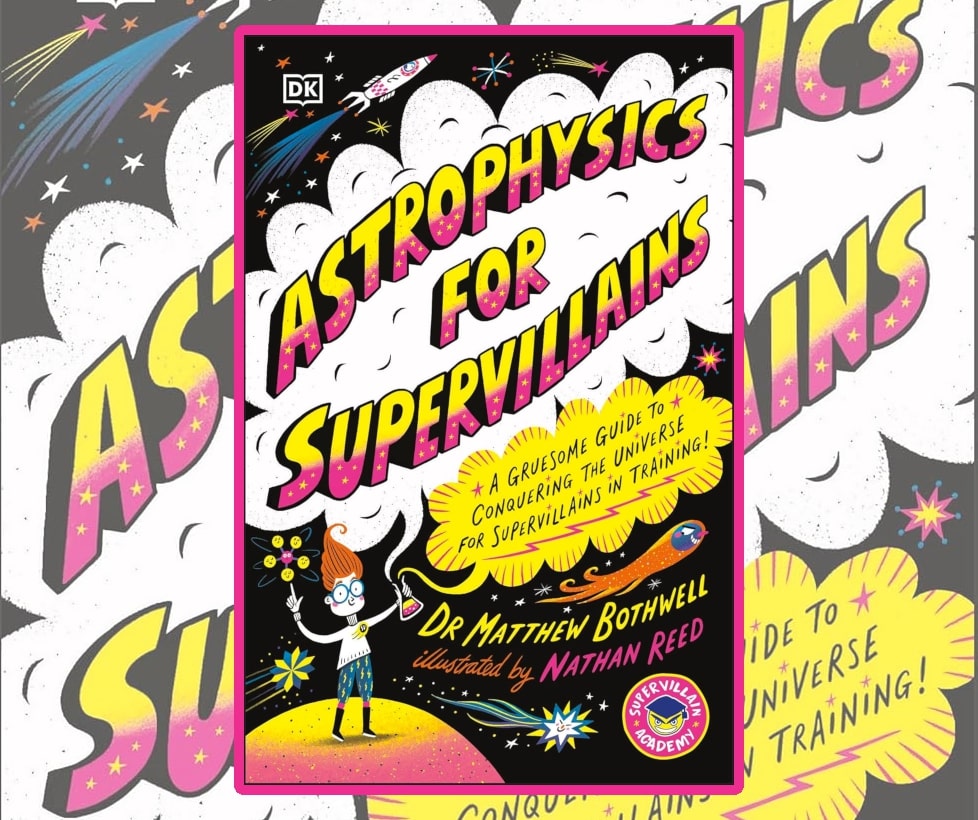
We like supervillains here at GeekDad, and many of us like astrophysics too. They both go with the geeky territory. What we love even more is when somebody cleverly melds the two. Enter Astrophysics for Supervillains, my final stop on DK’s “Summer of STEM” parade. Arguably, I’ve saved the best for last.

What Is Astrophysics for Supervillains?
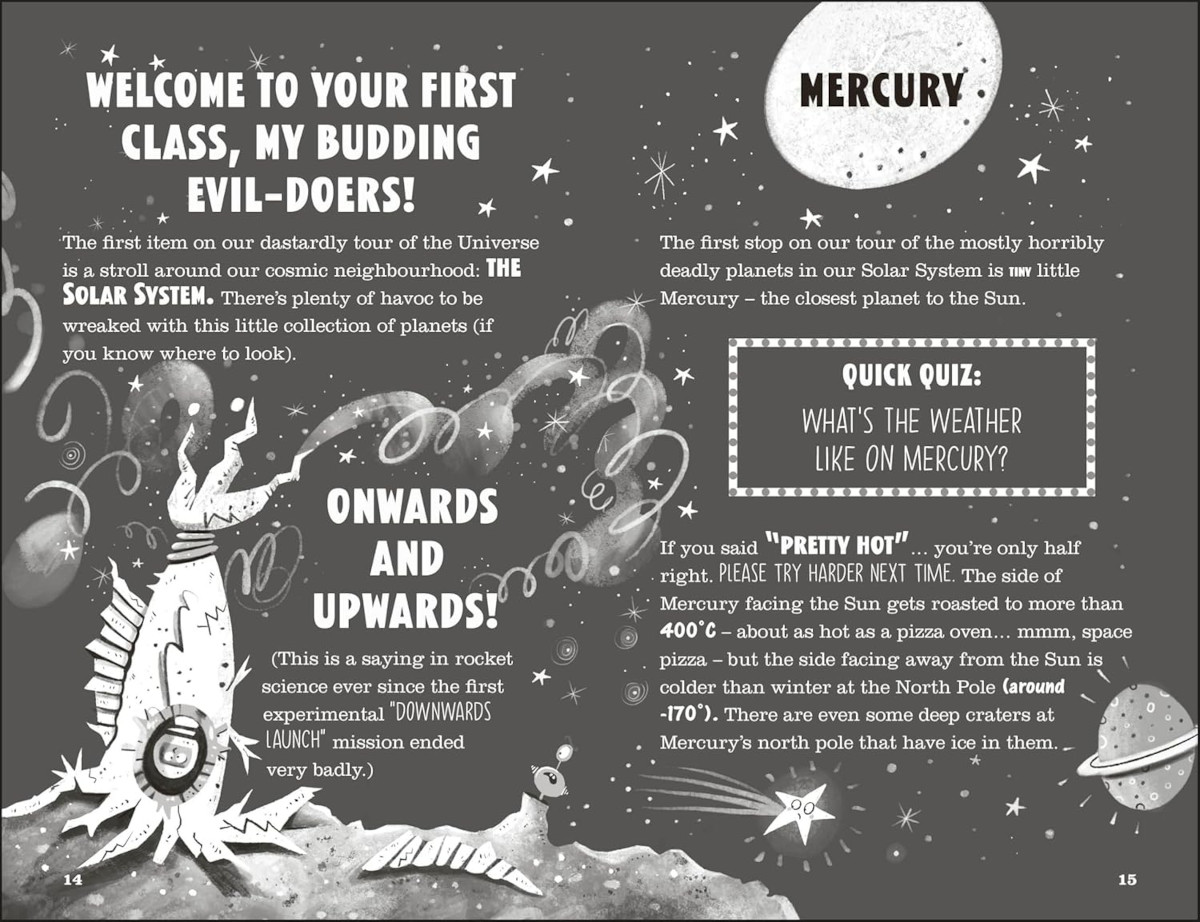
Unlike many (all?) of the DK books I’ve previously reviewed, Astrophysics for Supervillains is not a hardback full of sumptuous pictures and labeled diagrams. Instead, it’s a small, fiction-sized paperback filled with cartoon-style pictures and varying-sized fonts splashed across the page. It’s more akin to something like Diary of a Wimpy Kid than a classic non-fiction book.
The format is the brainchild of Dr. Matthew Bothwell, and he’s had his text brought to life by illustrator Nathan Reed.
The book opens by looking at the Solar System, mainly focusing on all the reasons why a particular planet is deadly, whether that be the atmosphere of Venus, the dense interior of Jupiter, or the fact it rains diamonds on Saturn. Any destructive facts about the planets—they’re here. Such as the collision of Theia with Earth; I knew it had caused the formation of the moon, but not that it also caused Earth’s axial tilt.
To be honest, there are many things that I didn’t know covered in this book!
Once the Solar System is out of the way, Astrophysics for Supervillains moves on to star formation, the burning of hydrogen, and ultimately star death—whether that be the destruction of Earth by the sun becoming a red giant or looking at how other stars become supernova and black holes. There’s lots of stuff about the black holes in this book!
The book finishes by looking at different theories about how the universe will end and then finally, a tongue-in-cheek look at the best ways to destroy the Earth. Essential reading for all supervillains out there!
Why Read Astrophysics for Supervillains?
The key thing about Astrophysics for Supervillains is how much fun it is. There aren’t lots of evocative photos to fire the imagination, but there are some excellent jokes, and a breezy writing style that draws readers in, entertaining them while teaching them all manner of astrophysics as they read. Matthew Bothwell has a gift for explaining the complex in an amusing and accessible fashion.
The book is a great resource for discovering how the universe and its galaxies, stars, and planets were formed. At the risk of repeating myself, it’s impressive how Bothwell and Reed have presented some complicated physics in a way that is easy to understand. My sons went through a period of loving the Story Treehouse books, and the style of Astrophysics for Supervillains reminded me of those. It’s silly and laugh-out-loud funny, but it’s also packed full of information. The book is a perfect example of form meeting function.
Whilst writing this review I discovered a follow-up book is due in March next year, Astrophysics for Supervillains: The Great Alien Hunt. On the strength of book one, I’ll definitely be checking it out!
If you would like to pick up a copy of Astrophysics for Supervillains, you can do so here in the US and here in the UK. (Affiliate Links)
If you enjoyed this review, check out my other book reviews.
As a randomish aside, while I was writing this review I stumbled on this article on the BBC—inspirational stuff for all budding supervillain astronomers!

I received a copy of this book in order to write this review.