

Over the past several years, STEM (Science, Technology, Engineering, and Mathematics) has become more engrained in education for today’s students. As a result, understanding coding or programming is more important than ever. While many first learn to code with block coding where different “blocks” of code are stacked together like building blocks, text coding is the next step. While there are several programming languages being used, the C programming language is widely used and a basis for several other languages. It can also be a bit more challenging than some languages such as Python. Luckily, there is an easier way to learn this computer language.
What Is Learn C Programming Through Nursery Rhymes and Fairy Tales?
Shari Eskenas, the founder of Sundae Electronics LLC, has authored several books with an innovative way to teach coding. For her latest, Shari has written a picture book that covers the basics of the C computer language. Learn C Programming Through Nursery Rhymes and Fairy Tales is currently for sale through Amazon. The paperback book runs $22.99. You can also get a Kindle edition of the book for only $9.99 or a hardcover edition for around $30. Shari’s previous books also teach readers either C or Python through a story about two children and their summer day as well as Python with nursery rhymes and fairy tales. These books are also currently available on Amazon.
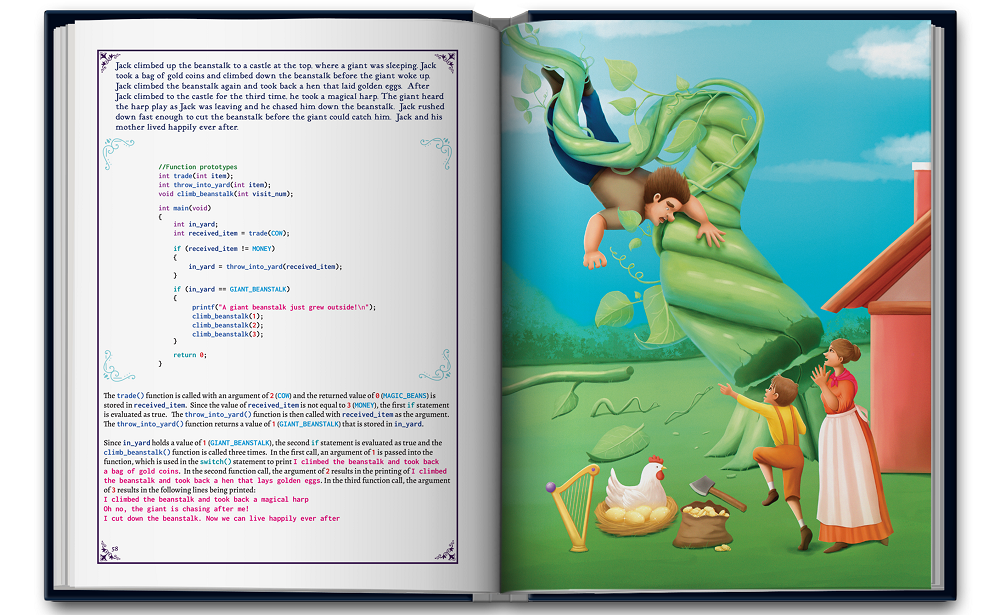
Don’t let the picture book format fool you that this is just for young children. This book can help older children and even adults learn C. Most books that teach how to code are dry, boring, abstract, and written for people already familiar with coding concepts. Learn Python Through Nursery Rhymes and Fairy Tales takes an innovative approach to teaching C. Across a spread of two pages, the content is divided into sections. At the top of the page is the story or rhyme written in prose. Following that is coding written in the C programming language which can be typed into an editor. Then when the program is run, the story will be told on the screen. At the bottom of the page is an explanation of what the code means. The opposite page features an illustration of the story’s events. New concepts are taught as readers progress from one story to the next.

Learn C Programming Through Nursery Rhymes and Fairy Tales covers the basics of the C programming language, including the following topics:
- Syntax
- Keywords
- Strings and data types
- Operators
- Input/Output
- Conditional statements and loops
- Lists, dictionaries, and tuples
- Functions and methods
- Classes and objects
- Modules
Why Should You Read Learn C Programming Through Nursery Rhymes and Fairy Tales?
As a computer science teacher in high school, and an advocate of teaching computer science to all students, I appreciate how coding can help students in many other areas. It helps with logical thinking, creativity, decision making, planning, problem-solving, and focus. In fact, as I have taught coding to students who struggle with math and algebraic concepts, they learned logic functions that then helped them with math. Coding also helps build confidence and perseverance so they gain the ability to work through challenges without giving up.
It is a good idea to learn the basics of the C language. While it can be more difficulty to learn than other languages such as Python, it is still used in many applications and it is the basis for other languages. For example, in my Software Development and Game Design, my students are learning and using C# to create video games. Other applications us C++. Having a knowledge of C can help with both of these other languages.
Years ago when I was a new teacher, I attended some training on teaching reading and comprehension while co-writing our school’s literacy plan. One of the presenters demonstrated the power of picture books for older students and even adults and showcased a number of picture books that were clearly written for older students and taught science and math concepts. Therefore, when I reviewed Learn C Programming Through Nursery Rhymes and Fairy Tales, as well as Shari’s other books, I have been pleased to see how they were written. I really like the format of story, code, and explanation. The story or rhyme is something familiar. The code then converts the story into C. Finally, the explanation helps readers to understand the commands and concepts in the code. At the end of the book, the author describes how readers can type in the code from the book into their computer using a C language compiler and watch the code work or even edit their code to try for different results. For example, in the code for the Muffin Man, by changing the word “muffin” in the tenth line of code to something else like “cookie,” when you run the program all instances of Muffin Man will be changed to Cookie Man. I am very impressed with Learn C Programming Through Nursery Rhymes and Fairy Tales and highly recommend it for anyone wanting to learn the C programming language as well as those who want to expose children to important life skills they can acquire through learning computer coding.

Learn C Programming Through Nursery Rhymes and Fairy Tales does a wonderful job teaching important coding concepts. As a computer science teacher, I love how it takes beautifully illustrated rhymes and stories with which readers are familiar and introduces basic and then more advanced coding as you progress through the book. Learning to code in C has never been more fun. While the book is available in digital format through Kindle, the paperback and hardcover editions are beautiful with their colorful pages. It reminds me of quality children’s books from my youth.
Be sure to check out this great book on Amazon.
Disclosure: GeekDad received a copy of Learn C Programming Through Nursery Rhymes and Fairy Tales for review purposes.


