Back in March, I wrote about getting into campaign games and shared a few of the games I’d already played and some that I was looking forward to. I was just looking back on what I’ve been playing this year and realized I had a very long list of campaign games that I’ve gotten to try, and a few more in the queue that I’m looking forward to playing.
First, I’ll start with a refresher on the games I’d already mentioned last time.
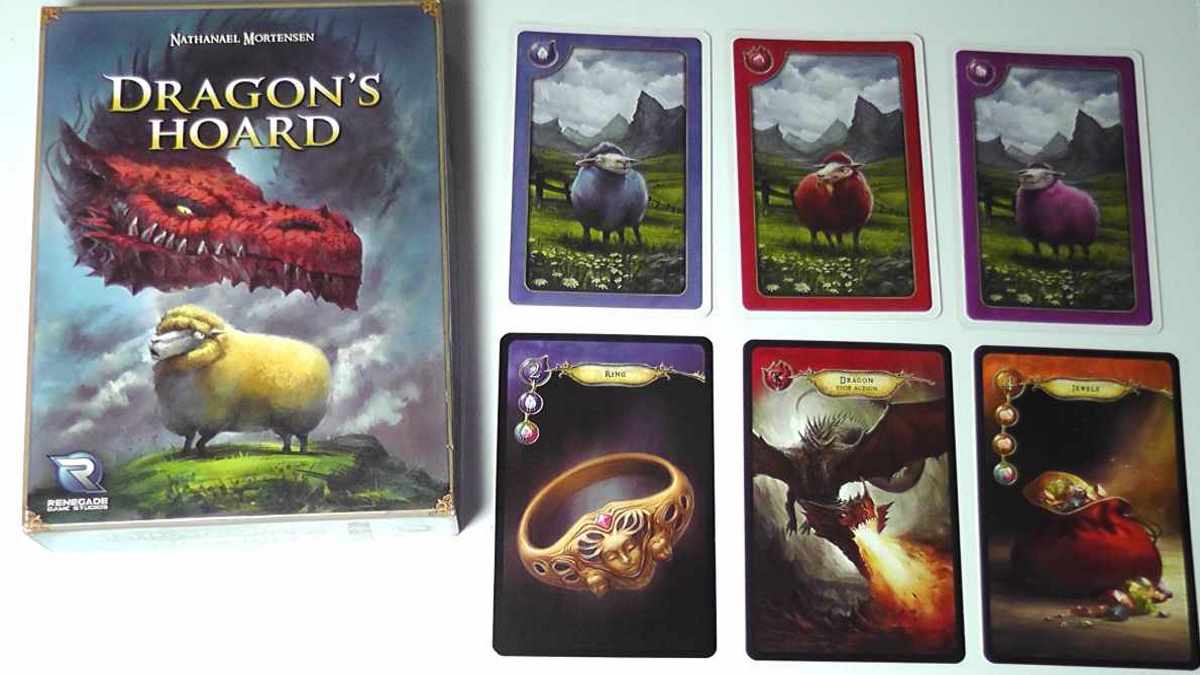
I did make some more progress in my 2-player Apocrypha Adventure Card Game, but we’ve had to pause for a bit due to a combination of things like schedule changes, some other 2-player games we wanted to try, or other folks joining in for game night with different gaming tastes. But we were doing pretty well—we’ve managed to win most of the scenarios we played so far. The game uses a “halo” setup where you can have cards that you’ve acquired placed in 8 slots surrounding your character card, and depending on the position of the cards, they can be used to assist you or specific other players. This aspect I think could get more interesting with more than two players, but even so, it’s been a neat concept to play with. One of the things that we haven’t experienced yet is character death—as you play, you may start accumulating “death” cards, and if you get enough of these, that character is permanently dead.
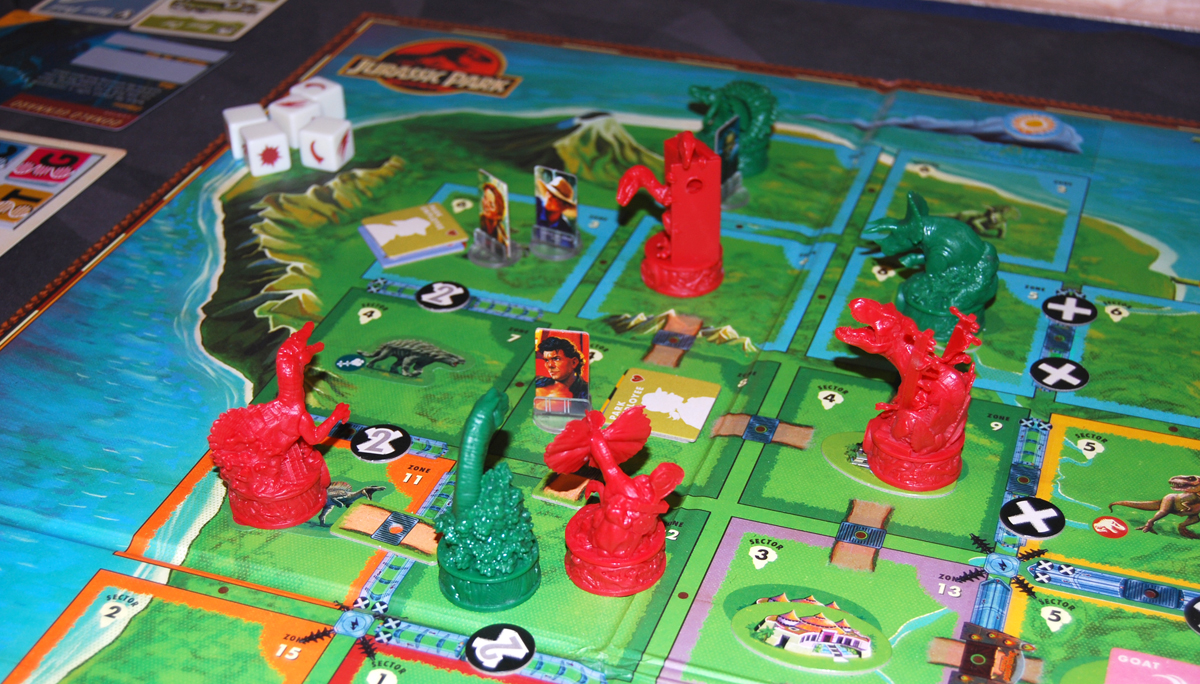
We wrapped up Jurassic World in May, with the highest possible campaign score. One of my players was fellow GeekDad Alex Hart, and this was his first ever completed legacy game, so he brought us some dinosaur-themed treats to celebrate. Overall, we had a lot of fun with it but (as evidenced by our score) it wasn’t too challenging. Since Funko Games has a broad audience and a lot of their games are sold at stores like Target and not just hobby game stores, I think they lean toward a little easier, both in terms of rules complexity and in the difficulty for things like cooperative games. (This contrasts with games like Pandemic, which I’ve heard Matt Leacock say he aimed for something like a 30% success rate when he designed it. Certainly, there are those who have become familiar enough that they can win much more often than that, but the expectation is that you won’t win the first time you play.) But even though we won every game of the campaign, I was impressed by the way that the game still managed to create a feeling of tension that kept us engaged and thinking. There was only one session that I remember feeling like things were smooth sailing and that we had plenty of time; all the other times it did give us a sense of accomplishment when we won.

When I wrote my post in March, I had gotten started with Frosthaven and had about 7 plays under my belt. I’ve since played about 30 times, usually one session a week, and it has been great to have that consistency. Now, the scenario book has 137 scenarios in it, and I know there are some paths that get eliminated as you make some choices, but I imagine there’s still a pretty long way to go. There’s a main storyline and a lot of side quests, and one of my players has a particular fondness for side quests so we’re doing a lot of those. In addition, there’s a puzzle book that unlocks additional scenarios when you solve things, and they’re really tough! At some point, I imagine we’ll resort to looking up some hints but we’re currently stuck (and the book has a lot more pages after this one). We’ve each managed to retire one character so far, and it’s been interesting to learn a new character and start over.
I like the outpost, too, which is one of the new things that Gloomhaven didn’t have. You build up various buildings in the outpost, which then allow you to access better gear, upgrade cards, and so on. One thing we haven’t really experienced much yet is the outpost attacks—we built up our walls and trained soldiers in anticipation of attacks, but so far I think we’ve only had two attack events, so I’m not sure if we’ve just gotten lucky or if those will increase later. At any rate, we’re still going strong with Frosthaven and I’m still really enjoying it. You can see my full review of Frosthaven here.
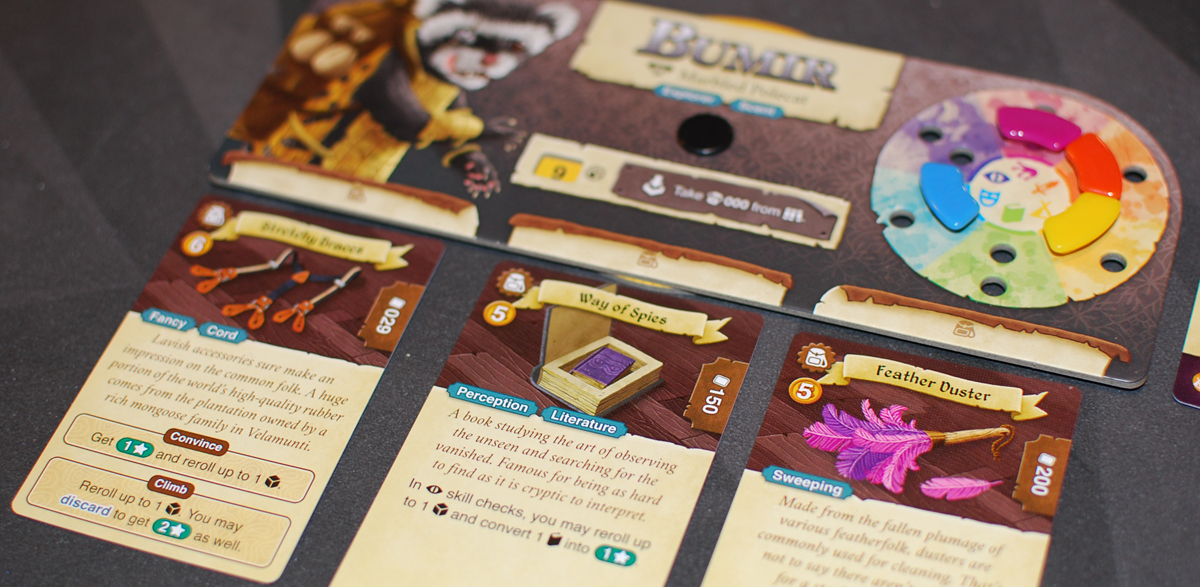
Our campaign of Lands of Galzyr has been on hold for a little bit, mostly because of scheduling. I was playing with two of my kids and one other friend on Friday nights, but my teenager ended up working a summer job and often wasn’t available on Fridays, or else I had other folks for game nights on Fridays so we couldn’t play this one. We’ve just gotten four “months” into this one so far. It has been a lot of fun and we’ve had some hilarious stories—like the time I turned in my kid (who had been brandishing his own Wanted poster to seem more threatening), collected the bounty, and then helped him break out of jail to get another bonus. (He was not so pleased with me.)
The game has an interesting feel: there’s a lot of narrative, and little (sometimes multi-part) missions you can take on that will give you various rewards, like new items or money or even letting you modify your skill points. As you play, some cards get removed from the game and others will get shuffled in, which is a cool way to have future consequences of choices show up at a random time in the future. My understanding is that Lands of Galzyr doesn’t have a specific ending because it’s more like a series of vignettes than one overarching plot line. You can just keep playing, but eventually, you’ll reach the point where you’re repeating some of the content—the designer’s estimate is that in a multiplayer game, you should be able to get about one “year” (12 sessions) before you really start to see repeats, but even then if you choose a different option you may find a different story. Some people have noted there isn’t as much a sense of “progression” because your character doesn’t level up and become more powerful—you always max out at three items, and a specific total number of skill points. So you evolve, the world changes, but it’s not like the sort of game where you get stronger, the challenges get harder, and things keep escalating. I’m hoping we can get back to this one soon.

I mentioned Artisans of Splendent Vale, which I was planning to play with my kids as soon as my oldest was home from college. We were able to play about once a week during summer break so we got 10 sessions in, and we’re now on hold during the school year. (I did send her character sheet and book with her to college in case we got a chance to try playing over video chat, but the school year has been pretty busy so far so we haven’t attempted it yet.) The game is a mix of narrative-based exploration and combat scenes. Each character has a book, and when you select a place to explore, everyone turns to that section number in their own book. A lot of it is text, often with specific dialogue that will appear only in one character’s book, and those parts have a choose-your-own-adventure feel. Then there are maps to explore, with numbers noting things that you can check out; what’s cool is that there are often numbers that only appear in one book because your character has a specific interest in it. The combat scenes are played out in a map book, with players using a pool of dice for their various actions.
I’m working on a full review, but here are a couple of the things I’ve really enjoyed about Artisans of Splendent Vale. First, the diversity of the characters: the four playable characters are people of color; one is blind and one is an amputee with a prosthetic arm; there are two women, one man, and one non-binary person. In the stories, you’ll get to know the characters and they have rich back stories about their families and communities and hobbies. The way the characters level up is also a lot of fun—each one has their own unique character sheet and ways of spending experience points to gain new skills. And the writing is great: sometimes funny, sometimes dramatic, and emotionally powerful. (Though, also, sometimes characters make absurd choices.) It’s been fantastic getting to play this with my kids and I just wish I didn’t have to wait until the next school break to continue!
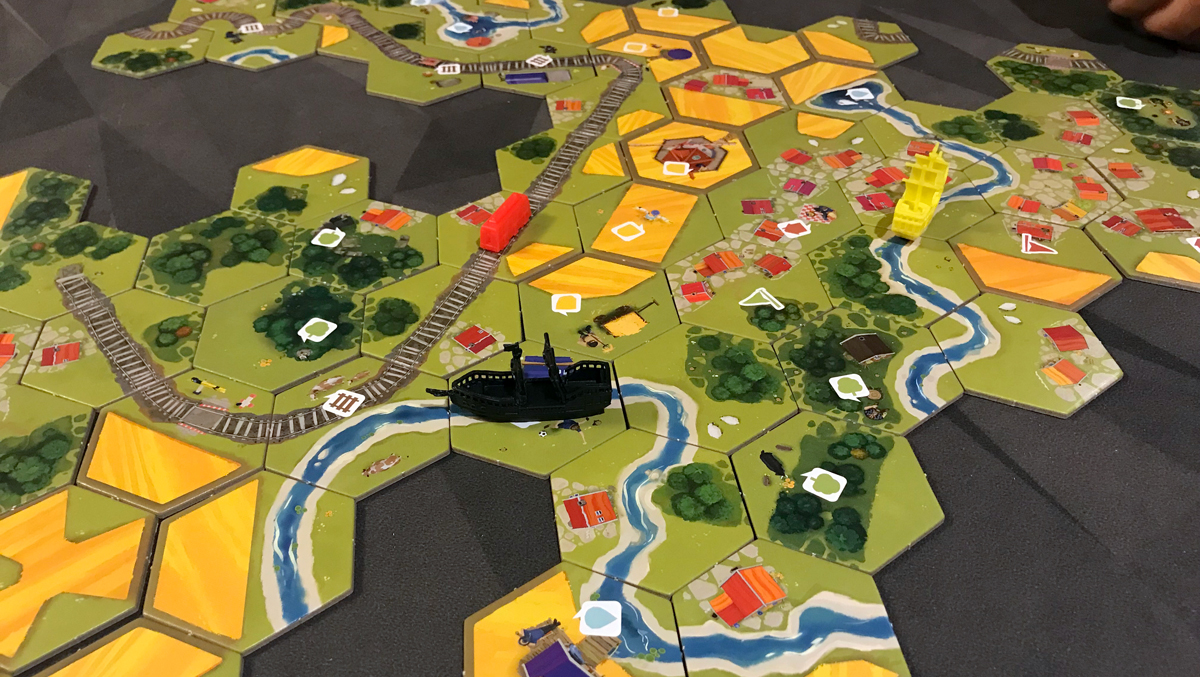
One campaign game I’ve managed to complete this year is Dorfromantik, which won the Spiel des Jahres earlier this year. I remember a while back I started seeing screenshots of a beautiful-looking video game crop up in my social media feeds. It seemed like a lot of the board gamers I knew were playing this tile-laying game about building out villages and forests and rivers and train tracks. I finally got it for myself (after a lot of the buzz had died down) and had a fun time with it, too. When I heard there was a tabletop version of it, I was really intrigued: the video game does have the feel of a board game, but also has elements that I felt would be difficult to reproduce physically. I ended up buying a copy for myself to see how it worked.
It really does feel a lot like the videogame version: although you can play multiplayer, it’s the sort of cooperative game where really it’s a solo game and you’re just taking turns. That’s fine, though—it makes for a nice, chill game where you can still chat about things and also play the game. Also, because there’s not really a story to follow (and things get unlocked in a different order just depending on how you play it), this is one campaign that you don’t necessarily need the same players for all the way through. For my first campaign, I just introduced different people to it at different game nights. The one caveat is that by the later games, you’ll have a lot more rules to teach than at the outset.
The board game simplifies things a little bit by just counting tiles—instead of 60 trees in a forest (something the videogame counts for you automatically), your goal might be something like 4 forest tiles instead, which is a bit more manageable. The game includes several little boxes—as you gain various achievements, you’ll unlock new special tiles to mix in, which give you new game rules and effects. There’s also a campaign sheet, and regardless of achievements, you can make some progress to unlock some of the other bonuses. The best part? The whole thing can be reset easily so you can start a new campaign once you’ve finished, and see if you can beat your previous records.
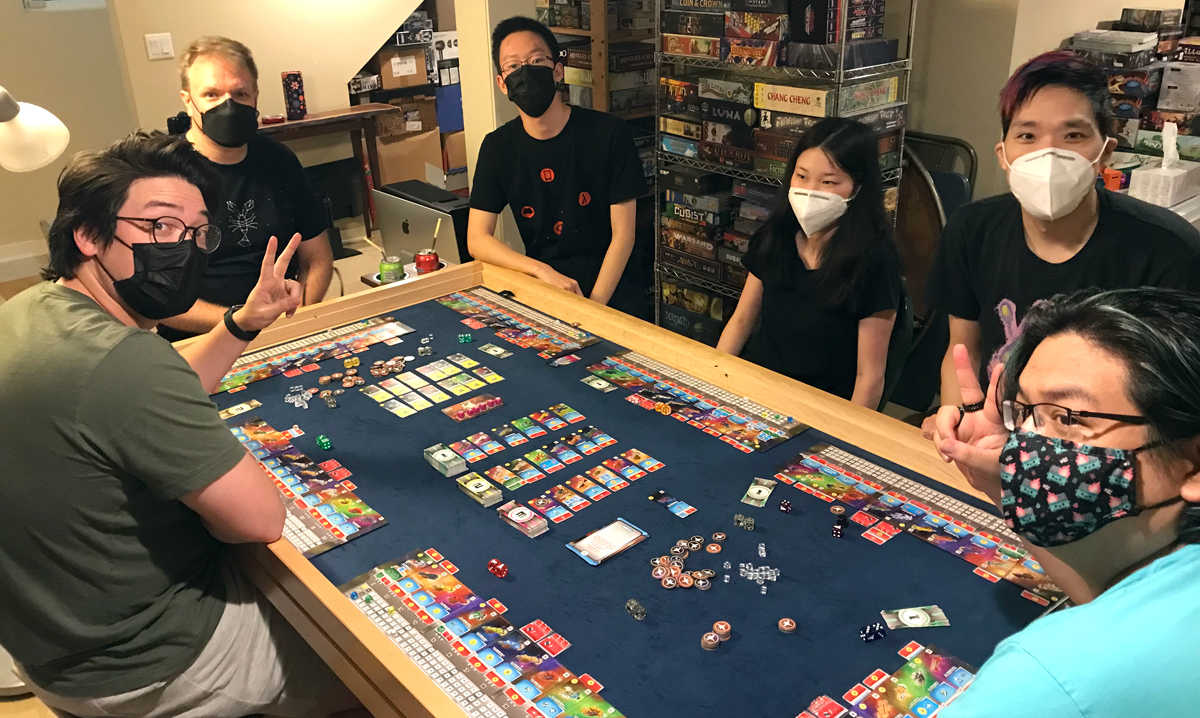
I hadn’t played Space Base in a while, but got it back out near the beginning of this year and remembered why I gave it our GeekDad Approved in the first place. I replayed the Emergence of Shy Pluto campaign with some new folks and then decided to pick up The Mysteries of Terra Proxima, which I had missed (along with the Command Station, which is basically the big-box storage solution that also adds enough components to expand to 7 players). I got some of my original Shy Pluto folks together with the new ones, and we’ve started in on Terra Proxima. Unfortunately, as you may expect, it’s tricky to coordinate that many schedules so we haven’t finished yet, but I like the way the Space Base expansions build a story around the new rules and modules.
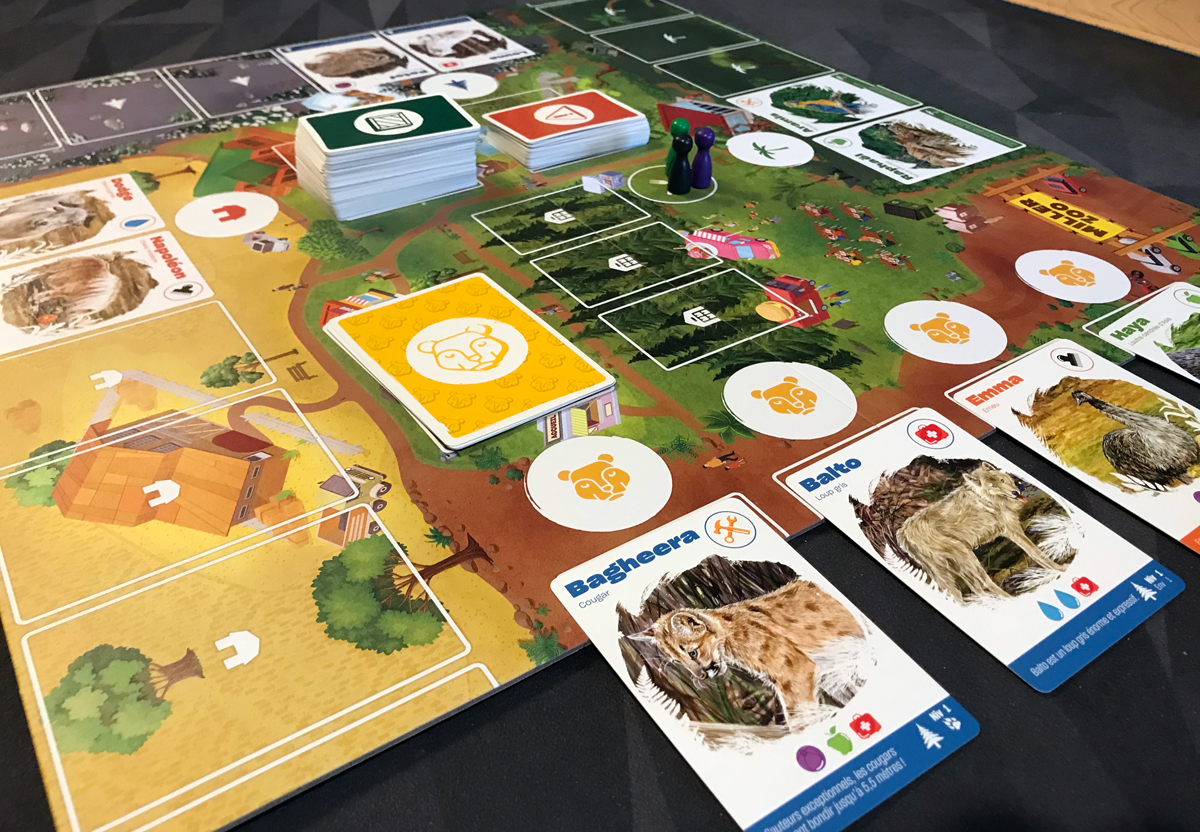
I got a review copy of Miller Zoo, which I’ve been playing with my 10-year-old. We’ve got about 9 plays of it so far. This one is a light legacy game akin to Zombie Kidz Evolution, where you get stickers on an achievement track and you’ll add some stickers to some of the cards, but nothing gets destroyed or removed so it’s possible to play the campaign again (just that you’ll need to make your own new achievement track). The cooperative game is based on the real-world Miller Zoo in Quebec, which has several rescued wildlife who are injured or impaired. Your team needs to balance your resources to welcome new animals and also take care of all of the existing animals. As you play, you’ll unlock new animal cards, character abilities, and more. Aside from the overall progression, there are also many challenges, kind of like achievements, that will earn additional stickers.
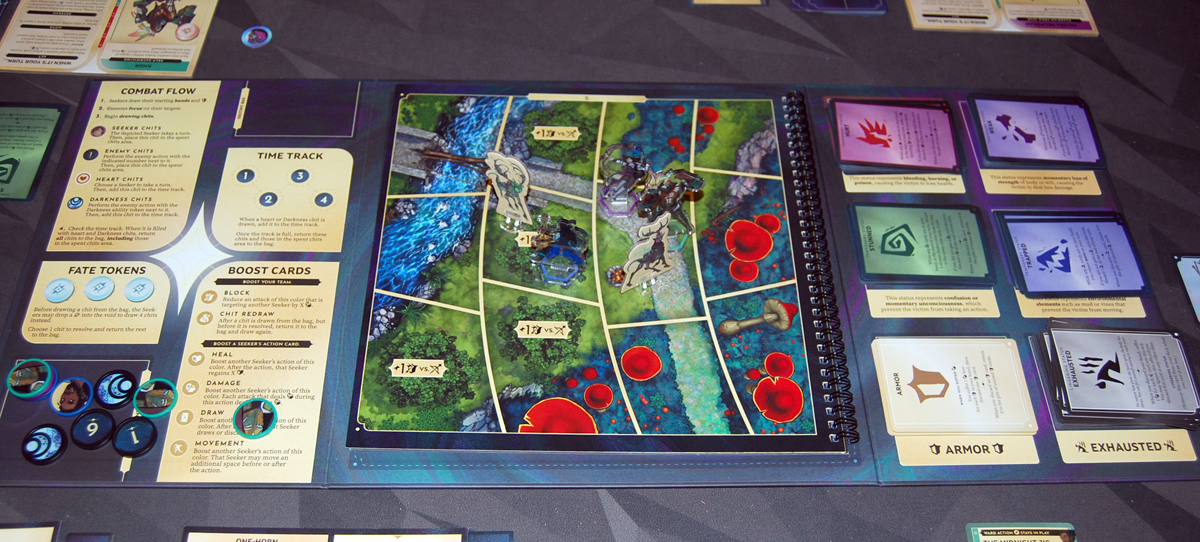
I had mentioned Kinfire Chronicles: Night’s Fall in a Kickstarter roundup last year; it was delivered to backers this fall and I was sent a review copy. I finally managed to get a 3-player game of this started in October, and in four weeks we’ve managed to blast through roughly half of the 21 available quests because it’s so fun that we don’t want to quit. (It also helps that the quests are about an hour long, a lot shorter than the 2 to 3 hours I often spend on a Frosthaven scenario.) Kinfire Chronicles is the first game from Incredible Dream Studios and it is, indeed, an incredible dream. While the various characters are analogous to your traditional RPG classes—this one is clearly the wizard, that one is a bard, there’s your rogue—most of them have unfamiliar titles like “tactician” and “opportunist” and “guardian from afar.”
The game uses a clever card system: your character gets a certain number of slots of the three colors (which roughly stand in for strength, dexterity, and intelligence), and your deck is built from those colors. What’s new is that the cards come in pairs, so each slot is actually two cards of the same name: one is an action that you would use on your turn, and the other is a boost that can only be used on another turn (sometimes to enhance your teammate’s action, sometimes to block against an enemy attack). As you progress through the campaign, you’ll gain access to more powerful cards that can be swapped into your deck.
There’s also a good bit of story. Some of it is in a series of cards that you’ll make progress through during a quest—it’s not just the battle scene (but every quest has one), but you might also get some sections where you’ll have to make a choice between two different paths. And in between quests, you’ll get to visit town and take various actions there—shopping for wares, training for combat, and even gambling! I’ll be working on a review of this one soon as well, but playing it this past month has been a highlight for me.
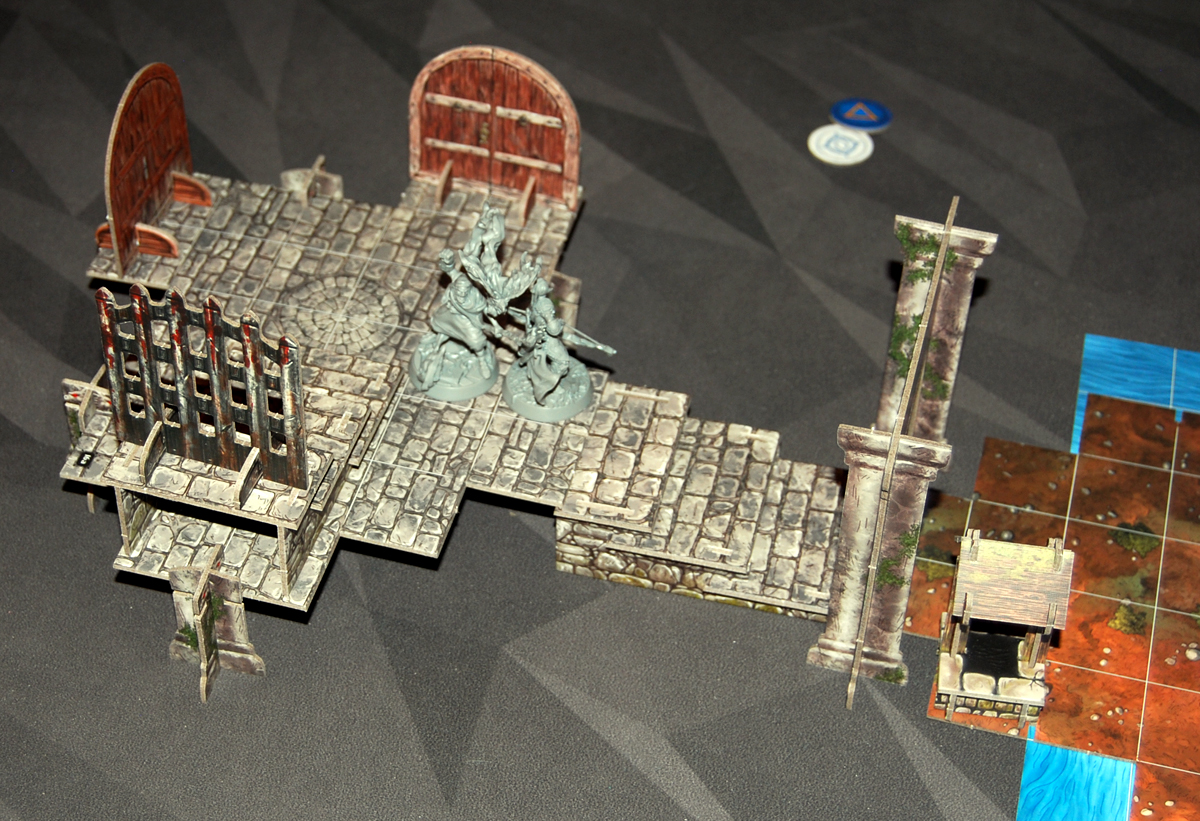
One game that I’ve just scratched the surface of is Descent: Legends of the Dark. This is one that was sent to me recently—I believe this is the third iteration of the dungeon-crawler Descent, and they just released Act II this year. I’d actually never played any of the Descent games before so I was curious to see how it works. This version relies on an app—it gradually reveals the map setup as you explore, and while it tracks the enemies’ health and notes what their actions are, it does not manage where you and the enemies are on the physical map, so there’s a balance between what the app handles and what you take care of physically.
The game relies on some double-sided cards and a fatigue system—you can often add fatigue to cards or yourself to use abilities (up to the limits of those cards), and then you can flip cards over to clear the fatigue and switch to another mode—for instance, between your two starting weapons, or between your two character abilities. I haven’t gotten very far into this one yet—we just did a 2-player learning session so far—so I’ll report back when I’ve gotten a bit farther. The one striking thing about this one is the vast amount of 3D cardboard terrain that it comes with, and the system used to create raised floors at multiple heights, which is kind of neat.
Okay, that’s probably all I have time for this time around, but I’ve got a list of others waiting in the wings! I finally bought a copy of Holding On: The Troubled Life of Billy Kerr, which has you working together as a medical care team for a patient who suffered a massive heart attack. You have to juggle managing his health with helping him open up about his story, in the hopes of reconnecting him with family. We’ve played this one twice so far so there are still many game effects we haven’t encountered yet. From the same publisher, Hub Games, I’ve also bought a copy of Prism Arena, a kid-friendly legacy game about some characters training to become Guardians of Hope. I saw a prototype of it at Gen Con back in 2019 but never got a chance to play it, so that’s one I’m hoping to try with my youngest when we’re through Miller Zoo. I got sent a copy of Ticket to Ride Legacy: Legends of the West, which I’m very curious about but need to find a group that will commit to the dozen sessions. And, finally, I’ve got a copy of Eila and Something Shiny waiting for me—it’s a solo game about a rabbit going on an adventure, and I’ve been warned that it has some deep emotional themes in it.
As you can see, I’ve really been enjoying the campaign experience. It’s very cool to have a game’s effects carry over from one session to the next so that you can get a sense of building up, and by the end, you have a history to look back on. It definitely does present some challenges in terms of scheduling—playing Frosthaven weekly means I can’t invite other people to that game night, and if one player in the group isn’t available then I generally have to just cancel. But if you’ve got a pretty consistent game night group, there are a lot of campaigns, both short and long, that let you immerse yourself in the world of a game beyond just the separate plays, and that can be a really wonderful experience.