I read several comic books this week, plus I finished a novel that I’ve been working my way through slowly, so let’s have a look!

Cat’s Cradle: The Mole King’s Lair by Jo Rioux
I mentioned the first Cat’s Cradle book last summer; this is the second book in the series (so if you haven’t read the first, you may want to skip the next paragraph to avoid spoilers). It’s a very fun fantasy series filled with bizarre creatures and a young girl who considers herself a Monster Tamer but often doesn’t recognize the true nature of the characters who are right next to her.
Suri is on her way to the Monster’s Cradle, looking for somebody big enough to adopt Byron, the giant dog-like creature who looks terrifying but is really just a big sweetie. She’s accompanied by Caglio the imp, who’s self-centered and greedy but doesn’t really have any other options. The prince is on their trail, hoping to hunt the monster. The prince also has the assistance of three caitsiths, the cat-like monsters who can disguise themselves as humans and have their own reasons for tracking down Suri: the ball of golden twine that she has no idea is the real source of her unreliable magic abilities.
This book finds them encountering yet another group of caitsiths, as well as some strange mole creatures living in a mountain where there’s supposedly a chamber full of gold. The little traveling party really needs some funds to buy food, so they decide to take a chance, and eventually all the threads come crashing together. I’ve really enjoyed this series so far—the artwork is a lot of fun, and the world that Rioux created has lots of mysteries to uncover. Keep an eye out for this one in June!
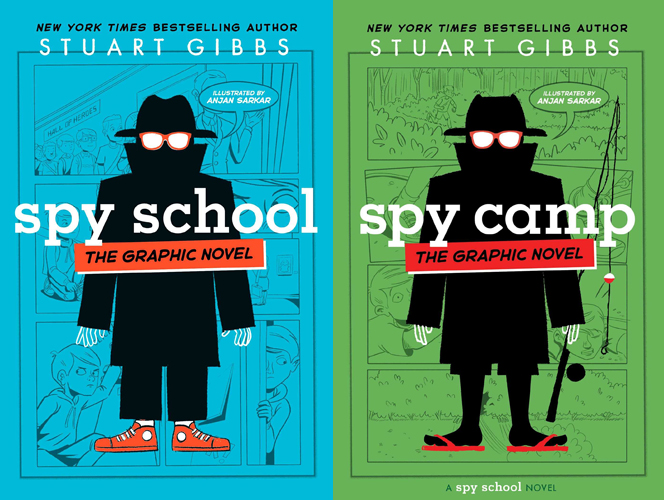
Spy School: The Graphic Novel & Spy Camp: The Graphic Novel written by Stuart Gibbs, illustrated by Anjan Sarkar
I missed the train when it comes to the Spy School middle grade novels—I think when I first found out about them they’d already hit book 6 or 7 in the series so I didn’t pay a lot of attention to them. But the graphic novel adaptation is more recent (with the second book released this month) so I decided to give them a try.
Ben Ripley is obsessed with becoming a spy, and his dedication to playing a video game on the CIA website finally attracts the attention of the CIA. He gets recruited to the Academy of Espionage, which turns out to be a lot like regular middle school—bullies, terrible cafeteria food, boring teachers—except a lot more dangerous. He finds himself in the middle of some nefarious plot, with people constantly trying to attack or kidnap him. Why does everyone seem to think he’s an expert on cryptology? The story has a lot of very silly moments and Ben manages to survive despite his lack of training, which paves the way for the second book, in which he’s sent to the CIA’s summer school camp to learn outdoor survival skills (and gets targeted again by the bad guys).
I read the two books with my nine-year-old and while we both had some laughs, we also both thought a lot of the plot was pretty ridiculous and full of holes. None of the actual spies in the book are very good spies; for instance, despite some things being very top secret, all the characters just talk about them in the open without any concern for who might overhear them. Still, if you like spy kid stories then you kind of expect a lot of over-the-top action and hand-waving logic.
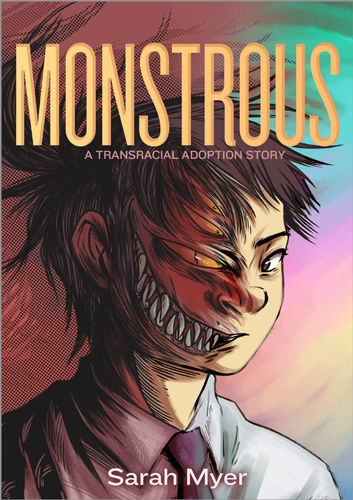
Monstrous: A Transracial Adoption Story by Sarah Myer
This comic book for young adults is autobiographical: Sarah was born in South Korea and adopted as a baby to a white couple in a rural town in Maryland, and this book is an attempt to convey some of their experiences growing up and struggling to fit in. (Note: although Myer uses “they/them” pronouns, the Sarah in the book uses “she/her” pronouns for most of the book so I will do so when referring to the character.)
Sarah had an older sister, also adopted from Korea, but Lizzy was always better at fitting in. Sarah was impulsive and noisy and got in trouble often; her one strength was drawing, which sometimes helped her make friends. Sarah’s inability to keep her emotions in check, combined with not understanding why her birth parents gave her up, made her imagine herself to be a monster, something horrible and different from everyone else. These feelings were exacerbated when she got a little older and started experiencing more overt racism at school.
This story encompasses several aspects of Sarah’s life: aside from looking different from her peers, she also had mental health issues that were not really addressed for a while, and she also had to work out her own complicated feelings about her identity, including her gender and sexuality. She does eventually find her people and start to get a better understanding of herself by the end of the book, which covers the end of high school and start of college.
Myer includes an Author’s Note (along with lots of old photos) at the back that explains a little more about their story and what they’ve learned since then. It’s a powerful story that can be painful to read in places, but ends on a hopeful note. Monstrous will be released in June this year.

Keeping Two by Jordan Crane
I first came across Jordan Crane’s comics many years ago, when I picked up a thick zine-like booklet somewhere (at a comics festival? I don’t exactly remember) called “The Shortcut,” featuring a kid and his cat taking a shortcut to school and getting chased by a giant tree monster. I thought it was fantastic but could not find anything more about the artist, listed in the book as “Jane d’Rancor” (which I found out much later was an anagram of his actual name). Sometime later I found The Clouds Above, a bigger hardcover comic about what happens to the the kid and the cat after they arrive at school—late. And he’s also the genius behind Keep Our Secrets, which I wrote about over a decade(!) ago, a board book that has heat-sensitive ink: if you rub the dark parts of the illustrations, they reveal strange secrets.
I picked up Keeping Two at a bookstore sometime last year but just hadn’t gotten around to reading it yet until this week—after which I went back and re-read “The Shortcut” and The Clouds Above because I was feeling nostalgic. Keeping Two features a couple, Will and Connie, who have just arrived home from a long road trip. Connie goes out to find them some dinner, and Will starts working on the dishes.
But there’s also a lot of flashbacks, identified by the wavy panel borders: Will remembers some arguments they had during the drive, as well as the memory-within-the-memory of the book that Connie was reading to him on the way. There are also current imaginings: when Connie doesn’t return home for hours, Will can’t help imagining all the horrible ways that Connie might have died—did she get mugged? Or get hit by a drunk driver while walking? He switches back and forth from being impatient to being worried to being angry. I’ve definitely had similar emotional ping-ponging myself, like when one of my kids is late getting home from school or if my wife isn’t responding to messages when I thought she should be reachable.
While it feels like there is not a lot that actually happens in the story, there’s a lot going on internally with the characters and Crane manages to capture those in a way that is believable and familiar. I found out after reading it that this book has been 20 years in the making—Crane has serialized the story in a quarterly comic, and it was finally collected and published last year.
 A Tale for the Time Being by Ruth Ozeki
I mentioned I finally finished a novel I’ve been reading for a while—that would be A Tale for the Time Being, which I suppose ended up being a longer time than I’d anticipated. I can’t explain entirely why this book took me so long to read, other than the nature of it felt like it warranted a slower pace. The two threads of the book are about Ruth herself discovering a batch of things that apparently have washed up in Canada from Japan, perhaps from a tsunami; and the journal of Naoko, a teenage girl who has been contemplating suicide but is also trying to write down the story of her 104-year-old grandmother who’s a Zen monk.
The chapters alternate: half of them follow Ruth’s life as she reads the journal and tries to find more information about Naoko and her family—aside from the journal itself, there are letters in both French and Japanese that she needs help translating. She and her husband Oliver live on a small island community that is constantly bracing for the winter storms, which can cut off power to the island. The other half of the chapters are from the journal itself, as Naoko describes some horrific bullying, her father’s attempted suicides, and her visit to the temple where her great-grandmother begins to teach her a different approach to life.
What’s interesting is the way that these two storylines—even though they take place about a decade apart—begin to blur together as if they’re happening concurrently, and there are even ways that the stories start to overlap. There are also plenty of footnotes—some explaining Japanese terms, some digging into the practice of zen—as well as some appendices that go even deeper into some of the subject matter. It’s interesting because it’s a novel, but with non-fiction sections.
All in all, I found the book really absorbing—I got caught up in both worlds. I was as invested as Ruth was in the fate of Naoko and her father, and yet I didn’t want to read too quickly to get to the end.