Last week I posted a review of the board game Dying Message, in which players take turns being a victim, setting up a crime scene in which they leave clues for the other players to figure out the murderer. Murder mysteries are, of course, not new to the board game scene, or to literature. I grew up playing Clue and reading The Westing Game. As I reflected in my Dying Message review, it’s a strange thing to be entertained by, but perhaps part of it is the way that in games and books and movies there’s often a clear answer by the end: it’s a puzzle that has a solution and everything wraps up neatly by the end. In some cases, it’s even enough just to identify the killer, and the other details surrounding the case aren’t actually important.
The other thing I discovered in the past couple weeks is that, well, maybe it’s not the best thing to read just stories about murder for several weeks in a row. It can get a bit wearisome and doesn’t do great things for your overall mood, depending on the type of story, so I suggest partaking of this week’s offerings in small doses.
At any rate, today’s stack is a big collection of murder stories: comics, puzzle books, and even jigsaw puzzles.

Murder Most Puzzling: Peril at Quandary Park by Stephanie von Reiswitz
Let’s start with a book: this one is almost like a picture book, though there is still a good deal of text accompanying it. You are a detective (apparently with a bit of a drinking problem), summoned to Quandary Park, where the owner of the estate Adelaide Hatchett was found dead in a locked greenhouse. Your job is to sort through the estate and figure out if one of these many colorful characters often present at Adelaide’s elaborate parties was the culprit—and if so, what was their motive and how was it done?
After an introduction to the case and the various characters in play, each “chapter” involves about a page of text accompanied by some full-page illustrations with some sort of puzzle to solve. Some stone animals have been removed from the balustrade—which one holds the key? A medicine cabinet is full of bottles and jars—but what’s really contained inside?
Some of the puzzles were easier than others for me: I could figure out the logic puzzles, but there were some that required finding hidden objects, a la Where’s Waldo?, that stumped me. Overall, though, I enjoyed the story, the way that the various threads were woven together to lead to the killer.

Murder Most Puzzling: Poisoned Patisserie by Stephanie von Reiswitz
This entry in the Murder Most Puzzling series is an actual jigsaw puzzle, also illustrated by Stephanie von Reiswitz. The box is designed to look like a large hardcover book, and inside the top flap is a story about the deceased Clemency Burnside, owner of the pastry shop. Her three underlings introduce themselves and describe Clemency’s death—choking and convulsing, with a horrible grin. Medea Thorne, the private detective you’ve accompanied to the shop, explains that it must have been strychnine poisoning—which of the three underlings was responsible?

The puzzle—whose full image is not included on the cover—is a display of various elaborate cakes. Paired with the brief descriptions of the three underlings, you’re supposed to figure out who made which cake … and which cake was poisoned.
I enjoyed piecing together the puzzle—the cake names helped me sort the pieces—though I did have a little bit of trouble with the mystery itself, which required some outside knowledge of the poison that wasn’t included in the story itself. The solution (as well as a full image of the puzzle) is included in an envelope inside, though there isn’t much else to the story: you figure out the cake, determine the culprit, and that’s it—there’s no story to explain why they killed Clemency or anything else.

Murdle: In the Hedge Maze by G. T. Karber, illustrated by Sean C. Jackson
In case you’re not familiar, Murdle is the name of a daily murder mystery puzzle by G. T. Karber; the name is presumably a portmanteau of “murder” and “Wordle,” even though it’s a logic puzzle instead of a word puzzle. The mysteries use the little grids and a series of clues: “Mr. Green’s neighbor has a cat. Posy’s owner likes to drink coffee.” Marking off boxes in the grids according to the clues eventually leads you to the solution—and in this case, it’s always catching a killer, and you’ll have to identify the suspect, the weapon, and the location.
There are also a few books of Murdle puzzles as well and, now, a jigsaw puzzle. Murdle in the Hedge Maze has some similarities to the Murder Most Puzzling jigsaw above: it has the same sort of book box with a story on the inside flap: Dame Obsidian’s lawyer was murdered in the hedge maze. You’ll have to match up each suspect with their weapon and location, and then figure out who did the deed.

What’s fun about this one is the inclusion of Deductive Logico and Inspector Irratino, the two detectives on the case. Logico is all about using the Deduction Grid and the stated clues. Irratino just wants to wander through the hedge maze to look at clues. As it turns out, you can solve the murder either way: as a regular deduction puzzle (using the included grid sheets), or by assembling the entire puzzle and following the maze-like paths to see who went where. Note that even if you’re using the grid, you still need to do at least some of the puzzle, since there are clues like “one of the suspects still has their weapon.” But the deduction puzzle gives you a chance to figure out the mystery before the puzzle is complete.
My daughter and I had fun with this one—she decided to work on her grid before the puzzle was finished and came up with the right answer, while I love working on puzzles and enjoyed following the twisty paths to see how everything lined up. The illustration (also not shown on the cover) is a network of mazes and presented a nice challenge, with lots of similar-looking regions that made sorting out pieces a bit difficult.

Murdoku by Manuel Garand
If you like logic puzzles, here’s a collection of 80 puzzles with a sort of Sudoku twist. Each puzzle comes in the form of a floor plan, and you’ll have to figure out where each of the people goes based on the clues given—the person who’s in the room with the victim is the killer! Where the Sudoku comes in is that no person can be in the same row or column of the grid as any other person. My daughter has been working her way through these and has been enjoying them.

The clues may tell you that a person is next to a window, or on a particular type of floor, or in a specific room of the house. Some clues tell you the relative position of another person or something about the furniture. Eventually, if you get everyone placed correctly, you’ll be able to narrow down who did it. As you make your way through the book, things start to get more complicated, with spaces that can’t be occupied, numbers of rooms that are left empty, and tricky layouts that make it seem like there are multiple spots for each suspect.

Codex Regenesis by H. M. Batsel
This book is both a gorgeous piece of art and a puzzle to be solved. An inserted letter presents you with this book and a strange story about an old bookstore owner. Norton Oufle went to a book fair, but then passed away afterward—according to the young man who shows up claiming to be his grandson. His store will be shut down, and all of his rare books sold at auction. Your friend who wrote you this letter discovered that Norton was apparently obsessed with this particular volume for some reason, and thinks it may hold the answer to his disappearance. Did Norton really die of natural causes, or did something more sinister happen?
The book itself, with the subtitle “Five Fables of Magick Misused,” is made to look like an old volume of folk tales, with a beautiful custom font that looks like gothic lettering and elaborate illustrations in black and red ink on cream-colored paper. Each fable is about somebody encountering magic of some sort—and then suffering the consequences of abusing that magic. There are five special interactive illustrations, one for each story, that fold out or slide apart in some way, offering a clue. The back of the book is a clever compartment, locked with five dials: you must find the right words to unlock the book and learn what Norton had discovered.

I really enjoyed this one—the interactive illustrations were cleverly done and, though they weren’t necessarily difficult to figure out, they felt magical when you found the solution. The stories themselves have some echoes from one to the next, so although they feel at first like separate tales, by the end you see how they all weave together.

Can You Solve the Murder? by Antony Johnson
The title of this interactive crime novel may not be very catchy, but it’s a good description: it’s up to you to solve the case, following the clues and deciding what to investigate next. That’s right, you get to choose your own adventure, so to speak, jumping around from one page to another based on your decisions. Unlike the old kids’ books you may be used to, though, this one is a bit more complex. As you make your way through the story, you’ll need to write down little codes (J4, T3) in your detective notebook, because later in the story those could affect which story sections you’re allowed to choose next. For instance, sometimes you don’t have time to follow every lead—which one will you pursue?
The story takes place at Elysium, a fancy wellness retreat center in England. The victim was apparently stabbed with a fork and fell from a balcony, and for some reason there was a rose put in his mouth. What does it mean? How did the killer get into the locked room with the balcony? And who has the key now? I haven’t cracked this case yet because I haven’t finished the book, but I’m enjoying the puzzle so far.

Who Killed Nessie? written by Paul Cornell, illustrated by Rachael Smith
In this graphic novel, Lyndsay has just started her new job at a hotel … and for some mysterious reason she’s been left in charge of the whole hotel for the weekend of a big convention. The manager seemed really eager to get going, and warned that they’re kind of weird. Oh, and that the security cameras are all off at their request.
Well, as it turns out, the convention is for a bunch of cryptids and other mythical creatures, though at first Lyndsay assumes it’s just really good cosplay. Plus, she doesn’t believe in that sort of thing. Unfortunately, it doesn’t really matter what she does or doesn’t believe in, because Nessie turns up dead and the creatures turn to her as the only impartial being on site. She’s only got a few days to solve this thing before the convention is over and everyone heads home, but this murder could have huge consequences for the future of these mysterious creatures.
As Lyndsay meets the various creatures and starts to interview them, she discovers that there’s a big controversy stewing: some of them want to be recognized as real creatures by humans, but that would also change the fairy magic that protects them. Was Nessie killed because of her position on the issue?
The story has a lot of fun with the cryptids: there are funny habits, weird abilities, and, apparently lots of romantic relationships among the creatures. Lyndsay has to figure out how to bring her rational brain to solve a case that is very much outside of her logical world.

This Place Kills Me written by Mariko Tamaki, illustrated by Nicole Goux
Abby Kita is not a fan of Wilberton Academy, a fancy all-girls boarding school. She doesn’t really fit in, and there are rumors that she deals drugs or is perhaps gay. But she was the last one to see Elizabeth Woodward alive.
Elizabeth played Juliet in the Wilberton Theatrical Society’s performance of Romeo and Juliet, and everyone loved her. Then she was found in the woods after opening night, dressed in her costume and apparently dead of a self-inflicted stab wound. The police chalk it up to a suicide, but Abby isn’t so sure. She found some evidence left behind by Elizabeth, but isn’t sure what it all means. As Abby starts to poke around, she faces the wrath of the popular girls of the WTS, as well as the school’s administration, who have never been entirely pleased with her presence. Somebody has been keeping secrets, and Abby can’t help digging into them.
This is a book that tackles some very serious issues about bullying and peer pressure, about systems of abuse and the people who enable them, about how difficult it can be to be yourself (especially in adolescence).

The Murder Next Door by Hugh D’Andrade
Unlike most of the titles in today’s column, this one is a memoir, and while some names and details have been changed, it is based on the author’s actual experience. When he was a kid, D’Andrade came home from school one day to find the two kids who lived next door outside, arguing with each other. At first he thought it was a prank, but soon discovered that their mother had been murdered. Soon after, his neighbors moved away and he lost touch with them; when he finally returned to school, there seemed to be an agreement that it was best not to talk about what happened. The killer was never caught.
The book jumps back and forth between the past and present day, often with D’Andrade talking to his therapist. Even though the murder took place decades ago, it still affects him deeply. It colors how he thinks about masculinity in himself and in other men; there is a feeling of dread that looms over him, a fear of this monster that is still out there somewhere and could hunt him down. This comic book follows D’Andrade’s process of untangling his feelings and finding some resolution.

Model Five Murder by Tan Juan Gee
Io, a cyborg working on a space station, encounters a body floating in space—one that happens to be a Rohm Model Five, just like her. The dead Model Five was apparently a Detective Neumann, according to the business card found on his body, so Io decides to investigate. She runs into Yanfei, a former colleague, who was recently contacted by Neumann and given his latest case file, the disappearance of a union leader who had tried to change the labor laws on the station. There’s evidence he was murdered, but with Neumann gone, the case is still unsolved. Io and Yanfei begin to investigate—but Rohm Industries is a powerful company with a lot of secrets, and Io’s recent memory issues don’t make things any easier.
This comic book isn’t long, but it’s a tightly woven mystery with some shades of Blade Runner. Even when you find out who the killer is, there’s still about half the story to go and it keeps you on the edge of your seat wondering what happens next.

String written by Paul Tobin, illustrated by Carlos Javier Olivares
Ever since Yoon-Sook’s parents were killed when she was a child, she’s been able to see two types of “strings” connecting people. Blue strings connect people who have had sex; black strings connect killers and victims. Her strange ability has made her a consultant or detective of sorts: suspicious people hire her to check on their spouses or lovers, a gang member pays her to find the killer of his nephew, cops recruit her to identify murderers. When Yoon wakes up and sees a black string attached to herself, she knows that she’s either going to be a victim or a killer, probably within a day. She seeks out Luke Mayfield, a police detective she had just worked with to catch a murderer, and asks for their protection and help figuring out what’s going on.
String is an exciting graphic novel, with lots of explosive action but also sharp dialogue. Yoon and Luke have an entertaining rapport, and we also see various glimpses of Yoon’s non-police work as she follows up with her various clients to see if any of them might be trying to do her in—and that’s a colorful cast of characters as well.

Don’t Let Go written by Fred Duval, illustrated by Didier Cassegrain, based on a novel by Michel Bussi
The Bellion family enjoys a vacation on Reunion Island, but then Liane Bellion vanishes from her hotel room, which is found locked. There’s evidence of a struggle and some blood spatters in the room, and Marshal quickly becomes the top suspect in the murder of his wife—though it feels a little too obvious. Then Marshal takes his young daughter Sophia and goes on the run, hiding out and making his way to the volcano at the center of the island … and there’s a trail of bodies in his wake.
But very soon the police start running into issues with their theory. Marshal isn’t just a tourist here on Reunion Island, and some of the resort staff knew that. What is Marshal up to, and where did Liane’s body go?
The story switches perspectives, following different characters throughout the story. Sometimes we get Sophia’s point of view, mixing fantastical images from her imagination with her own theories about what her dad has been up to. A lot of the story focuses on police captain Aja, a long-time resident of the island who does not want the case to get away from her, and her hedonistic partner Christos, who’s great at his job when he’s not sleeping in or drinking or canoodling with his girlfriend Imelda (who, like Encyclopedia Brown, may be the real reason Christos is able to solve any crimes at all). It’s an intense story that will keep you guessing!

Past Tense written by Jason McNamara, illustrated by Alberto Massaggia
This comic book combines murder with time travel, of a sort. Past Tense (and some other companies like it) has the ability to send camera drones into the past, and charges clients exorbitant fees to watch. Ashley is a tour guide for Past Tense, and she makes a little extra on the side from clients who are obsessed with watching more gruesome events. When she discovers the trail of a serial killer, she starts selling trips to his murderous past to her clients. The problem is, this killer is still alive—and he’s discovered Ashley’s little scheme, which makes her the next target.
But that’s not all: the killer seems to have intimate knowledge of Ashley’s life. He’s not just interested in finishing her off—he wants to torment her a bit before then. Ashley tries to concoct a plan to expose the killer, who seems to be one step ahead the whole time. It’s an intense cat-and-mouse chase, definitely for older readers because of the content.

The Principles of Necromancy written by Jackson Lanzing and Collin Kelly, illustrated by Eamon Winkle
Here’s a comic book that’s a perfect fit for spooky season: it’s gruesome and gory and creepy. The doctors in the city—named for their areas of specialty—are proud of their scientific achievements, though there is one truth that they all hold: what is dead stays dead. Doctor Jakob Eyes, assigned to opthalmics, isn’t content with that. He has been experimenting with flesh and stitching together monstrosities, which gets him thrown out of the medical community. But when the City King is aging and ailing and he cannot trust the sycophantic doctors to tell him the truth, Doctor Eyes is fished out of the dungeons to work his miracles for the King.
The illustrations are delightfully creepy. Jakob’s own eyes have been replaced with weird black disks (a little reminiscent of the button eyes in Coraline), but the most unusual thing is his doctor’s mask, an alien-looking thing with sharp proboscis and chin and bulging eyes. As the story goes on, Jakob’s experiments bring death and new life (of a sort) to whoever he feels deserves it—and the list is long.

Whodunnit? by written by El Torres, illustrated by Vicente Cifuentes
This comic book is a curious one: it’s a Victorian murder mystery with supernatural elements, and also all the characters are anthropomorphic animals. Miss Quirrel has just been hired as a maid at Strutter Manor, where several relatives are gathered at the request of Lord Harold Strutter, who has an announcement to make. It’s clear he has some guilt on his conscience as he mutters to himself in his room—but he never gets to make his announcement, because a cloaked assailant stabs him to death, to be discovered by Miss Quirrel.
Inspectors Forrester and Wallcroft arrive on the scene to investigate, and it turns out that Wallcroft and Quirrel have a history with each other. They discover a secret passage in Strutter’s room and vanish into its dark hallways, while Forrester continues to interview the remaining family and wonders where his partner has disappeared to. The family has a lot of buried secrets that get dug up over the course of the story, and we also learn that Miss Quirrel has the ability to see ghosts. You’d think that would make this a much easier case to solve, but her power has some limitations, and the plot is pretty twisty. This one was a fun story with a lot of false accusations and startling discoveries.

Simplicity by Mattie Lubchansky
Set in the future, when New York City has become a walled fortress, Lucius Pasternak is sent outside to do an anthropological survey of Simplicity, the home of the Spiritual Association of Peers, a cult-like group that moved into the woods in 1977. Billionaire mayor Dennis Van Wervel is building a history museum, and wants to include Simplicity in the exhibit. The small community is strange and Lucius isn’t quite sure about participating in their rituals, but he does his best to find people to interview about their beliefs and practices, and starts falling for one flirtatious acolyte.
Then people start disappearing, leaving behind gruesome scenes, and the Peers wonder if there’s a bear or something worse on the loose. Lucius has vivid dreams of strange monsters and it starts to get hard to separate his visions from reality. And then he discovers Van Wervel’s real plan for Simplicity, and it’s up to him to stop it.
Simplicity is a queer story in all senses of that word. Lucius is a trans man, and many of the Peers don’t conform to traditional gender norms. The visions that Lucius experiences are trippy and sexual, and the reveal of what’s been terrorizing Simplicity is surprising. It’s a story about power and fear, the way that the people in the city demonize those outside it and vice versa. If you’re looking for a graphic novel that doesn’t give you easy answers and isn’t afraid to veer into the bizarre, check this one out.

The Great British Bump-Off by John Allison et al
This comics series had two storylines, and somehow I managed to get issue #1 of the first one and issue #2 of the second, so I’ve gotten to read just enough to intrigue me and not enough to know whodunnit. The series features Shauna Wickle (seen previously in the Bad Machinery series), now a young adult but still solving mysteries from time to time. In the first storyline, Shauna is a contestant on The UK Bakery Tent (though you can guess the real inspiration for this reality cooking show). But right at the start of the show, Neal—one of the contestants who’s already been a jerk to several of the bakers—is found in the tent, poisoned by a mouthful of his own batter. Although he’s not dead yet (at least in the first issue), I think this qualifies for this stack because it was an attempted murder. The show must go on! Shauna tells the producers that she’ll figure out who did it—which means she’ll have to survive the baking challenges long enough to do her detective work.
The second storyline, Kill or Be Quilt, finds Shauna living on a houseboat for some reason (probably explained in the missing issue #1) and working at Canalside Crafts, a fabric store. When the store owner’s electric vehicle goes up in flames, she suspects that Pat, the owner of the competing store Stitch Pickings, is trying to keep her out of the upcoming quilt show. Shauna is sent to work at Stitch Pickings as a spy—but then after some sabotage is found there, Pat sends her back to Canalside Crafts as a double agent! Hijinks, presumably, ensue.
I was a big fan of Bad Machinery and it’s always fun to see how the kids from that series turned out in John Allison’s later comics. The first storyline is from a couple years ago, but I’ll have to go look up the rest of the series to find out what happened. The second storyline has a collected edition coming out next month!

Murder Kingdom written by Fred Van Lente, illustrated by Chris Panda
Tanith works as a ride operator at The Storybook Kingdom, a theme park in Florida based on classic fairy tales that is definitely not Disney. When the actress playing Briar-Rose has a public meltdown, Tanith is recruited to take her place because of her red hair—and but then she finds Brie, brutally murdered in the hedge maze. As the book continues, more and more cast members are killed off by a creepy Alice-in-Wonderland-ish character in a mask, all in ways that mirror classic fairy tales, and Tanith starts to uncover some of the deep dark secrets hiding behind the facade of “happily ever after.”
The plot of this comic book was pretty clever. The murders are very bloody, but there is a logic behind them if you can piece it all together. There’s a lot of different threads that weave together: some of the characters attempting to unionize; the history of the park and Roy Oswald, the Disney-like genius behind it; the strange visitors in the park wearing what look like Apple Vision Pro headsets. Each of the five chapters includes a splash page with a short excerpt of a fairy tale, hinting at the way the next victim will die. One thing that doesn’t entirely make sense is the way that this place and its history exists at the same time (and in the same State!) as Disney and the Magic Kingdom—never mentioned by name but clearly referenced.
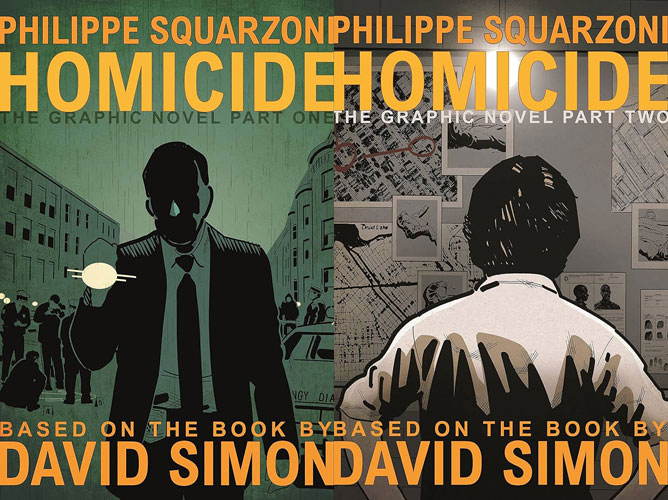
Homicide: The Graphic Novel by Philippe Squarzoni, based on the book by David Simon
This is a two-volume comic book, about 700 pages altogether, based on Homicide by David Simon, a book that was originally published in 1991 and was turned into a TV series and then later inspired The Wire. Simon spent a year shadowing detectives in the homicide unit of the Baltimore Police Department, and the result is an intense, close-up look at the process of finding a killer.
Squarzoni’s illustrations are a perfect fit for the subject matter: a realistic style with a bit of noir to it, mostly in black and white with subdued touches of color here and there, except for the deep red used for blood spatters and for the red marker used to record open cases on the department’s whiteboard. There are a lot of dead bodies throughout the books, but they’re approached with a neutral, documentary lens—not meant to shock nor titillate, but simply showing the scenes as viewed by the detectives. The detectives, too, are portrayed realistically: you see the gallows humor and their contempt for some suspects, their determination to close cases, the pressure from the chain of command to prioritize some murders over others, the performances they give in the interview rooms and ploys they use to squeeze out confessions.
Over the course of a year, there are many different types of murders, but one of the most chilling—and the one that becomes an albatross around the neck of the lead detective—is an 11-year-old girl found in an alley. As the year wears on, the book keeps circling back to that one when a lead pops up, when new evidence appears. We get a glimpse of the morgue and the work of the medical examiners. In 1988, when these events took place, there was already a shift in the way the department handled police shootings, and those concerns are represented by a case in which a suspect on the run is found shot, but none of the police on duty will own up to it.
What I found most remarkable about Homicide is the way that that it shows a respect for the work being done by these detectives without glamorizing them or the job. It made me appreciate the difficult position that the detectives are often put in, but also shows that sometimes they feel absolutely sure about something when there’s no evidence to back it up. If you’re looking for a clear-eyed book about true crime, I’d recommend this one.
My Current Stack
Like I said before, it’s a lot of murder all at once, so take your time with this stack! In the meantime, I’ve been reading several other comics that I thought could fit the Halloween season. Stay tuned next week, when I’ve got another doozy of a list about not-so-wicked witches, plus some traditional and not-so-traditional monsters.
Disclosure: I received review copies or digital access to the books covered in this column. Affiliate links to Bookshop.org help support my writing and independent booksellers!