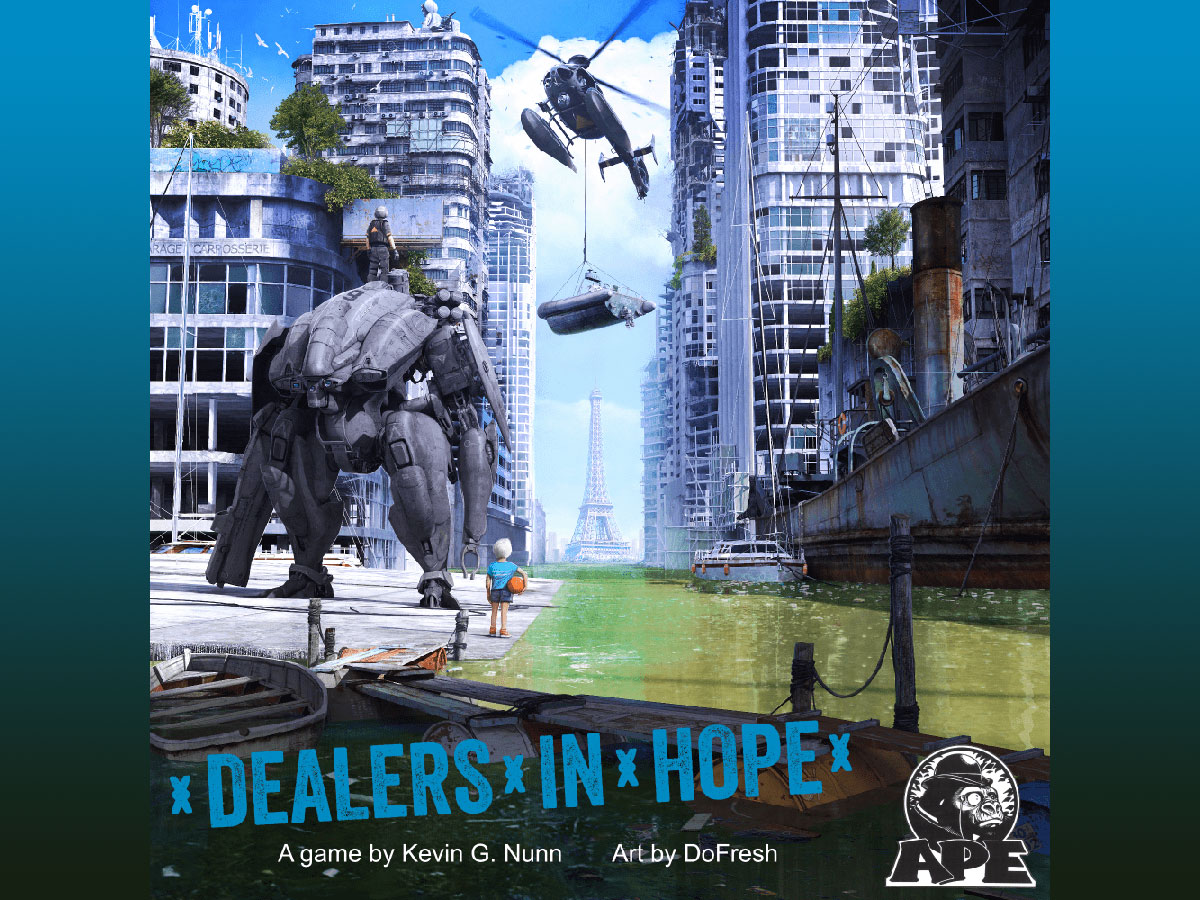
Factions compete for territory in a world wrecked by climate change.
What Is Dealers in Hope?
Dealers in Hope is a deck-building wargame for 3 to 5 players, ages 14 and up, and takes about 90–150 minutes to play. It’s launching soon on Kickstarter, with a pledge level of $69 for a copy of the game, which will also include the expansion. (Note that shipping will be calculated when the game is actually shipped, and there is a special note about the uncertainty of tariffs for US backers.)
Dealers in Hope was designed by Kevin G. Nunn and published by APE Games, with illustrations by DoFresh.
UPDATE: Unfortunately the campaign was canceled shortly after launch today.
New to Kickstarter? Check out our crowdfunding primer.
Dealers in Hope Components
Note: My review is based on a prototype copy, so it is subject to change and may not reflect final component quality.
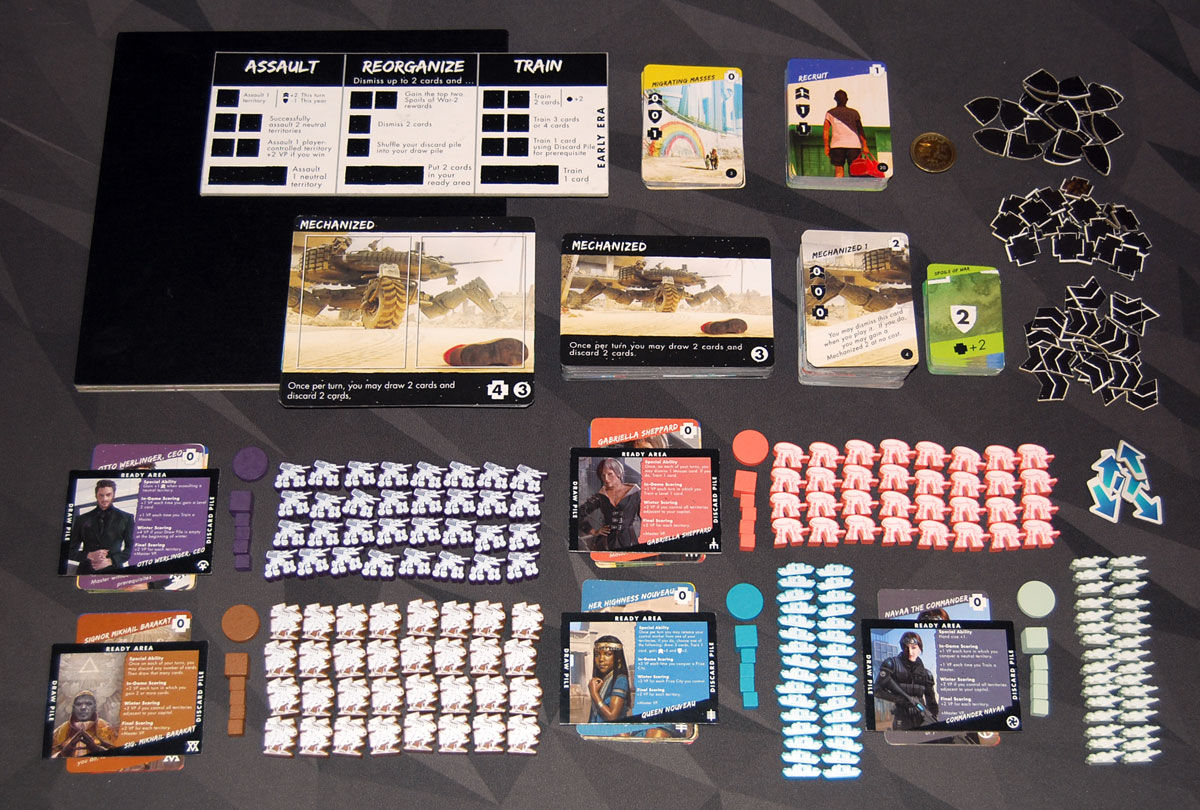
Here’s what will come in the box:
- Double-sided game board
- Action board
- 15 Masses cards
- 50 Citizen cards (Recruits, Veterans, and Tutors)
- 12 Master cards
- 60 Player Master card copies
- 123 Professional cards (Level 1 and Level 2 cards)
- 50 Location cards
- Start Player marker
- Strength markers (Attack, Defense, and Support)
- 2 Battle arrows
- 5 Player Component sets, each containing:
- Faction Leader mat
- 14-card Faction deck
- Capitol marker
- Leader Action cube
- 4 Action cubes
- 34 Meeples
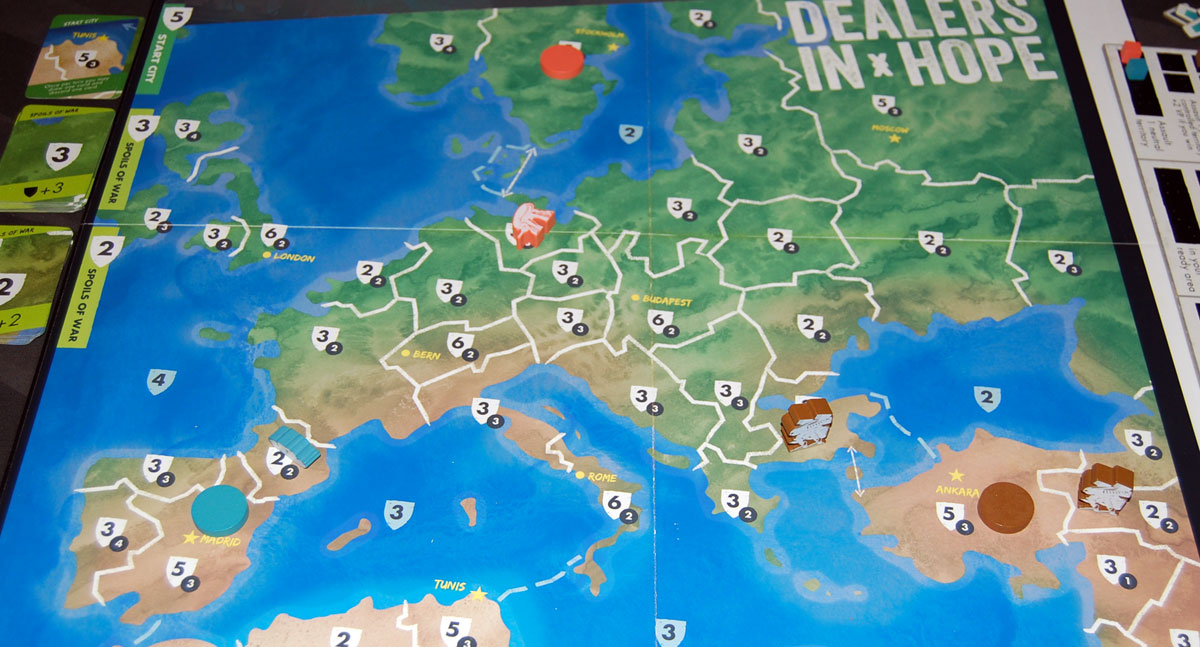
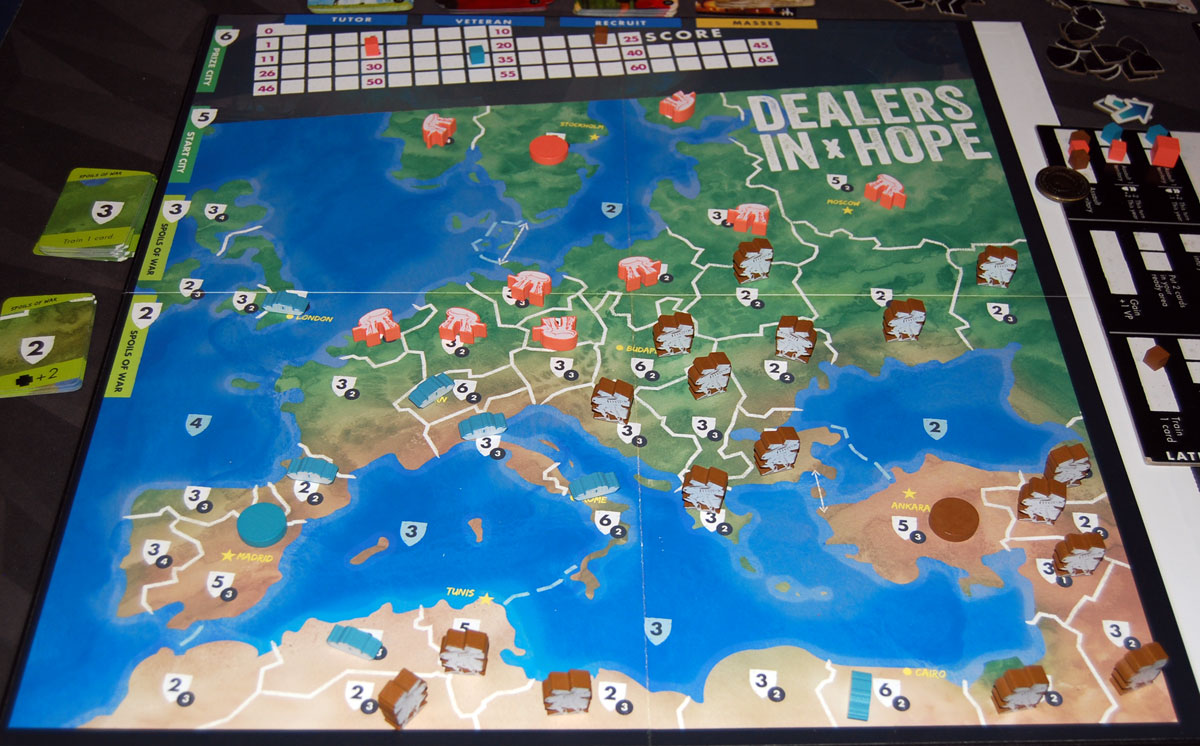
The main game board will be double-sided: the Europe side is for 3 players, and the North America side is for 4 or 5 players. (My prototype only had the Europe side and I’ve played the game with 3 players.) The board shows the world circa 2140, with changed coastlines due to rising ocean levels. There are a few major cities marked but most of the territories are simply spaces marked with a shield for defense level and a small circle for neutral territories.
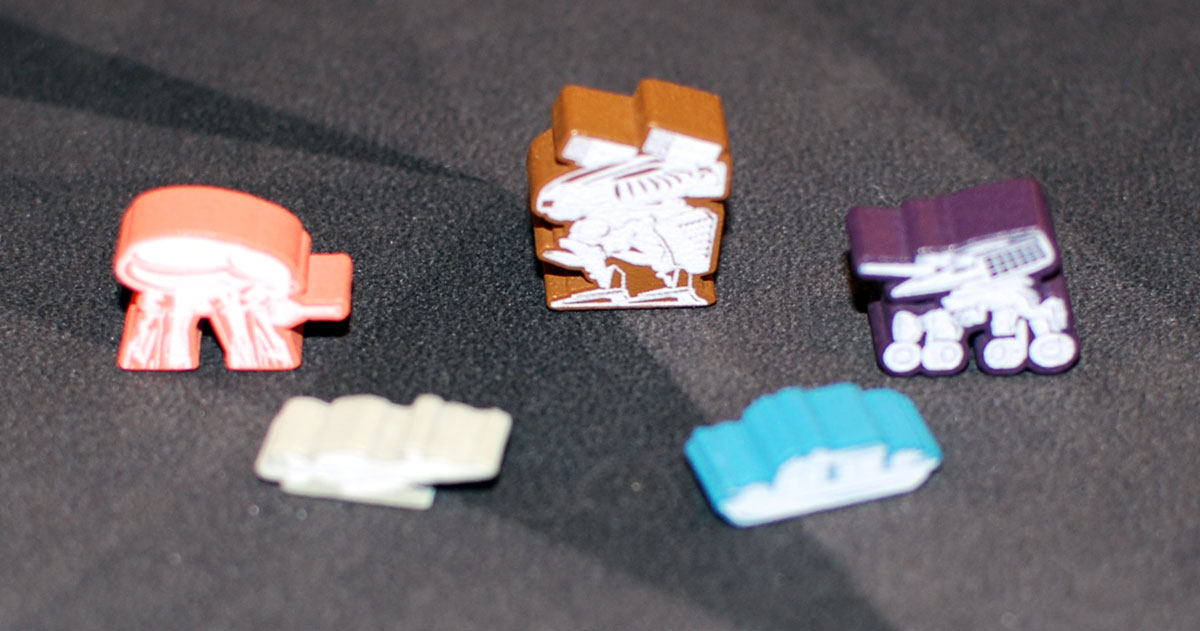
Each faction has its own unique meeple, which is nice both for thematic flavor and for ease of distinguishing between them, but it is interesting how much they vary in size. The brown meeples are the largest, two-legged mechs with rocket launchers, and the green ones, which appear to be fighter jets, are tiny in comparison. The blue faction has boats, which does seem a little funny when they start spreading across land, but I suppose there’s water everywhere at this point. All of the meeples are custom shaped with white screen-printing.
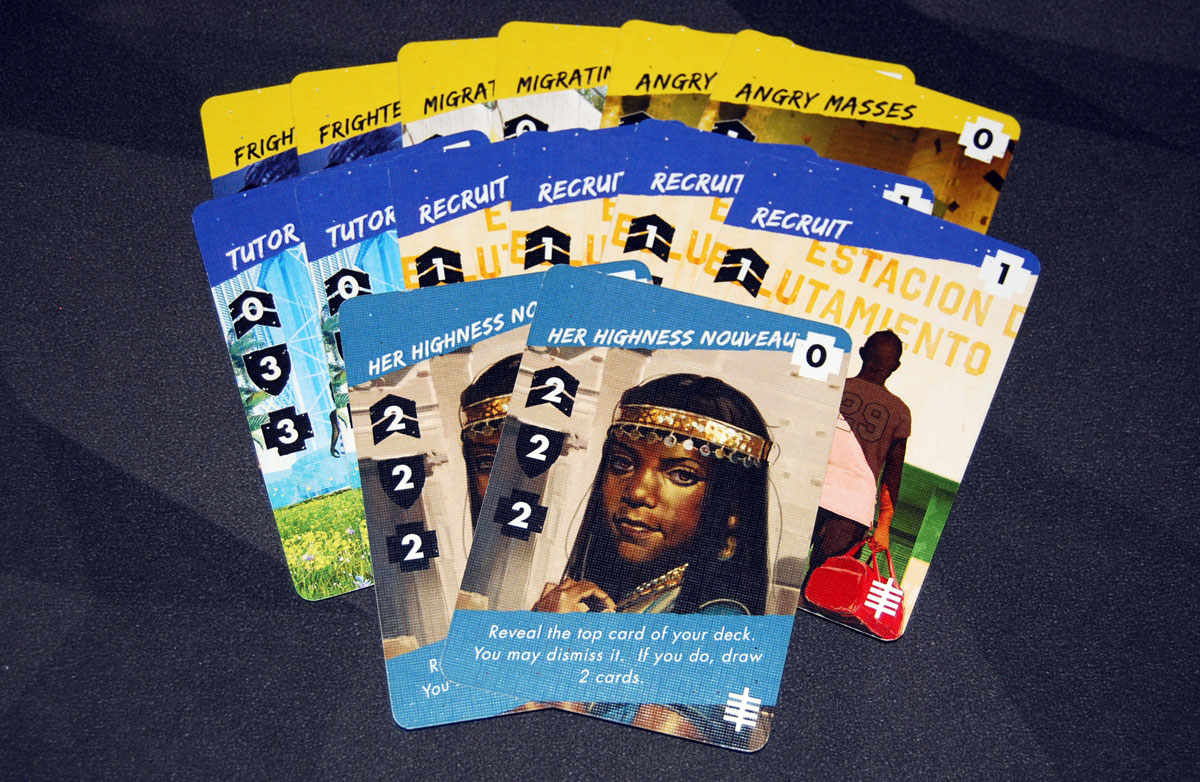
Each faction’s starting deck is also different: it includes two copies of that faction’s unique leader cards, and then some combination of the basic cards: masses, recruits, veterans, and tutors. There are different mixes: one deck begins with almost no masses (the weakest card in the game), but some of the others start with nearly half the deck as masses. The small faction mats also depict the leaders, and include a faction ability and special scoring rules.

The cards that form the market are are one of the unique parts of Dealers in Hope. Unlike most deck-building games where you will have some number of card types (sometimes in separate piles like Dominion or sometimes all shuffled together like Clank!), here the cards come in sets, each containing a Level 1, Level 2, and a Master. The Master is a large oversized mat that has space for the two decks, and shows an ability at the bottom. The Level 1 and Level 2 cards fit on the mats. Finally, each player has a (slightly smaller) copy of every Master—these are placed in your player area when you’ve unlocked them. My main complaint about the player copies is that I’m not sure why they need to be so large—if you manage to unlock all 8 of them in a game, it takes up so much space on the table and the card is primarily artwork with a small ability at the bottom.

There isn’t always the same number of Level 1 and Level 2 cards from one set to the next—in the photo above, you can see the small numbers at the lower right of each card shows how many are in the decks, and there are 12 total Mechanized cards but only 10 total Spoils cards. Usually the artwork on the two card decks matches the background shown on the Master, though sometimes with a little bit of sizing or cropping differences so the individual cards still look good.
How to Play Dealers in Hope
You can download a draft of the rulebook here.
The Goal
The goal of the game is to score the most points by controlling territories, training master cards, and achieving your faction’s specific scoring conditions.
Setup
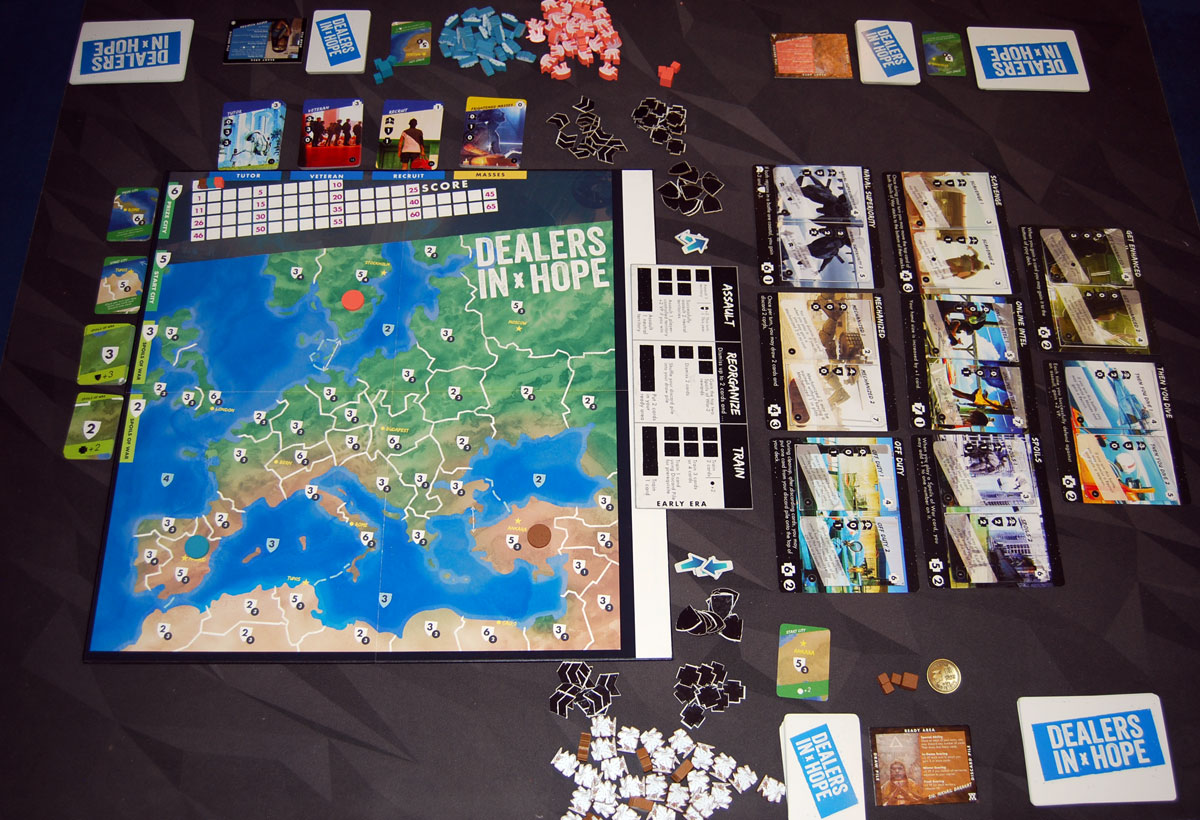
Place the game board and the action board within reach of all players. Set up the card market by selecting 8 of the Master cards to use, and then placing the corresponding Level 1 and Level 2 cards on top of them. Place the location cards along the side of the game board, as well as the Masses, Recruits, Veterans, and Tutors. Make supplies of the strength markers. Choose a starting player and give them the start player token.
Players draft factions and starting cities—though for our learning games we just randomly dealt them out. Each player takes their faction leader mat, starting deck, and corresponding meeples and tokens. Place one cube on the scoring track. (In a 4- or 5-player game, each player also removes one action cube from the game.) Place your capitol city marker on your starting city. Each player should also find the 8 Player Master copies matching the card market and set them nearby.
Everyone shuffles their starting decks and draws 4 cards.
Gameplay
The game takes place over two eras, and each era will last until every player has been start player once, so over the course of the game each player will be start player twice total. Note that the first player market may also be used as an action, so the first player gets an extra action.
On your turn, you discard any remaining strength markers you may have, and then draw back up to your hand size (typically 4). Then you either place one of your action cubes on the action board and take its action, or pass. When everyone has passed, the “year” is over.
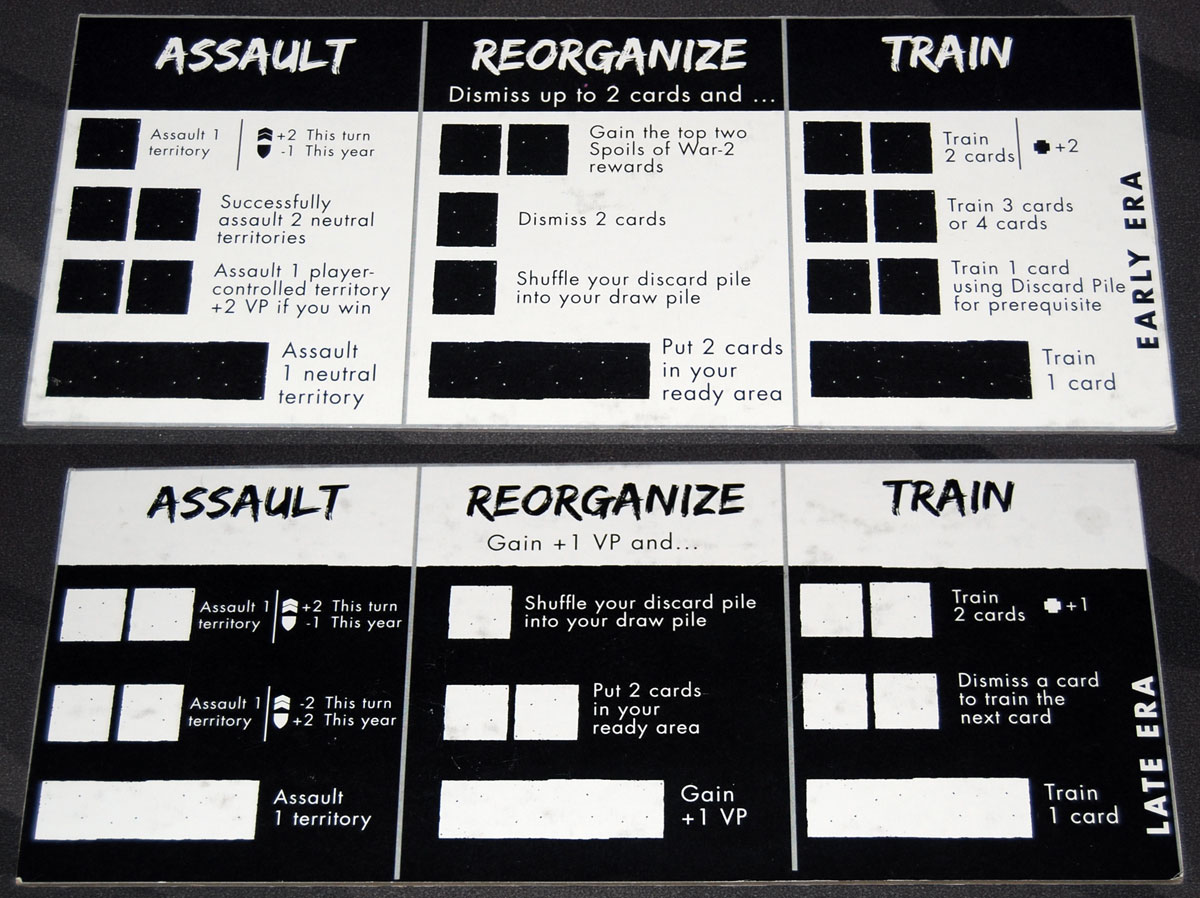
There are three types of actions: assault to take over territories, reorganize to set up your deck, and train to gain new cards. Each of the specific action spaces also has some special effects or abilities. The small spaces can only take one action cube, and the wide spaces can take any number of action cubes. Each player also has one large leader action cube—this can be used once per era, and can be used on a space that is already occupied.
After choosing an action, you may then play any number of cards from your hand and use any abilities you have to support the action you chose. When you play a card, you may generate one of the values—attack, defense, or support—and also use the cards ability, if any. For actions that let you do multiple things (assault 2 territories, dismiss 2 cards, train 2 cards) you lose points if you do fewer than the specified amount.
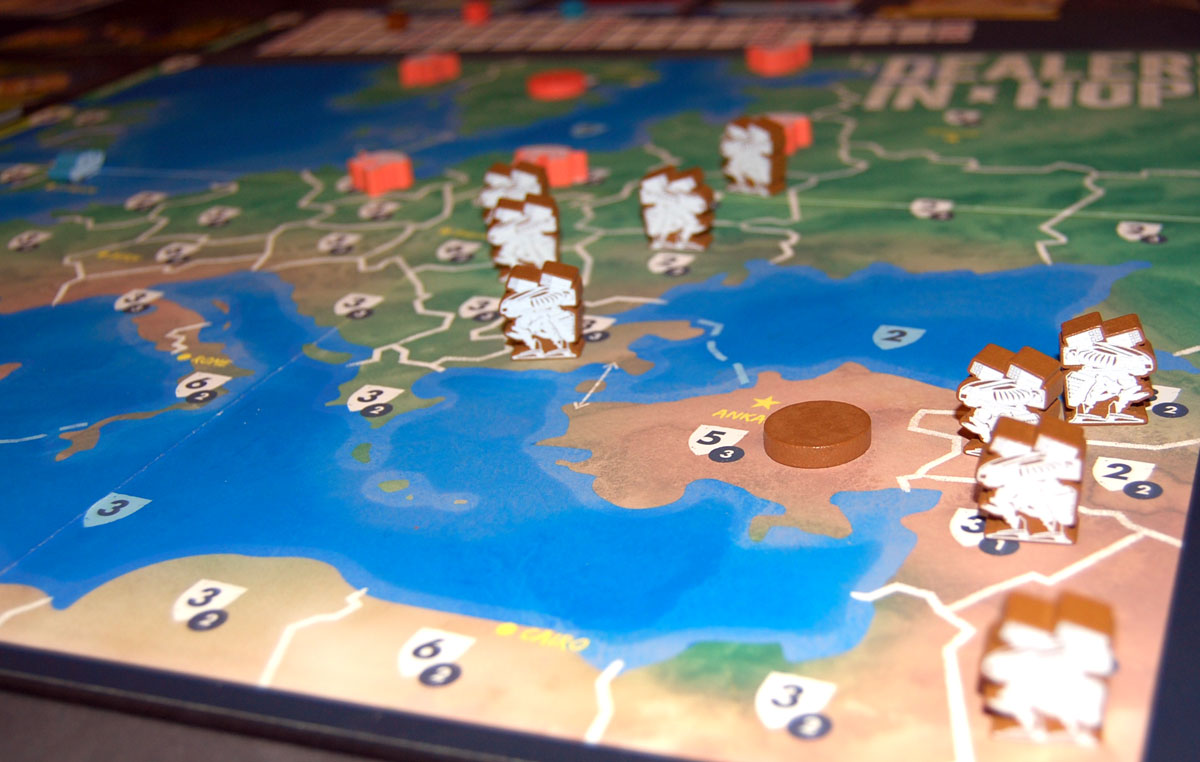
Assault: when you attack a territory, you must generate enough attack to match its defense. For neutral territories, the defense is equal to the shield value plus the small circle value—play cards that give you enough attack value. If you’re attacking across water, you must also add the shield values shown in any water that you cross to the territory’s defense. If you have enough attack, then you claim the territory and place one of your meeples in it. For the smaller territories (2 and 3 shields) you claim the corresponding Spoils of War card, which can be played on any turn for its effect. The named territories (unclaimed starting territories and prize territories) are stronger and have specific location cards with ongoing abilities.
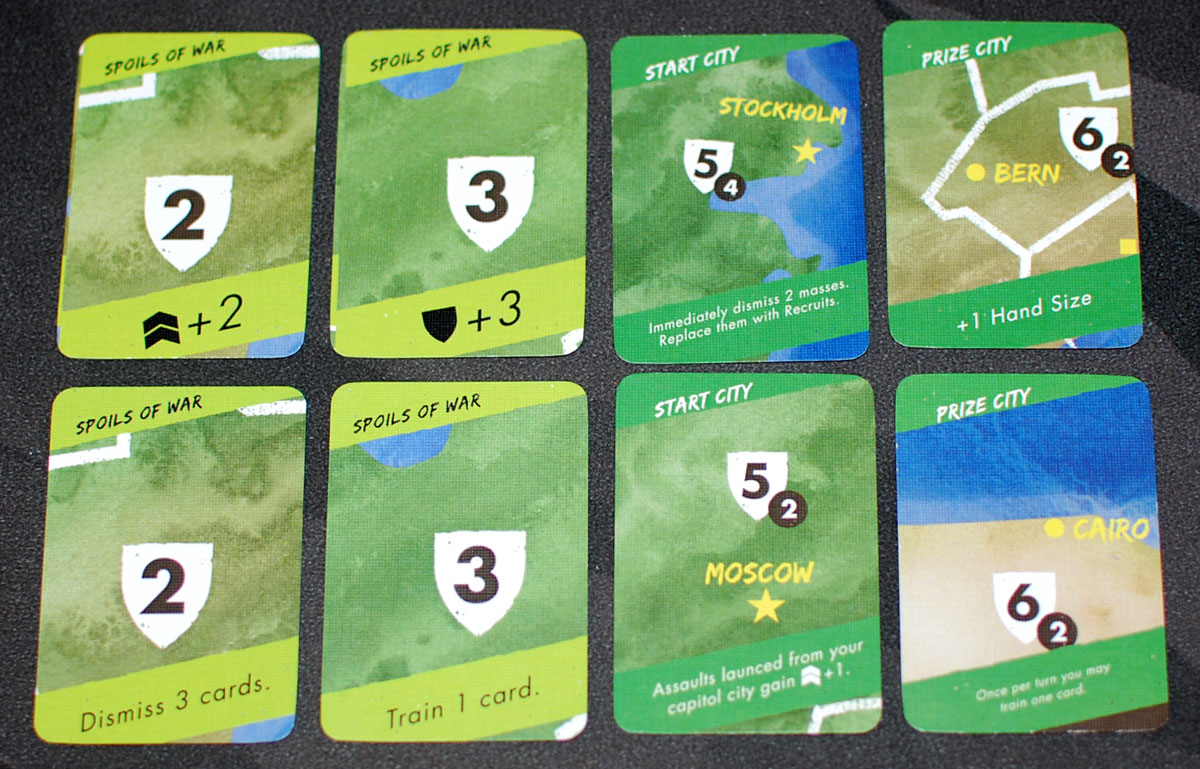
If you attack an occupied territory you must meet the shield value of the territory plus any additional defense that the defending player already has. Then the defender has one opportunity to play cards to increase their defense, and then you have one opportunity to overcome any added defense. If you lose, you just slink back home in defeat; if you win, replace the defender’s meeple with your own, and take a Spoils of War or location card as applicable.
Reorganize: The “reorganize” action has several different options. Dismissing cards means trashing them: they go back to the supply, or if they are your specific faction starting cards, they are removed from the game. Your “ready area” is a spot above your faction mat: cards placed into the ready area don’t count against your hand size, and can be played on future turns as if they were in your hand. You are allowed to place your Leader cards into your ready area usually, but the reorganize actions let you place other cards there as well.
Unlike most deck-building games, you do not reshuffle your discard pile into your deck when you run out—you only do that at the end of each year, so if you run out of cards before the end of the year you may find yourself with no cards on your turn. One of the reorganize actions lets you shuffle your discard back into your deck, both to give you more cards and to get to your newly acquired cards sooner.
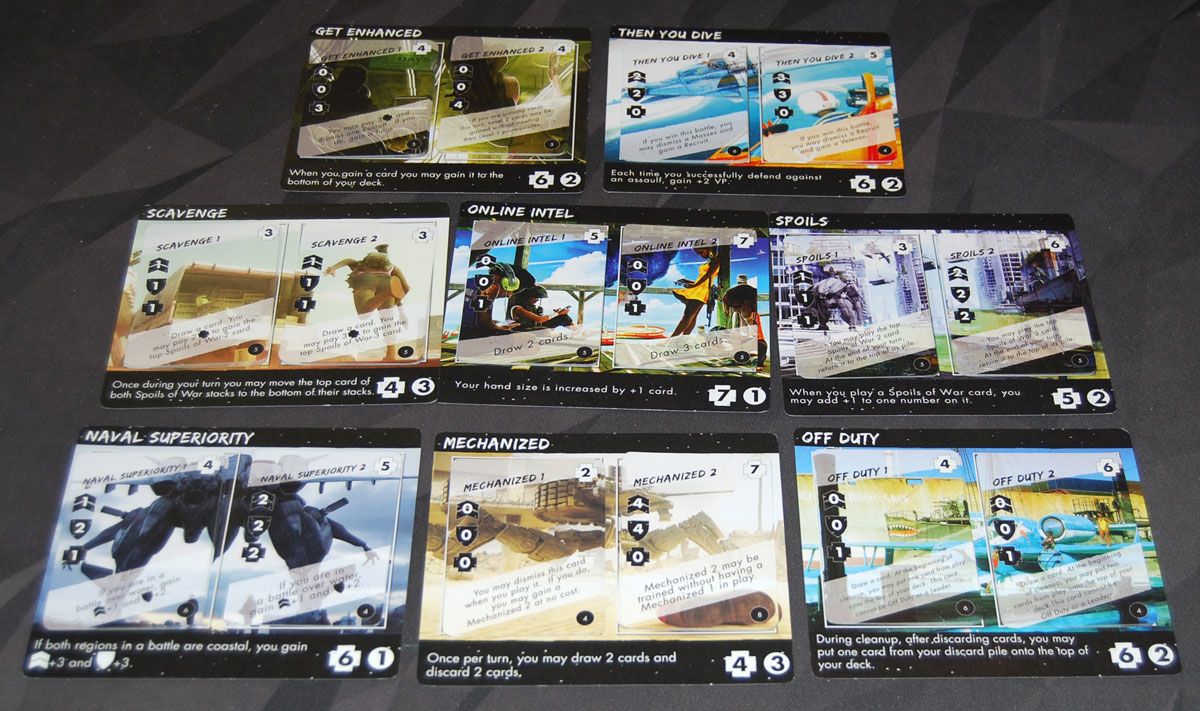
Train: Training is how you get more cards into your system. When you train cards, you spend support to meet the cost shown on the card you want. However, you can’t just train any card from the market: you usually have to start with Level 1, and to train a Level 2 card you must have played the corresponding Level 1 on that turn. To train a Master, you must have played the Level 2 card on that turn. One of the Train actions in the early era lets you use your discard pile to meet the prerequisite, and in the late era there is an action that lets you dismiss a card to train the next level up. When you train the Master, you find your player copy and place it face-up in your play area, and it unlocks an ongoing ability for you.
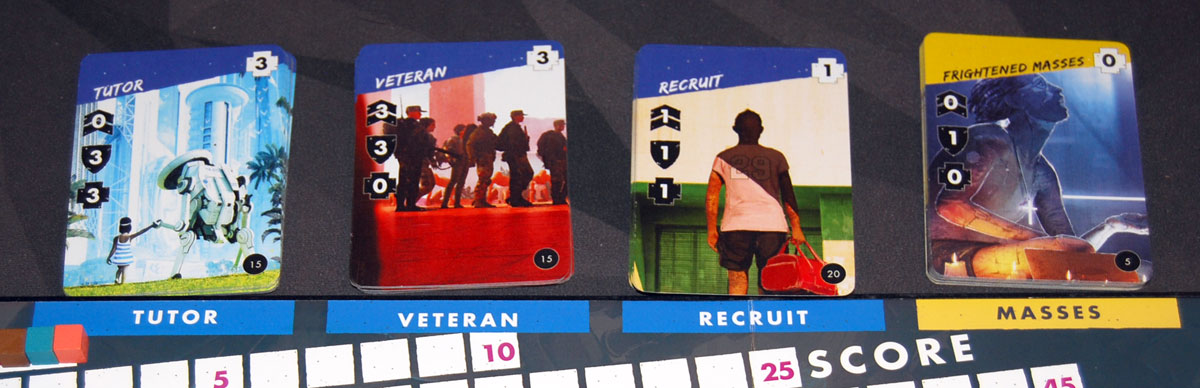
There are also basic cards that can be trained: there are a few types of Masses cards (which are free) but each one only provides 1 resource. Recruits provide 1 of anything, Veterans provide 3 attack or defense, and Tutors provide 3 Defense or Support.
At the end of your turn, you draw back up to your hand size. Note that any cards you did not play remain in your hand.
Round End: Winter
Once everyone has passed, the year is over and it’s time for winter. Each faction has its own conditions for winter scoring—if you meet the conditions, then you score points. Then, you may discard any number of cards from your hand, and then shuffle your discard pile and place it under your deck. Return action cubes to their players (but discard the Leader action cubes) and pass the first player marker.
If everyone has had a turn as first player, then you flip the action board to the Late Era side and everyone gets their Leader action cube back.
Game End
The game ends after everyone has been first player once during the Late Era. Score 2 points for every territory you control, and also score points for each Master that you have trained, as shown on the Master cards. The highest score wins. (The rulebook draft does not have a tie-breaker yet.)
Why You Should Play Dealers in Hope
I don’t typically play a lot of war games, even though many games I’ve played may have some element of combat or area control. Many folks in my gaming group are competitive but not confrontational, so the idea of direct assault can be a little off-putting for them. On the other hand, I really love deck-building games and I love seeing how people use that in unique ways. So I was curious about Dealers in Hope, which incorporates elements of both (as well as some worker placement).
The title of the game comes from a Napoleon quote: “A leader is a dealer in hope.” The game is set in 2140; land has become more scarce because of rising ocean levels, probably due in part to all those ChatGPT queries, and there are various leaders competing to claim territory for their own factions. I’d say this would be a good time for humanity to find ways to cooperate and coexist, but I have to admit that fighting is probably a more realistic outcome. Thus: dealers in hope. You tell your faction that if they follow you, you’ll usher them into the promised land. If that means walloping the other factions to drive them out, so be it.
The deck-building aspect of Dealers in Hope has a lot of changes from what I consider “typical”: your hand size is only four cards instead of five, you don’t automatically reshuffle your discard when you run out of cards, and the way you acquire cards is more restricted. It’s that last piece that stands out the most, though. Instead of just being able to acquire any card that you can afford, you have to progress from Level 1 to Level 2 to Master, playing a card as a prerequisite to training the next level up. Since you don’t automatically reshuffle until winter, that means typically it would take you three “years” to work your way up to a Master card—and that’s assuming you had enough support in your hand on the turn that you played the card. There are other ways around it, of course: some characters have powers that let them skip past prerequisites. One of the train actions in the early era lets you use your discard pile for the prerequisites instead. There are also card abilities—for instance, the “Get Enhanced” cards, that let you skip past Level 1.
The introduction of the Master cards is also an interesting feature. Although they are trained in the same way as the other cards, they don’t go into your deck and instead give you ongoing abilities. Most of the abilities enhance the effects of the Level 1 and Level 2 cards they’re tied to, but you can also find some great synergies between card sets too. Of course, the other reason you want Masters is because they’re the only cards that are worth points.
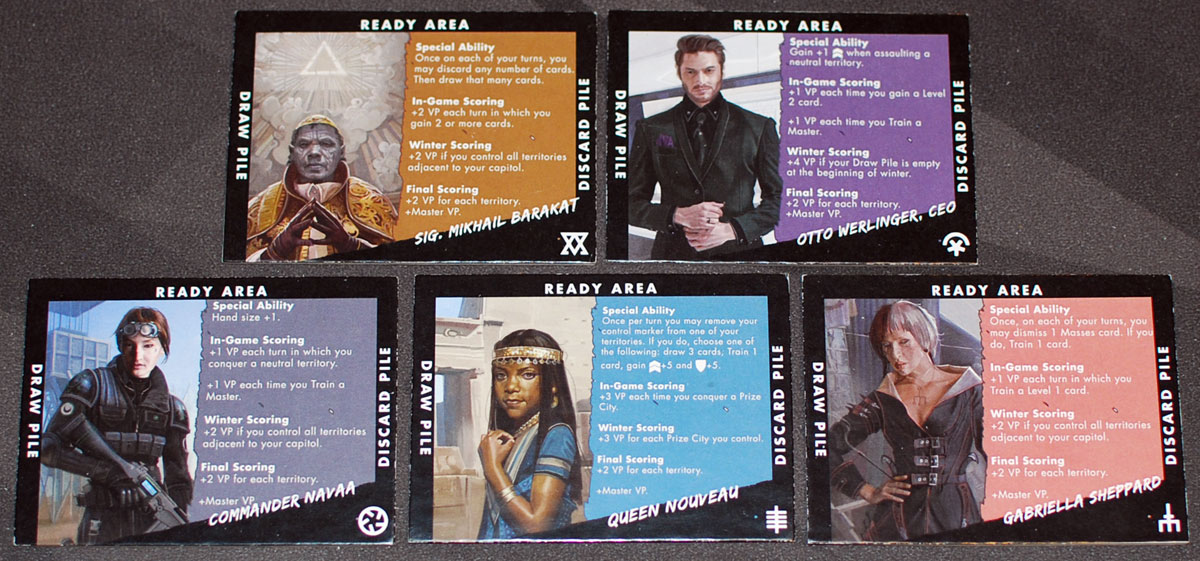
So: what about the combat? The game is set up to encourage a lot of expansion in the early area, when you can take a single action to assault two neutral territories; in the late era each action only lets you assault once. If everyone spreads out early on, then you’ll start to run into each other and combat ensues. However, it’s not guaranteed. In the times I’ve played so far, there have been players focused on training cards or pursuing other goals. Queen Nouveau’s scoring is about taking prize cities, so her player may work on taking over a few key locations instead of conquering a lot of territories. Unlike a game like Small World, the map felt big enough (at least in a 3-player game) that we still had some neutral territories even at the end of the game, and combat was more about depriving a rival of points than running out of room.
Combat itself is a pretty simple numbers game without too much back-and-forth. The attacker has to overcome the inherent defense; the defender has one chance to add more defense, and then the attacker has one chance to respond. Although the meeples look like battle units, they’re really control markers—you just have one on each of your territories, and you don’t amass a big army of them on a border and swarm into a space. Instead, the strength of your attack or defense is entirely based on the cards you play.
I like the variety in the different leaders and how they work. They have different special abilities (shown on the leader mat), leader card effects, and scoring conditions that will drive you toward certain strategies. Signor Mikhail Barakat is able to take extra Masses cards to take control of neutral territories—it lets him spread out quickly but at the risk of diluting his deck with weak cards. By contrast, Queen Nouveau’s card ability lets her dismiss cards to draw more cards; weeding your deck is important, but in this game you could find yourself running out of cards before the year ends. I do think it might be helpful to have some tips and hints for each leader, though, because some players had a hard time knowing how to make the most of their factions.
The actions are driven by a worker placement mechanic: you choose actions from a board, and since spaces are limited, it can be important to know what your opponents may want to do. Each of the action sections has one space that is unlimited, but it tends to be the most vanilla action in that section. If you want to make an assault with extra attack power, or train more than one card, or reshuffle your discard pile early, then you have to beat other players to those spaces (or use your special leader action cube). I like the difference between the early and late eras, too: it gives the game a nice arc with a build-up period early on, and moving toward using your deck in the second half.
One caveat I would give is that the game is quite long. It’s listed as 90–150 minutes on the box (presumably to account for the range of player counts) but my 3-player games have lasted between 3 and 4 hours each. Admittedly, that’s because we were also still learning the game, but this is the sort of game that allows for complex turns with cascading effects. I imagine that we could get the time down a little once everyone is familiar with the rules, but that doesn’t change the fact that it’s just a big game. Every game there are 24 different card effects in the card market for you to consider, which is a lot for a deck-building game. That said, it didn’t feel to me like it was dragging, either: there’s just a lot of things to do. In a 3-player game, you’ll get as many as 22 turns over the course of the game, so to keep it to 90 minutes you’d need everyone to take their turns in under a minute and a half—that seems incredibly speedy!
Dealers in Hope is an intriguing mix of deck-building and area control. I think it will be best with game groups that enjoy some direct confrontation and battle games, even though the primary mechanics are worker placement and deck-building.
For more information or to make a pledge, visit the Dealers in Hope Kickstarter page!
Click here to see all our tabletop game reviews.
 To subscribe to GeekDad’s tabletop gaming coverage, please copy this link and add it to your RSS reader.
Disclosure: GeekDad received a prototype of this game for review purposes.